Introduction: The Rise of Machine-Written Content
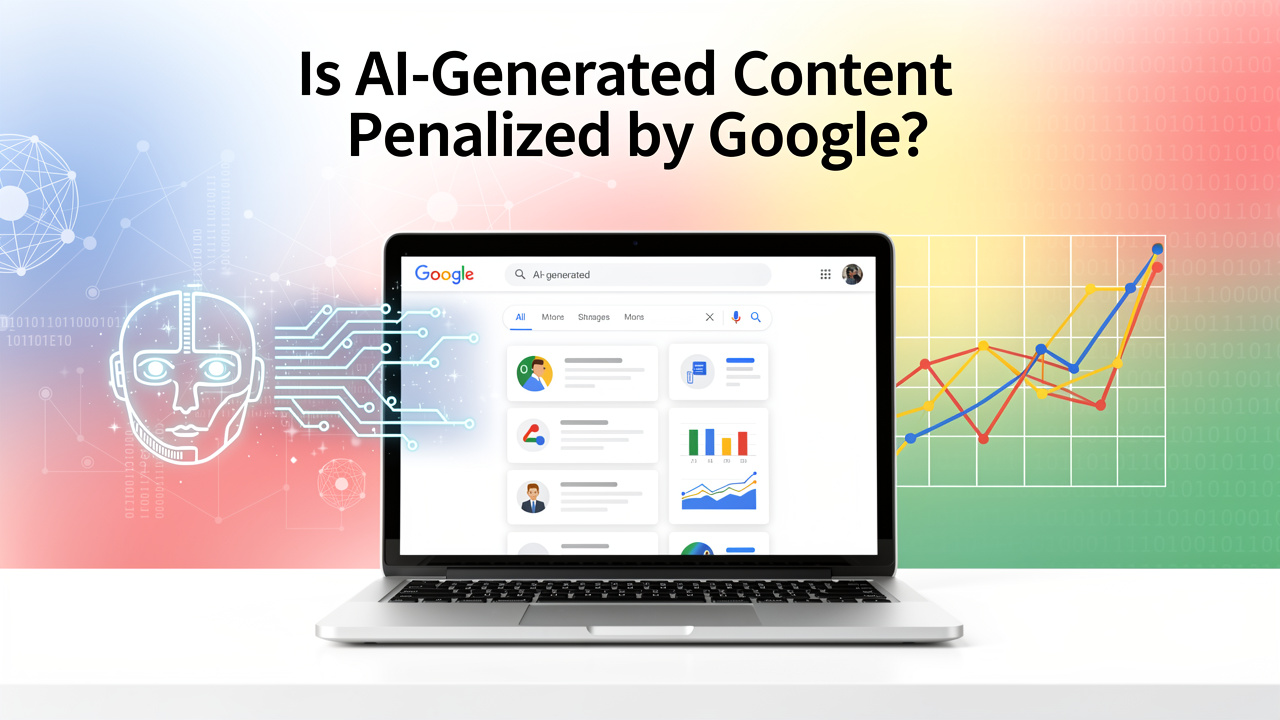
The question "is AI generated content penalized by Google" has become one of the hot topics in digital marketing in recent years. In general, AI generated content is created by artificial intelligence tools, such as ChatGPT, Jasper, Copy.ai, or Google's Gemini instead of human from beginning.
The figures are shocking. Of those surveyed in 2023 by Salesforce, 51% of marketers already say they are using generative AI as part of their processes - and the percentage just keeps on rising. Blogs, product descriptions, captions for social media, an entire website — for things like this, it all used to be created by people.
But here's the eternal question that keeps webmasters awake at night—does Google penalize you for it?
The short answer is more complex. Let's separate it into a proper explanation.
Is AI Generated Content Penalized by Google: Official Stance
Google has been remarkably explicit on this, but many still misinterpret the message. In February 2023 Google's Search Advocate John Mueller released an advice confirming that AI generated content is not an automatic violation of Google's webmaster guidelines. The crucial phrase from that statement: "our focus is on the quality of content, not how it was produced".
So Google isn't punishing AI content just because it's AI content, but what Google is punishing on a whole new level - is content that is poor quality, spammy, or trying to game the search system instead of actually providing value for the user. That difference is critical.
Google's Helpful Content System, which was introduced in August 2022 with a major update in 2023, is most concerned with content that seems to have been created for Google rather than human visitors. And to be fair, much of the AI content I've seen is precisely that. Thin, spammy, monotonous articles that answer a query without actually providing any meaningful insight.
Google's E-E-A-T formulae, standing for; 'Experience, Expertise, Authoritiveness and Trustworthiness' is a big factor here too. It is a very important addition. AI tools, even the most advanced ones, can't truly offer the evidence of first experience as they have no first experience to reference or judge from. They can only emulate it, but as mentioned above, Google's systems are evolving to spot that emulation and penalise it accordingly through Google algorithm updates.
When AI Content Helps vs. When It Hurts
Not all AI content is created equally. Some can be actually useful, whereas some are just digital junk food—appears to satisfy but is actually empty.
Beneficial Uses of AI Content
- Drafting and editing assistance: Many top-tier publications use AI to create first drafts that human editors then substantially revise and fact-check.
- Structured data generation: Product descriptions, technical specifications, and metadata can be efficiently produced by AI without sacrificing quality.
- Multilingual content scaling: AI translation tools allow businesses to reach global audiences without hiring dozens of native-language writers.
- Research summarization: AI can synthesize large amounts of source material, which human writers then transform into original analysis.
When used this way, AI is nothing more than a power tool. It simply increases the speed of production and leaves the quality of the craft untouched.
Harmful Applications of AI Content
- Mass-producing thin content: Publishing hundreds of AI-written articles with minimal human review, hoping to capture long-tail keywords.
- Fabricating expertise: Using AI to write authoritative-sounding medical, financial, or legal content without actual expert input.
- Spinning existing content: Feeding competitor articles into AI tools and generating slightly reworded versions — this is essentially plagiarism with extra steps.
- Ignoring factual accuracy: AI tools hallucinate. Confidently. Publishing those hallucinations as fact is both dangerous and a serious ranking liability.
Real-World Case Studies: Penalties in Practice
The evidence from real sites can already give us a fairly clear story about whether is AI generated content penalized by Google in practice.
CNET'sAI CONTENT' TEST In January/February 2023 CNET published a number of financial explainer articles generated by AI, for which they did not disclose the author. The articles included factual inaccuracies and the experiment attracted harsh public criticism. CNET did not suffer a Google penalty but they did see a hit to organic traffic and damage to their reputation. The program was abandoned and editorial controls tightened.
Sports Illustrated (2023): SI used AI to write articles under author profiles which did not exist. Fake author headshots were also created using AI along with contrived biographies for each author. When discovered, the story was quickly pulled and raised significant doubts regarding the publication's editorial oversight. In terms of SEO, the pages in question quickly fell from the SERPs.
- Smaller Affiliate Sites: Nowhere did the slaughter take place more effectively than on these sites. As all of Google's Helpful Content Updates from 2022-2023 hit, hundreds (and hundreds) of smaller affiliate/content farms that were spewing out push-button ai content found themselves suffering anywhere from 50-90% drops in traffic. And it wasn't murky or subtle - these were sites churning out hundreds of low-quality AI articles per week with no human intervention.
The trend is the same: AI content plus awful editorial judgment is penalized. Where the content is of real benefit to the reader I haven't seen sites penalized.
Expert Opinions and Statistics
"Google's systems don't care if a human or a machine wrote your content. They care if it's useful," said Barry Schwarz, founder of Search Engine Roundtable and one of the most venerable voices in the SEO world. That framing is likely the most useful way to think about this.
According to Semrush's 2023 State of Content Marketing report, 68% of those content marketers who use AI tools state that they have maintained or improved their search rankings. However, the majority of those content marketers also employ human editors who significantly revise AI output.
Meanwhile, according to a study by Originality.ai, websites publishing large amounts of AI-generated content without human editing experienced an average of 23% reduction in organic traffic after each rollout of Google's Helpful Content Update.
What does it all mean? The data at rest suggests a clear compromise: AI as partner, not substitution. Understanding AI content guidelines becomes crucial for maintaining search visibility.
Practical Tips for Using AI Without Getting Penalized
Content creators don't need to abandon AI tools. They need to use them smarter. Here's how:
-
Always add genuine human expertise: After AI generates a draft, inject personal experience, original research, or expert interviews that the AI couldn't possibly fabricate authentically.
-
Fact-check everything: AI tools make up citations, misquote statistics, and present outdated information as current. Every factual claim needs independent verification before publishing.
-
Optimize for E-E-A-T signals: Include author bios with real credentials, link to authoritative sources, and demonstrate first-hand knowledge throughout your content.
-
Avoid mass-publishing without review: Publishing volume is fine; publishing volume without quality control is what triggers algorithmic penalties.
-
Use AI for structure, not substance: Let AI create outlines, suggest headings, or draft introductions — then fill in the substance yourself with original thinking and specific details.
-
Disclose AI use where appropriate: While Google doesn't currently require disclosure, transparency builds reader trust and protects your brand reputation long-term.
-
Monitor your analytics closely: If you're using AI content extensively, watch for traffic drops following Google algorithm updates. Early detection lets you course-correct before small dips become catastrophic losses.
-
Prioritize topical depth over keyword density: Google rewards content that comprehensively covers a topic. AI-generated keyword-stuffed content does the opposite.
Conclusion
AI written content is not auto penalised by Google- but in reality that isn't as reassuring as most think it is. Google penalizes 'bad content', and a lot of AI content, if used haphazardly, is just that.
The sites that are succeeding with AI tools are doing what they ought to be doing: acknowledging that they are, in fact, a fast (sometimes brilliant) and perpetually-flawed first-draft system that requires extensive human editing before publish. The sites that are failing are trying to run their AI—and their sites on auto-pilot.
Google's algorithms improve by the year in identifying content that isn't truly beneficial to users. The best (and frankly, the only) safe move is to produce content that a human being would truly care about. If AI helps you do this more quickly, go for it. Just don't let it do the heavy lifting.