The short answer is: not quite.
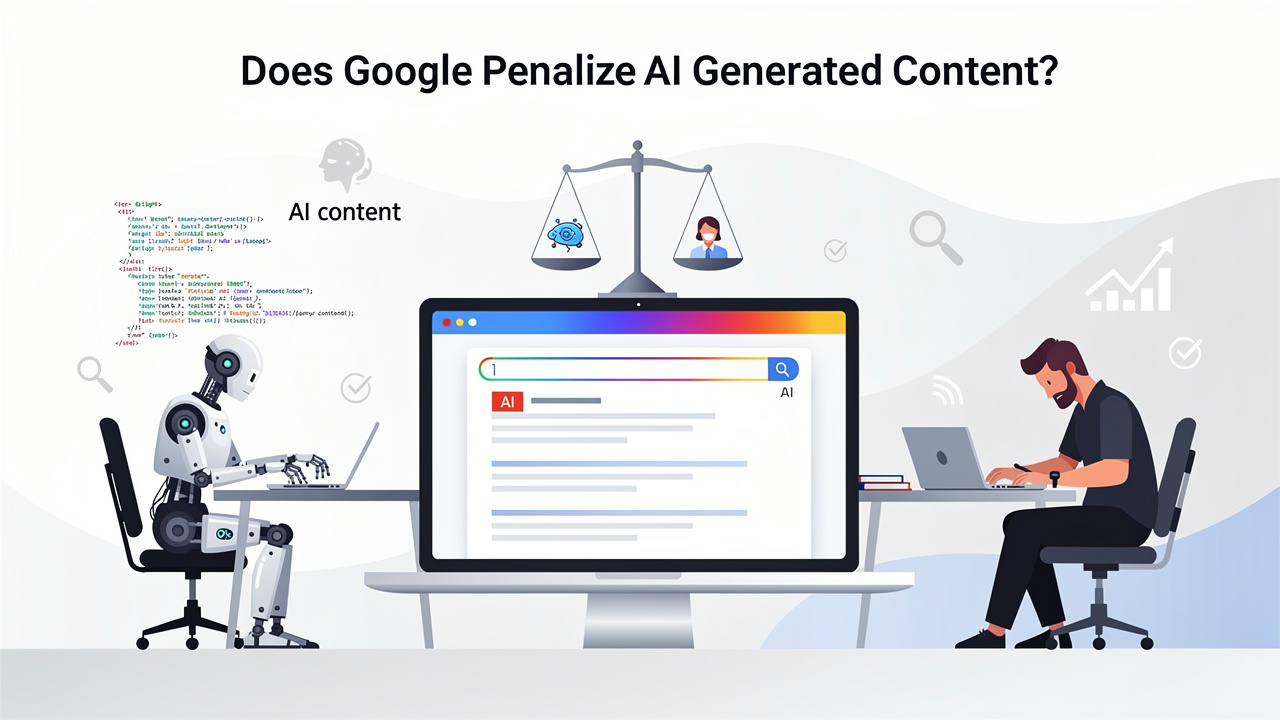
However, that answer requires a lot of nuance because the reality is more complicated than many people realize - and a mistake can seriously harm your site's rankings. Understanding whether Google penalizes AI generated content is crucial for modern content creators navigating today's digital landscape.
What Is AI Generated Content?
AI generated content is text, images, or other media created with extensive input or assistance from AI content generators (like ChatGPT, Gemini, Claude, Jasper, etc.)
Using huge language models pre-trained on immense datasets, these programs create well-formed, semantically logical output from natural language prompts. These AI content guidelines have become increasingly important as more businesses adopt artificial intelligence tools.
Now it gets tricky.
"AI generated" content falls on a grey area.
There are some systems that are purely written with minimal input to pass into a search, and then others which are "AI-assisted" then heavily processed, edited, and proofread by human editors.
They are vastly different, and assuming they are one and the same is one of the biggest mistakes marketers make when considering Google search ranking factors.
This distinction has major SEO implications.
Does Google Penalize AI Generated Content Officially?
It appears that Google has been pretty firm about this, but many folks just miss the detail.
In February 2023, Google's John Mueller stated that AI generated content should not be inherently penalized.
What Google will penalize are spam violations, regardless of whether the content was written by a human or a robot, and most definitely not if they pass all their other quality checks.
Google states that: "We focus on the quality of content, not how it's produced, which is a huge factor in helping us deliver reliable, high quality outcomes to users."
Seems pretty clear.
However, Google has rolled out the "helpful content" system to combat content that feels generic or uninformed rather than actual useful information for the end-user.
Much AI content falls under this broad umbrella.
Google's Helpful Content System: When AI Content Will Suffer
Google's working algorithm for detecting AI-dense sites is the method that needs to be understood - not an additional AI detector.
The method rewards content that has:
- Can only be created with experience - Past, recent, first-hand accounts of a specific topic or detailed analogies not just a range of generic examples.
- Relevant experience and knowledge - Do you demonstrate expertise?
- Do videos or quotes link back to the original source - Is it relevant and properly attributed?
- Factual accuracy - Don't produce content with a language model and call it authoritative without verification.
- Genuine value - Beyond what AI can produce, what would a genuinely interested person get? Are you entertaining or educational at some level? You create human-enhanced AI content by checking your writing, clearing your output, making your original parts and artwork, and re-optimizing this for user value.
Mass-produced AI content generally misses many of the above criteria, and makes Google suspicious. Or so it seems.
Websites attempting to game the system may be fine initially, but their real performance standards will vary.
The data backing the case for AI content penalties vs. fine-tuned search engines is simply not definitive - at all.
Where It Has Happened in the Wild
Here are a few extreme examples.
CNET - 2023: CNET quietly released dozens of AI-generated financial explainers.
The site ran into trouble when the truth was discovered. Corrections were required for several factually inaccurate pieces, and the articles had their bylines updated by human writers.
While the direct SEO impact was uncertain, CNET's reputation suffered with readers.
Sports Illustrated: After reports that this sports news site published articles with fake, AI-generated author names and profiles, it came under scrutiny.
The site's reputation and trust in the brand was diminished, and the publishing powerhouse was heavily criticized.
Google did not hit them with a manual penalty, but the reputation problems are apparent.
The positive case: Bankrate and NerdWallet: These two financial sites use an AI-assisted approach for their blogs, and content is then checked and corrected by qualified financial experts.
Their search engine visibility remains healthy.
How are they different? They use AI as an assistant, not a replacement creator.
The data pattern in practice is not going to reward fake content with massive volumes, and their general practices are to be recommended.
The connection is apparent: massive content production can seem quickly like artificial city-building according to a neglectful mentality, but without reliability, relevance, and understandability, it is doomed to sink.
Industry Expert Opinions
The folks in the SEO space seem to agree on the point that Google checks quality signals, not AI detection of content origins.
Barry Schwartz, founder of Search Engine Roundtable, found: "The systems inside Google for ranking your pages focus more on ranking signals. Their focus is not how you generated your content" rather than whether AI was involved. Google cares about quality, and even AI-generated content would not automatically get penalized.
Lily Ray, VP SEO Strategy at Amsive Digital, observed that Google's Helpful Content System was most influential for sites hit by the 2023 and 2024 updates, and their targeting of low-quality, thin, unoriginal AI pages in relation to that update is notable.
Additionally, algorithm analysts have admitted that: "relaxing E-E-A-T standards and high quality content priorities when AI is involved without human involvement is problematic."
And whoever appears to be leading or promoting such technologies better be sure they can support algorithm updates.
The Common Misconceptions
Some incorrect assumptions to clarify:
-
False: Google has reliable AI detection tools. You should avoid assuming Google can reliably tell you which piece of content was AI-generated. Current AI detection tools are flawed, and exhibit frequent false positives and negatives. Google's ranking is based on quality signals, rather than content production method detection.
-
False: Disclosing the use of AI-generated content shields you from being algorithmically penalized. Transparency about AI usage does not guarantee that the content will rank well or avoid potential issues.
-
False: AI generated content will definitely get ranked out of existence. Many sites make successful long-term use of AI tools, with no problems. But the output quality, not the AI involvement, is what determines whether content scales successfully.
How To Navigate The Landscape Responsibly
How does a publisher act responsibly regarding AI-generated content? Keep the following AI content guidelines in mind:
-
Always use AI as an assistant to speed up, enhance, and optimize original human output.
-
Incorporate substantial human input and oversight - Provide your own insights, quotations, images, examples, personal experiences, data points, or other original knowledge products to add unique value that AI cannot hope to produce.
-
Verification after generation - Don't fall for the hallucination issues of AI, fact-check confidently and verify yourself before publication.
Check any statistics, quotes, and claims before publication. Edit for voice and specificity.
In a recent poll of 2,122 consumers, 55% expressed trust in AI-written content, an increase from 43% in the previous year, as reported in Forbes' "10 Statistics About How Consumers Feel About Artificial Intelligence (AI)".
But the fine print?
Many that trust AI also think humans are still in the loop, stating in another survey by the Pew Research Center that "although artificial intelligence has become much more powerful, nearly half of people said computers and humans do not cooperate better than humans alone to get a job done".
"It is not an anti-AI change, it was an anti-quality content change and an anti-spam content change," said Google's representatives during the Search Off the Record podcast episode, when asked about the impact of the latest Google core update.
"If I use AI for research to make sure all the stats, numbers, and quotes in my article are accurate, you betcha I'm going to go ahead and use those kinds of AI-powered tools and insights."
This March 2024 update penalized websites using unhelpful and unoriginal content - essentially anything that isn't truly valuable or unique for users - whether it was written by humans or machines.
That is also the principle underlying our overall approach to recommending how people publish quality content; it is a standard we set to ensure that people get useful results for what they're searching for.
Sites heavily reliant on the rapid output of AI tools without significant human editorial involvement and unique value often dropped significantly in rankings.
Google aims to serve users with helpful and reliable information, not just to rank more content volume.
The March 2024 update specifically tackled what Google identified as low-quality content - defined as unhelpful, unoriginal, and potentially misleading - a move that impacted websites utilizing AI without proper human oversight and value addition.
This adjustment reflected Google's ongoing efforts to promote genuine expertise and user-centric information across its search results, reinforcing important Google search ranking factors.
This shift means that the approach should be about augmentation of expertise, not the automation of production for content where human insight is a must-have, not just a nice-to-have.