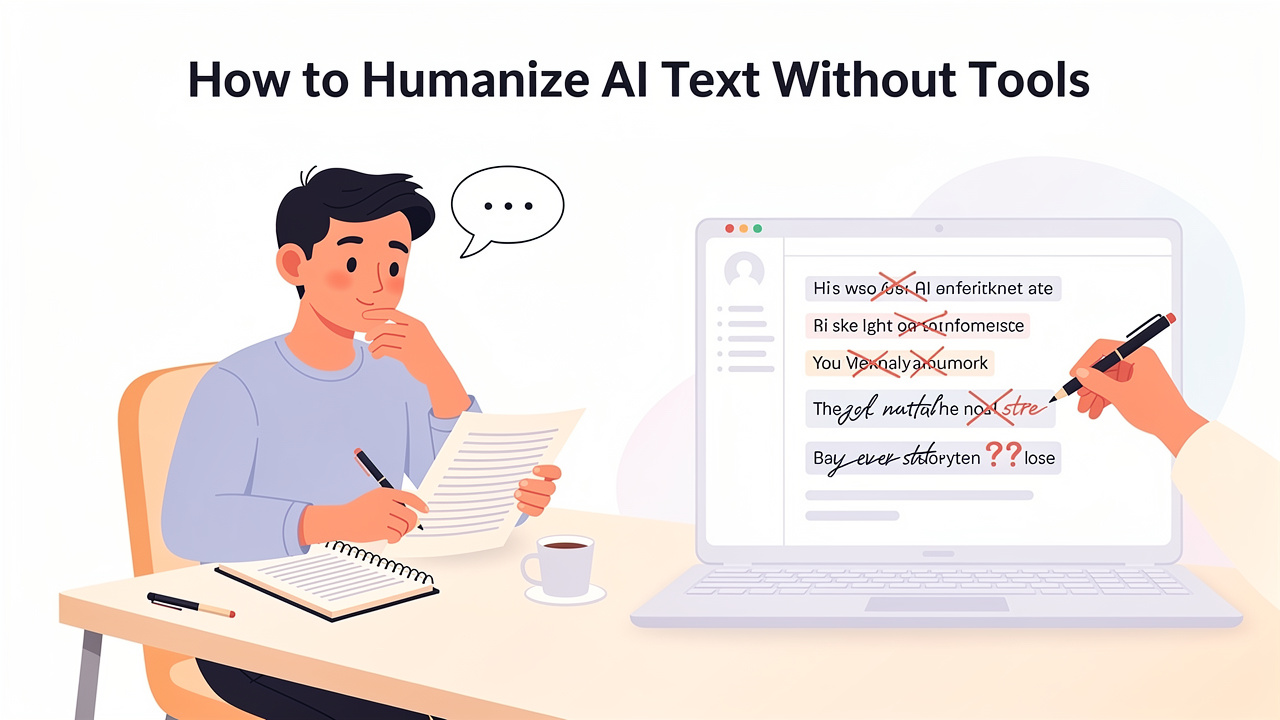
Learning how to humanize AI text without tools is now essential as AI-written material becomes part of the everyday writing process. Quick, prolific and ever so clever - it can do the hard yards. Yet there is an issue to overcome.
Most of the AI output reads as, well, a machine attempting to mimic humanity. The content is too perfect, the style too matter-of-fact and the formats almost programmer-like in their uniformity. Indeed, such type of content is hard to ignore, even if such awareness has yet to be specifically identified.
The positive?
You don't have to buy expensive programs or use complicated tools to do this. Just by making a few simple changes, you can turn the robotic, boilerplate copy into something that reads like it's been written by a person and improve AI-generated content significantly.
Why the Human Touch Still Matters
Here's the truth people respond to people. Not to machines or algorithms. When someone is reading your blog article, email, social media caption, etc, they are not absorbing words. They are weighing the credibility of the voice they are hearing and if the writing sounds disconnected and processed, that voice feels indifferent.
The interest wanes. People keep scrolling. And that perfect virtual essay? Doesn't attract any attention.
Adding a human voice to your digital assets creates trust, engenders loyalty, and – quite simply – makes the material more fun to read. It's what separates a chat from a staid press release.
Read It Out Loud First
Read the text aloud aloud for the AI writing. Not just read it once, but every single sentence. This is one of the best but most under-rated editing tools there is; it works because your ear can pick up what your eye misses.
If you have a phrase that trips you up, rewrite it. If a sentence seems to fit better in a legal contract, use plain language. If three sentences in a row are a certain length – short, declarative, dull, monotonous – kill that pattern on the spot.
Natural speech has rhythm. It accelerates, decelerates, stutters and repeats. AI text doesn't. It is plain as soon as you read out loud.
How to Humanize AI Text Sentence Patterns
AI modeling consistently output very similar sentence structures: Medium length, grammatically correct, logically ordered. Every. Single. Time. It's like a repetitive lullaby: acceptable content, but eerily hypnotic.
The fix is purposeful diversity. Short sentences pack a punch. They impose emphasis. Then you can follow with something more extended—a sentence that breathes, that uses its leisure to give an idea room to breathe, perhaps even a brief digression or glance of added context to bring the thought into perspective.
And sometimes? A piece will do.
Try to throw in a sentence beginning with "But" or "And" from time to time. This is considered bad grammar in academic writing but in conversational writing it mimics the way people actually think. The back and forth style of snappy sentences and more flowing long sentences ensures the reader remains interested without them knowing why.
Inject Personal Anecdotes and Specific Details
Nothing humanizes writing more quickly than a genuine story. The best AI can do is mimic the form of one; it can't actually provide a truthful personal account. This is where you come in:
For example, suppose you're doing an article on productivity. Replace the AI's preprogrammed text of—"Many people have trouble concentrating during working hours"—with: "Last week I wasted forty minutes organizing my icons instead of writing up a report. That's a typical personal truant. I'm sure I'm not the only one."
Notice the difference? Now you have a real person there.
You don't need a big, dramatic story. Tiny, everyday details will work just fine. Think of a real conversation you had, a mistake you made, an incident where you got really angry or had an unexpected breakthrough. These can't be convincingly created by a computer, so these become your signature—the evidence that you've been here.
Adjust the Tone: Less Formal, More Conversational
AI maintains a kind of neutral professionalism. It's not harsh, not complicated, it's pretty straightforward, which is generally a good thing. But some people might find it dull. Here are some ways to de-formalize AI and humanize AI writing effectively:
Some practical tone adjustments:
- Use contractions freely. "It is important to note" becomes "it's worth remembering." Or better — just say what you mean directly.
- Cut corporate-speak. Words like "leverage," "utilize," and "facilitate" rarely appear in natural conversation. Replace them with "use," "help," and "make happen."
- Add hedging language. Phrases like "I think," "maybe," or "from what I've seen" make writing feel honest rather than authoritative-to-the-point-of-arrogance.
- Throw in an aside. Parenthetical comments (like this one) create intimacy. They feel like a whispered addition, a small bonus thought shared just between writer and reader.
- Ask yourself: would a smart friend say this at dinner? If not, rewrite it.
Use Emotional Language Strategically
AI text describes but doesn't (feel) it. Will state a state of affairs is "difficult" or "advantageous" - factually correct, emotionally dead.
It's not about overdoing emotionally charged speech. It's about selecting stronger, more meaningful words. "Exhausted" speaks to us in a way that "tired" doesn't. "Thrilled" surpasses "pleased" as an emotional cue. "Dreading" makes an emotional impact more than "not looking forward to."
And more than how we choose our words, using emotion language means speaking to the reader directly. Using as if language—"you've probably felt this way" or "this is truly frustrating, and that's okay"—lifts you up and puts you alongside your reader. We see you. And when people see us, they keep reading.
Vary Your Vocabulary — But Stay Authentic
AI text also has a tendency to use the same words repeatedly. However, creating a sense of semantic monotony is just as easy by constantly using synonyms, colloquial terms and even the odd invented phrase.
Challenge yourself to sub more interesting words or phrases for boring ones. Instead of "important" use "critical," "necessary" or even "non-negotiable". Instead of "good results" say "results that really get you somewhere"- or whatever phrase works best to reflect your tone.
That being said, don't go overboard. Replacing all the general words with the thesaurus results in a whole new kind of unnatural stiffness. The idea is a natural sound, not a polished act. Write how you would voice things to a coworker at a cafe.
Humanize AI Text Without Tools: Add Opinions
The artificial intelligence is intentionally non-saying. It introduces alternative perspectives, it hedges anything it says. That's good in some kind of content, it makes more people read the article.
We have views. And big ones at times. Feel free to write "I feel this approach to be most effective" or "to be honest, this advice gets repeated so often it has become meaningless". Having a definitive view helps make your writing memorable and gives your readers an angle to connect with – even if they don't agree.
By the way, disagreement is not a failure. It's a good thing. It means your writing inspired a response. That's engagement.
Conclusion: The Real Value of Humanized Content
Make AI-generated text more human doesn't mean make it sound like it wasn't made with a tool in the first place. It's about what actually gets to the reader and how that will resonate with a human being.
Scoring higher and making the reader want more is easy if you read aloud, mix up sentence structure, weave in anecdotes, sprinkle in emotion and reflect sincere opinions. Take what the computer constructs and enhance it with your individual flair.
In a world where content is being overwhelmed with the output of machines, the writers who will win are those who remember the person behind the screen – the one who is curious, emotional and in need of something authentic. Provide them with that, and they will keep returning.