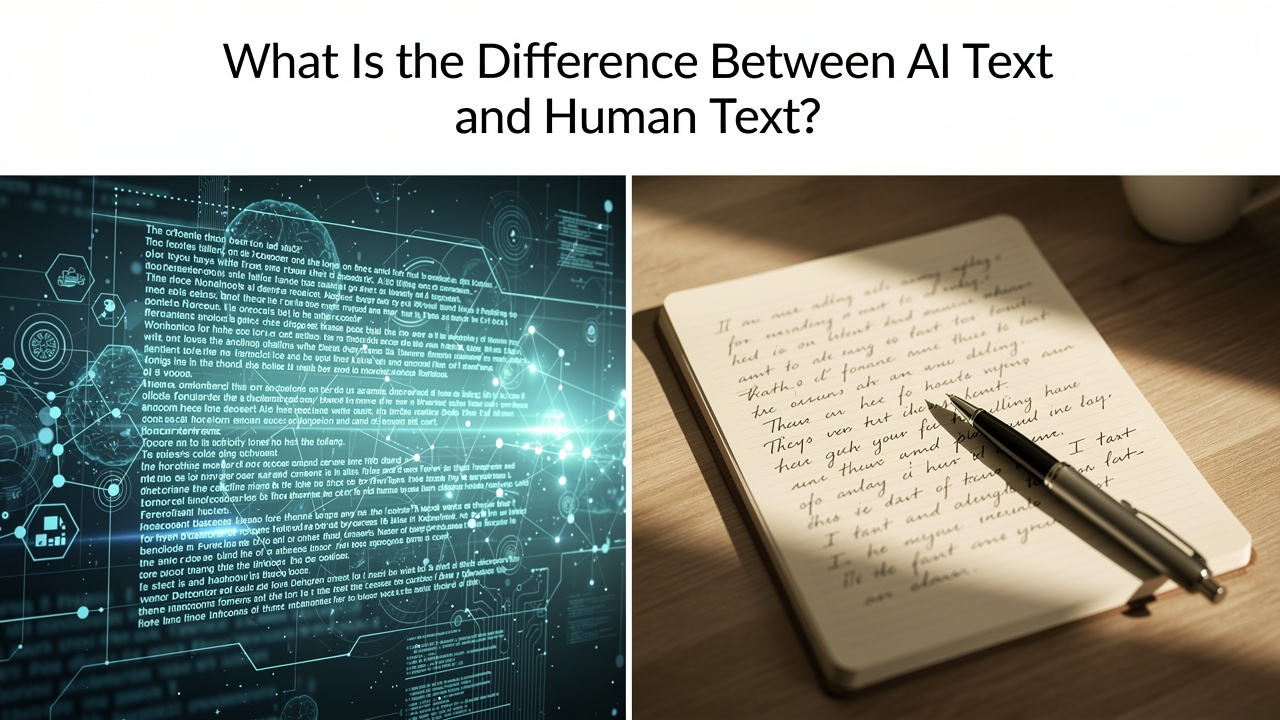
Two authors sit at their computers to compose the same article. The first taps on a keyboard, fueled by a lifetime of personal experience, anger, and human memory. The second pecks away, crunching through billions of tokens in a fraction of a second, producing human-like text by statistically predicting the next word in a sequence.
Understanding what is the difference between AI text and human text becomes increasingly important as both forms of content creation evolve. The results could be eerily similar superficially—that's not the point. This isn't about finding a "winner"—it's a bit more complex than that. Both AI—written and penned by humans—have their own qualities, true strengths, and real blind spots.
Navigating through those differences is only going to grow more crucial for everyone involved in content creation, marketing, education, or just plain using words to get things done.
What Is the Difference Between AI Text and Human Text in Authenticity
Human writing has something that's really really hard to imitate: lived experience. When a journalist writes about a hospital emergency room, or a teacher writes about one of her students watching a concept click in her mind, that writing comes out of memory of the senses, a memory of the heart, something at stake. That's what readers feel. Not magic - authenticity.
The truth is that human writers do make concessions. They break grammar for a purpose, split a sentence for emphasis, argue in the middle of a paragraph and then loop around for the thundering conclusion. They push their willingness to take a chance in a direction most writers wouldn't dream of going, trusting that the reader will read through the strikeout to find a larger lesson. That's the kind of creative risk that only a human can take.
It's also an important point about emotional depth, that human writers are able to write from pain, or joy, confusion, or anger—rather than merely about those experiences. It makes a difference. A grief counselor writing about grief has an impact they can't have: a language model's never lost a loved one.
But human writing has real limitations:
- It's slow. A skilled writer might produce 500 polished words per hour.
- It's inconsistent — energy, mood, and focus fluctuate.
- It's expensive, particularly for high-volume content needs.
- It's prone to bias, factual error, and personal blind spots.
- Scaling is basically impossible without adding more humans.
What AI-Generated Text Actually Does Well
AI text generation vs human writing reveals distinct advantages for artificial intelligence in speed, reliability, and scale. Supposed to produce 200 product descriptions by end of day Thursday? AI will do it no need to make coffee or raise a voice. First draft of a tech doc that condenses contents from many references? Soffice.
AI-produced content is coherent at the superficial level. It appears logical, uses proper formatting and doesn't stray onto tangents (unless directed to by the prompt). When it comes to a simple, factual kind of information - like FAQ, instructions, summaries and routine business writing - it excels.
There is also been incredible progress in contextual understanding. We no longer have an AI that simply strings words together; AI now tracks argument threads, automatically adapts tone of voice according to prompt, and outputs useful content across vastly different domains. One model can generate a legal disclaimer, a story for a five year old and a marketing email—all with equal competency.
AI text does a poor job in the following areas:
- Genuine creativity remains elusive. AI recombines existing patterns rather than generating truly novel ideas.
- Emotional authenticity is thin. The text can describe emotion convincingly, but it doesn't originate from feeling.
- Nuanced cultural context often gets flattened or misrepresented.
- Factual accuracy isn't guaranteed — AI can state wrong information with total confidence.
- Long-form coherence sometimes degrades, with ideas subtly contradicting each other across a lengthy piece.
Real-World Applications: Where Each Type Shines
Content Creation and Marketing
In marketing, the capabilities of AI in content creation are now not just helpful but essential for creating variations of ad copy, social media content, subject line A/B testing, and even optimized product pages. Platforms like HubSpot and Jasper have been developed solely for this purpose, and they deliver on their promises.
What about brand storytelling?
For now, those still greatly profit from human writers. The kind of story that makes the consumer feel something, that creates true brand loyalty as opposed to just awareness - I want a human on that one. AI can generate it, but a human should guide it.
Education
AI in education.. We think students need deep, meaningful challenge in order to learn. AI creates an interesting dilemma— AI can offer at very large scale personalized explanations, drills, and feedback, which may be extremely valuable to students who require a lot of scaffolding unavailable to a single instructor.
But, student writing is supposed to develop /through/ writing, and AI reduces that process to elements we are still learning how to manage. Content (textbooks, essays, instructions, lectures, etc.) produced by a human instructor—has pedagogical intention that AI content can lack. You could say that a good instructor's explanation is not just correct but also sequenced—knowing how a mind gets confused in reality.
Journalism and Research
This is where it's hardest. It takes source relationships, careful judgment, and that almost maddening never-stopping curiosity of wanting to make one more call. AI can synthesize existing journalism or compile data-based reports, but not break a news story.
It can't stare at a disgruntled employee across a table and make them feel safe. AI is helpful in research writing for literature reviews and draft writing. However, the analysis—the critical thinking of deciding what results mean, what questions they lead to, what their limits are—is a uniquely human intellectual achievement.
The Complementary Approach: Using Both Well
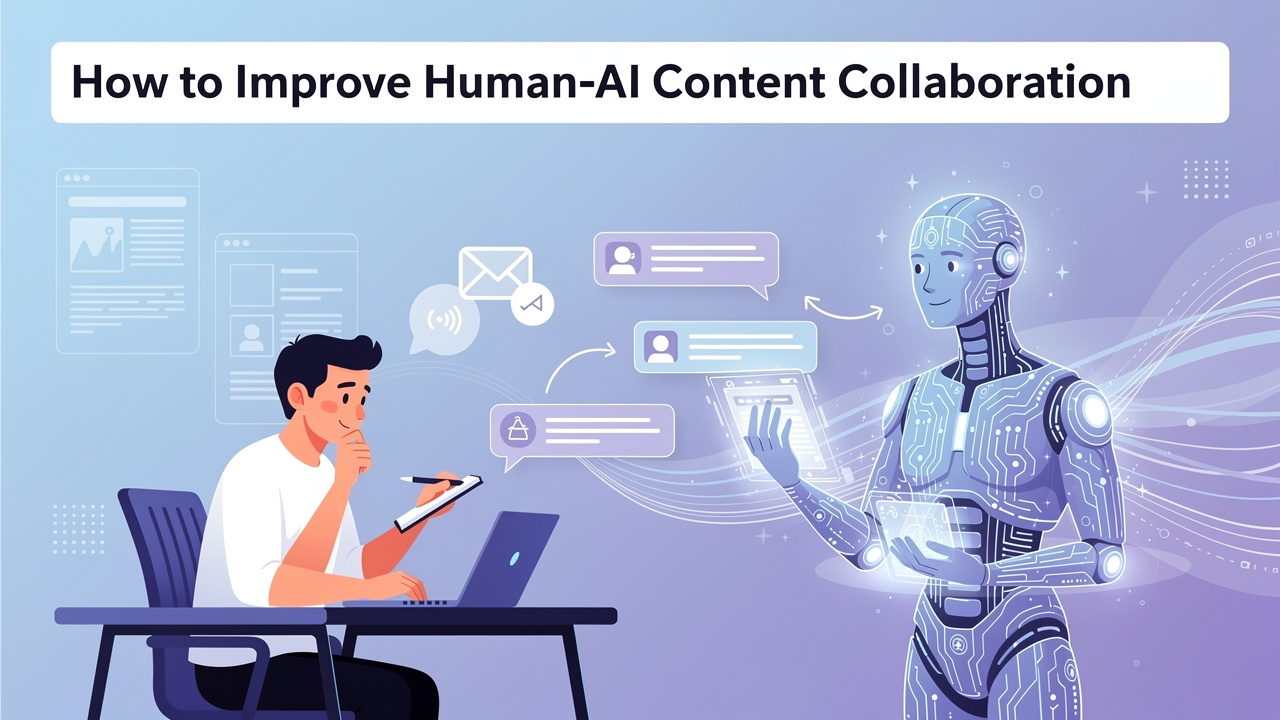
Honestly, the most productive framing isn't "AI vs. humans" - it's "AI plus humans, used intelligently." Here's what that looks like in practice:
- Drafting and editing: AI produces a solid first draft; a human writer refines voice, adds specific examples, cuts what's redundant.
- Research synthesis: AI summarizes sources quickly; a human evaluates credibility and draws original conclusions.
- Personalization at scale: AI generates content frameworks; humans inject brand-specific personality and adjust for audience nuance.
- Ideation: AI brainstorms broadly; humans select, develop, and push the best ideas further.
There are writers and marketers doing this successfully who aren't replacing human-based thinking; they are just putting the mechanical steps elsewhere so that human-based thought can be properly focused.
Which Type of Text Is Right for What?
| Task | Better Suited For |
|---|---|
| High-volume product descriptions | AI |
| Brand storytelling and emotional campaigns | Human |
| Technical documentation drafts | AI (with human review) |
| Investigative journalism | Human |
| FAQ pages and help center content | AI |
| Literary fiction and personal essays | Human |
| Social media copy variations | AI |
| Educational curriculum design | Human-led with AI support |
| Data-driven news summaries | AI |
| Opinion pieces and cultural commentary | Human |
Conclusion
AI is not so much "writing" in competition with human authored texts, but working in conversation with human authors as it fills a need where humans cannot: AI offers unparalleled speed and firepower, and an autopilot-like ability to generate text on a vast scale. Human authorship offers authenticity, genuine creativity, cultural insight, and emotional depth that machine authorship does not actually provide, however fluently.
Best thing for everyone is for people and organizations to know what they're good at and let the machines do that. Let the AI do the repetitive, the structural and the high-volume. Give the real voice, the real stakes to the people writers.
Because words are how we express ourselves to one another—and that's not a responsibility to take lightly, no matter who's (or what's) doing the writing.