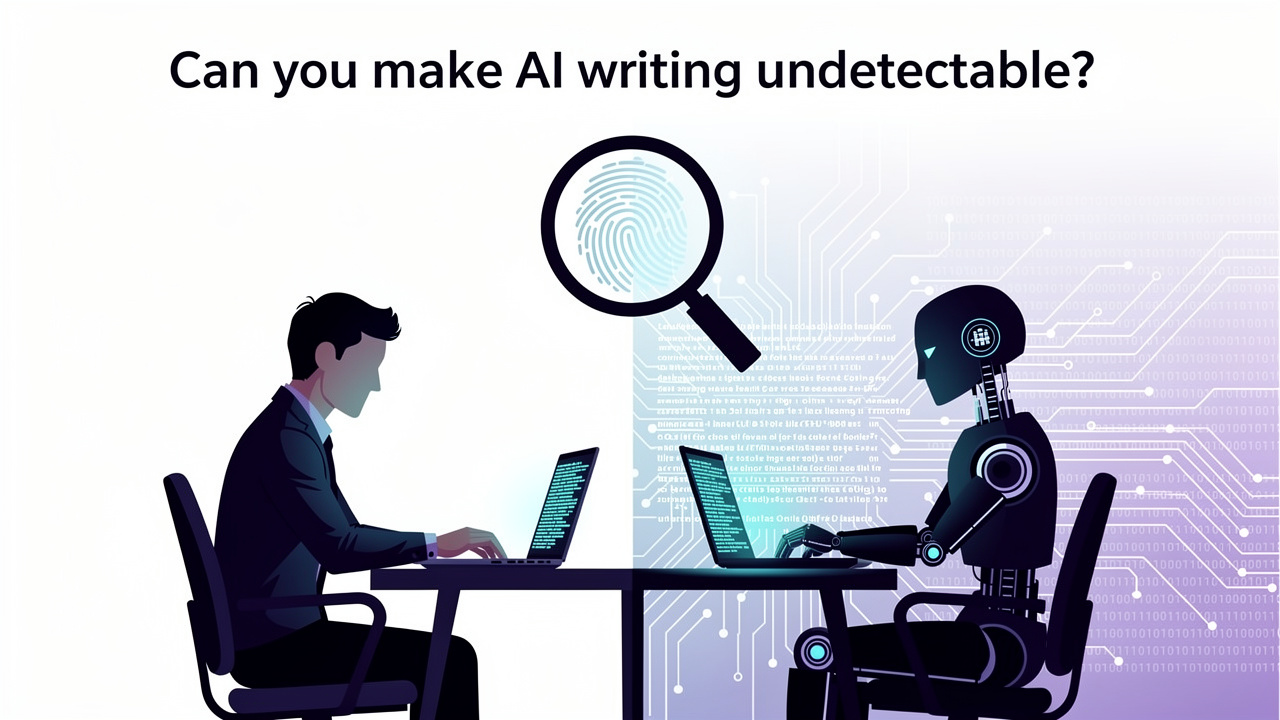
More and more, the internet is full of things written by AI. Just think about the thousands of articles, product descriptions, posts, and marketing emails that were partially produced by large language models. Despite that, it all sounds kind of empty. The question "can you make AI writing undetectable" has become increasingly relevant as AI content generation tools become more sophisticated.
Bland. Bizarrely standard to a degree that's almost impossible to quite describe, but… far too easily felt. The point of really good AI writing isn't just good grammar.
It's writing that—connects, that reads as if a person sat down and thought just a little bit more about what they wanted to say than the average Facebook status. That's actually much more difficult.
Understanding Why AI Writing Gets Detected
Now, before we get into potential solutions, let's just be real about the problem.
Writing detection tools like Originality.ai, GPTZero, Turnitin AI checker analyze statistical trends. They're trying to find those higher levels of perplexity (how often a writers predicts the next word), and burstiness (the amount of variation in the reader experience of the sentences). AI writing is very low on both counts. The sentences are too smooth. Too carefully measured. Almost like rhythmically repetitive in a way that no human writer actually is.
Let me clarify. Detection is not a pure tech issue. It is a writing quality issue. The sort of writing that truly sounds human will inherently not be detected, because it is better writing, not because of fooling the algorithm.
The Ethical Landscape
This is one of those cases where you can't have that conversation if you're not talking about ethics right up front.
To be fair, there are reasonable cases where undetectable AI writing makes sense. Ghost-writing has been around a long time, so an executive authoring a blog post with AI help is no more a loophole than hiring a ghostwriter. Marketing departments mixing AI drafts with humans doing the polish are just leveraging current technology. Content producers increasing throughput without sacrificing quality have genuine needs.
But the context is absolutely crucial:
| Use Case | Ethical Standing | Key Consideration |
|---|---|---|
| Academic submission presented as original | Problematic | Violates academic integrity policies |
| Marketing copy with AI assistance | Generally acceptable | Transparency with clients recommended |
| Journalism published without disclosure | Questionable | Readers deserve to know |
| Personal blog with AI drafting | Acceptable | Author still responsible for accuracy |
| Ghost-written business content | Long-standing practice | Same standards as human ghostwriting |
The bottom line, really, is deceiving people and having real consequences. Utilizing AI for producing a product description differs markedly from passing off AI-generated medical advice as if it were issued by a doctor. So, human review isn't merely a bonus—it's the moral foundation of producing content ethically with AI.
Can You Make AI Writing Undetectable Through Techniques
Actually, there's always work that must be done on the raw AI output. And here's how that work manifests itself when considering whether you can make AI writing undetectable.
1. Inject Specific, Personal Details
AI leans toward abstraction. It will say "many businesses have had success with this" instead of what you really want to see: "a Shopify store selling handmade ceramics in Vermont tripled their email open rates within six weeks." The quickest way to turn human is to lean specific, and to do the opposite, swap out every amorphous generality with a specific detail—even a made-up one—all of which can still be framed honestly:
2. Vary Sentence Rhythm Deliberately
Read the AI draft aloud. You'll recognize the monotonousness right away. Punchy short sentences.
Long sentences—man, the ones that take us through several ideas with smooth conjunctions, that have a narrator sounding like he is calmly thinking his way through a complicated idea—those just sound human. Smack 'em together mercilessly. A three-word sentence following a forty-word sentence produces precisely that balance of density and space we associate with natural speech.
3. Add Genuine Opinion
AI hedges go on forever. "Some experts say that..." "it could be argued that..." These are safe and dull. Make your own position. "In my opinion, the focus on keyword density has truly affected the quality of web writing" hits very differently to "some web experts think that keyword stuffing doesn't do any harm...". Own it.
4. Break Structural Predictability
AI loves structure. Introduction, 3 sub-points, summary. Bullet point lists.
A number of steps. These are not inherently bad - but they are predictable. There are times when a section should have an unexpected stopping point, a time when a vital note is written in brackets in the middle of a paragraph instead of a heads-up in bold.
Such unexpected turns reveal a human touch.
5. Edit for Voice Consistency
This one is less obvious but more important. When a piece of writing is done by a computer it often changes its tone halfway through the assignment. One paragraph will be written in an informal voice and then the next will be overly serious.
Human writers will have a voice that is fairly steady even when the style of the writing changes. Find those rough patches and smooth them out; well, ''replace'' them.
Case Studies in AI-Human Collaboration
Case Study 1: B2B SaaS Blog Content
A medium-sized SaaS project management company experimented with GPT-4 to generate technical blogs. The first (5 blog posts) were a complete failure: the text consisted of a copy-pasted Wikipedia paragraph. Their content team created the following process: GPT-4 generated the outline and rough draft, their editor completely overhauled the first 3 paragraphs of each article, and then a product marketing guy added 2-3 real-life customer calls as concrete examples. Metrics were up across the board: Minutes-on-page increased from 1:20 to 3:45.
Case Study 2: E-commerce Product Descriptions
An online furniture retailer ran AI to produce hundreds of product descriptions in seconds. They kept the factual, technically-accurate AI-generated specs and dimensions, re-wrote in-house the opening hook for each product, one specific element (e.g. how the fabric feels, how the grain of the wood looks in afternoon light) that the AI couldn't invent based on a spec sheet, and started to see detection scores plummet—and conversion rates increase.
Practical Tips for Seamless Integration
- Start with a human-written outline. AI fills structure better than it creates it. Give it a skeleton; don't ask it to build the bones from scratch.
- Use AI for the middle, not the edges. Opening and closing paragraphs should almost always be human-written — they set and close the emotional tone.
- Read every sentence twice. Once for meaning, once for sound. If it doesn't sound like something you'd actually say, rewrite it.
- Remove adverbs ruthlessly. AI loves adverbs. "Significantly improves," "dramatically enhances," "carefully considers." Cut most of them.
- Add friction deliberately. A small digression, a self-correction ("or rather, what I mean is"), a parenthetical aside — these are fingerprints of human thought that AI rarely produces naturally.
- Fact-check everything. AI confabulates confidently. Human oversight isn't just about style; it's about accuracy.
The Future of AI Writing Technology
Writing detection tools and AI content generation systems are locked in a real arms race. The better detection becomes, the better generation gets, and the better AI generation gets, the more detection needs to evolve. That cycle isn't slowing down.
More interesting, perhaps, is what this implies for content quality as a whole. The desire to produce indistinguishable AI writing is a desire to generate superior writing. More precise. More biased. More rhythmically diverse. More human.
The future probably isn't of AI replacing writers. It's of writers who know their way around AI systems beating writers who don't—by using those systems to do the informational and structural heavy lifting, while expending their own effort only in the areas which require judgement: perspective, emotional nuance, moral accountability, and true expertise.
Can You Make AI Writing Undetectable: Final Thoughts
Basically, the idea of "undetectable AI writing" isn't about tricking the algorithms. That's an entirely different approach and frame of mind. It's about writing good copy—something worth reading. Copy that exists for the reader, from human knowledge, with a human voice that no AI, willfully alone, can achieve.
The tricks here –– specificity, varied rhythm, injecting real opinion, consistency of voice –– are exactly that. Writing techniques that AI can't do for now without the human touch. Let the AI system do the speed, structure, and data-mashing. Leave your own attention to doing the judging, the voice, and all the tiny details that make a piece of writing human.
Human oversight isn't just a limitation on AI writing. It's why it actually works.