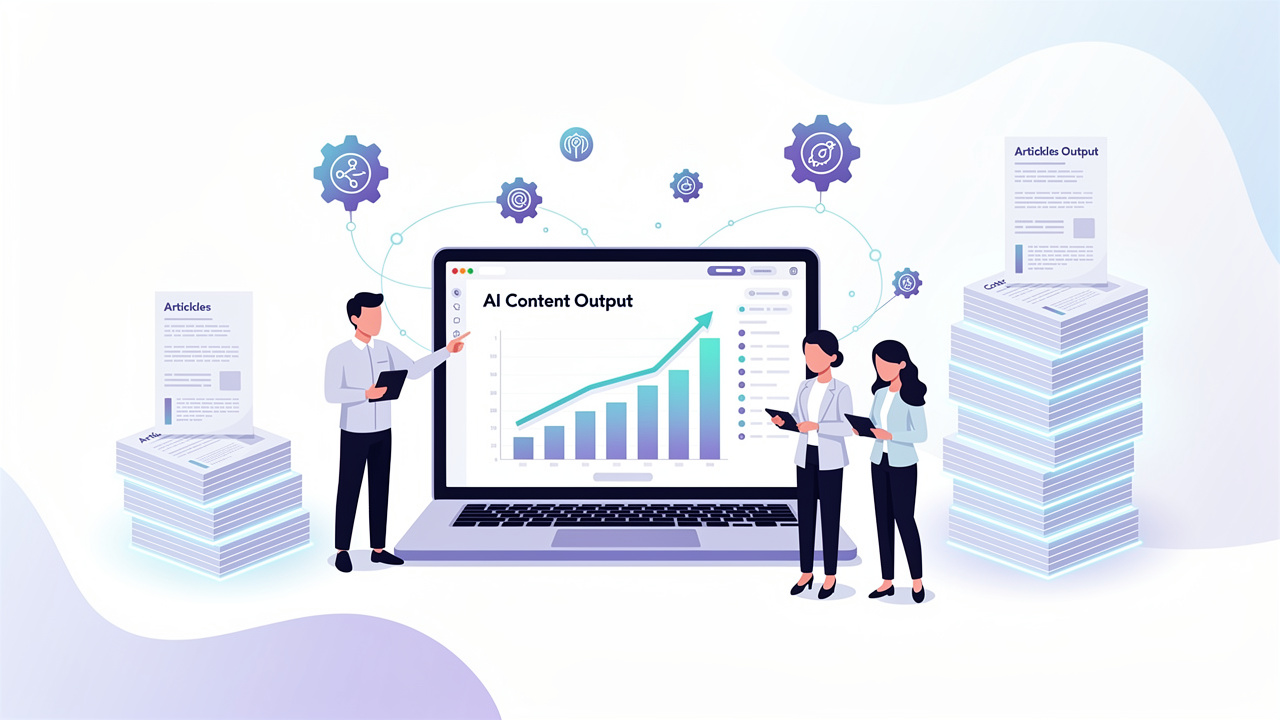
Scaling your content production tenfold sounds like a mission. However, companies that successfully learn how to scale ai content production from 5 to 50 articles per month do not work ten times harder. They are simply smarter and utilize AI tools as amplifiers rather than replacements for human creativity in their AI content production strategy.
The transition from five to fifty articles per month is entirely attainable, and the companies that have achieved it share some recurring tactics that are worth closer examination when scaling content creation.
Set Clear Goals Before you touch any AI Tool
Here's the fact: The reason most content scaling efforts falter is not technology, but a lack of focus. You must first answer fundamental questions before you even introduce a single AI tool to your work process:
- What topics will your 50 articles cover?
- Who is the target audience for each type of content?
- What actual business outcomes are you aiming to achieve, such as lead generation, traffic, or brand recognition?
- What quality benchmark do you have in place, and how will you measure it?
Successful content scaling companies treat their content production like any other product line. Every piece of content produced needs a clear purpose. HubSpot, for instance, became famous for increasing their blog traffic by structuring their content directly to guide the buyer's journey-awareness, consideration, and decision stages-rather than simply publishing whatever resonated that week. This deliberate approach is the difference between productive content at a large scale and content that... exists.
Choosing the Right AI Tools for Your Workflow
The market for AI writing tools is saturated, but not all tools are created equal. Some are experts at long-form articles that require deep research, while others are best suited for product descriptions or social media captions. Picking the wrong tools early on will result in the painful, expensive process of overhauling your workflow later.
Here's an breakdown of typical tool categories:
- Large language model writers (ChatGPT, Claude, Gemini): Ideal for initial drafts of full articles, creating outlines, generating article ideas, and repurposing content into different formats.
- SEO-integrated AI platforms (Surfer SEO + AI, Clearscope, Frase): Offer a dual functionality of keyword research with AI article drafting, which means your content is optimized from the outset and not treated as an afterthought.
- Workflow automation tools (Zapier, Make): Integrate your AI writing tools, content management system, and team communication, streamlining your entire process to save valuable time.
- AI image generators (Midjourney, DALL-E): Help streamline the time-consuming process of finding unique images for every article.
Teams aiming to publish 50 articles per month often use a combination of three to four tools. Expecting one tool to be a comprehensive solution usually isn't successful.
Create a Content Calendar that Works
A content calendar isn't merely a list of dates with ideas. At a larger scale, it becomes your company's operational framework and must provide enough detail for any team member (or AI) to begin working on an assignment with clarity.
Key elements of a high-performing content calendar for scaled AI production include:
- Topic + target keyword for each article
- Content type (how-to, listicle, case study, opinion)
- Assigned writer or AI tool for the first draft
- Human editor for review
- Publication date and distribution channels
- Internal linking targets - what existing articles should the piece link to?
Backlinko popularized a "content cluster" approach, where a pillar article acts as the main focus, surrounded by interlinked supporting content. This method is ideal for AI production as it allows for efficient creation of cluster content, providing the AI with the pillar article as context for each new supporting piece.
Scaling AI Content Production: Integrating Output with Human Touch
This step is arguably the most crucial. AI-generated content lacking human editing will almost always become generic and superficial. Such content is unhelpful. The optimal workflow typically looks like this:
Step 1: Human crafts the brief. A strategist or writer defines the topic's core message, extracts pertinent information and data, and outlines any unique brand perspectives the AI would miss.
Step 2: AI creates the initial draft. The brief is entered into the AI tool, which produces a draft that needs improvement in as little as 60 seconds. This first draft does not need to be perfect; it simply serves as a foundation.
Step 3: Human editor revises. An editor reviews the draft for accuracy, injects the brand voice, adds personal examples, corrects logical errors, and enhances the overall writing style. This takes approximately 20 to 45 minutes, significantly less time than the three to four hours it takes to write an article from scratch.
Step 4: Final review for E-E-A-T signals. Google emphasizes Experience, Expertise, Authoritativeness, and Trustworthiness (E-E-A-T) as quality metrics. A human final pass ensures the inclusion of personal experiences, citations from credible sources, and verification of all facts, which will protect your content's visibility in search results.
This four-step process enables teams to transition from five to fifty articles without sacrificing quality.
A Real-World Example: How a SaaS Company 10x'd its Content Production
A mid-sized SaaS company (around 200 employees) that specialized in project management was producing a meager six articles per month with their two-person content team. Within six months of adopting an AI-assisted process in early 2023, they were producing 55 articles a month, without increasing headcount.
Here was their strategy:
- Compiled more than 200 topic briefs tied to keyword clusters.
- Utilized Claude for generating first drafts, with each brief yielding a usable draft in less than two minutes.
- Hired two freelance editors exclusively for refinement of AI-generated content, which was more cost-effective than full-time writers.
- Implemented a quality assurance checklist that covered readability, accuracy, linking, and calls to action.
Their efforts resulted in a 340% surge in organic traffic over nine months. Although no two companies will experience the exact same results, the underlying framework of structured briefing, AI drafting, and human editing is scalable.
Measuring Success Through Analytics
If you scale content without tracking its performance, you are effectively publishing into a black hole. Metrics are essential from day one.
Measure these key stats:
| Metric | what you learned | how to measure |
|---|---|---|
| traffic by article (organic) | what content the search engine likes best | Google Search Console |
| Time on page | is your audience reading your stuff? | Google Analytics 4 |
| conversion rate | is your stuff contributing to your bottom line? | GA4 +CRM integration |
| # of new backlinks | content's quality and how much is being earned on itself | Ahrefs or Semrush |
| content velocity | how quickly your team churns out content | Internal spreadsheet or Notion |
Once a month - not quarterly - look at each of these stats. At 50 articles each month, you will produce a data sample large enough to start identifying which topic clusters the search engines find valuable, what formats tend to perform, and which content lengths work best for keeping people engaged. This data should feed into the next generation of briefs.
Practical Tips for Starting
If you have been producing 5 articles a month and wish you produced 50, please do not attempt it directly. that is not how the team remains employed, nor how quality doesn't drop precipitously:
- Scale to 15 articles per month the initial 60 days as you figure out tools and systems
- Draft a master brief template before you even craft your first AI prompt - that's the entire foundation of what will come after
- group similar content together because briefings on 10 similar topic clusters is far quicker than switching in and out of topics.
- rigorously review the first 20 pieces of AI content produced to understand what must change before producing more pieces.
- train editors for AI content, not the ones that have worked with human writers. that requires a new tool set.
Conclusion
5 to 50 an article each month with AI will not substitute writers but removes what's more mechanical to free humans for the meaningful work. The businesses doing it right have set business goals, the necessary technology, disciplined workflows, and rigorous editor review.
The technology is available; now your workflows and discipline should be. Begin with a strong brief template, select a couple of other tools, create a calendar, and measure all activity. Grow little-by-little, then test and again review, and you'll soon discover that 50 articles a month is not a limitation.