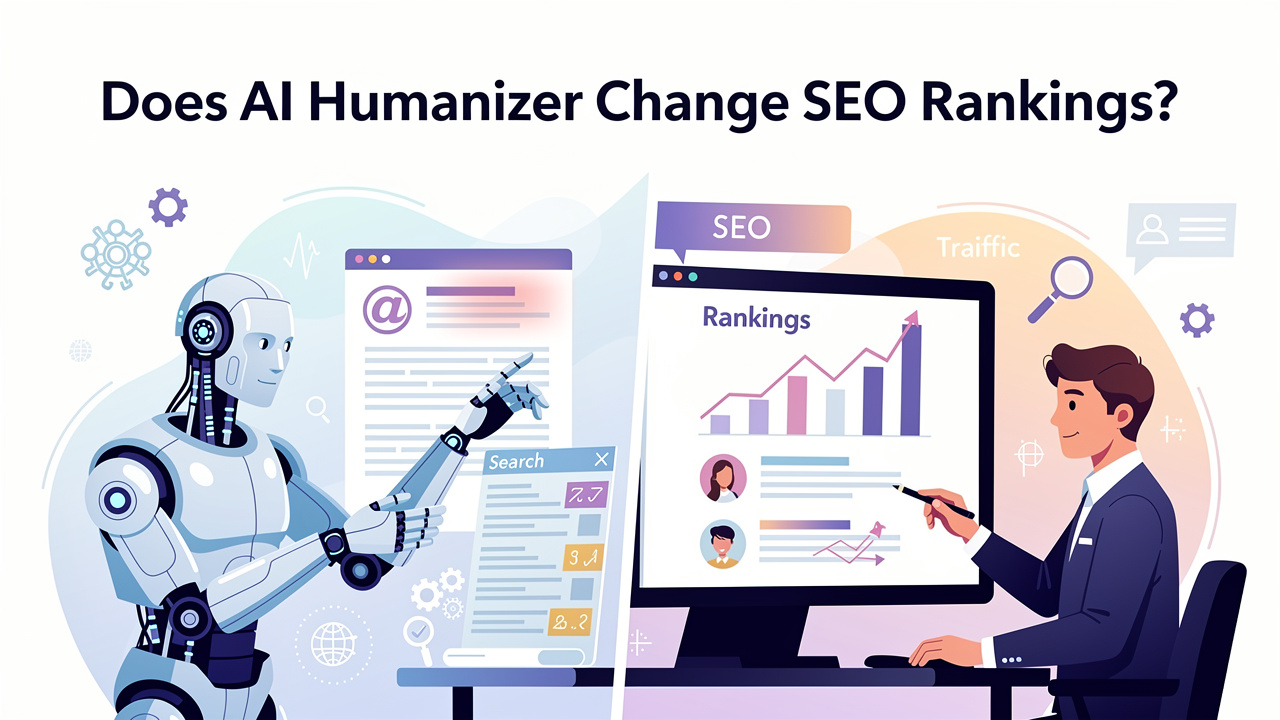
The short answer: no, they do not automatically; but the longer answer is much more intriguing (and much more crucial for anyone producing content in 2024). Does Google penalize content humanized by AI? Google couldn't give a crap about whether it was written by a human or an AI or a chimpanzee (though I'm sure they can recognize the latter). What Google cares about immensely and continually is if your content is useful.
That's a significant distinction and one that most content producers do not seem to understand or heed.
Google's Quality Guidelines: What They Actually Say
There is no reference to AI being a penalty trigger in Google's Search Quality Rater Guidelines. But there is a lot of guidance about a concept called E-E-A-T: Experience, Expertise, Authoritativeness and Trustworthiness. Content shows it has real user intent and genuine expertise will rank, content that doesn't will flounder, no matter who or what created it.
Updated guidance on helpful contentIn 2023, Google finally specified in its helpful content guidance that quality issues are caused by content producedmainlyto manipulate rankings, as opposed to answering people's questions. An article created by AI that contains keyword stuffing and has little meaning? Not good. A well written article that used AI content generation to help structure a paper and improve clarity? Fine. Actually, very fine.
Here's the thing - Google was already filtering out low-quality, thin content with its algorithms back in 2011 (thanks to Panda). The AI merely provided a more efficient means for the malcontents to churn out that same low-value content. The tool changed; the problem did not.
Does Google Penalize Content Humanized by AI?
Now, let's be specific what really pays!
The March 2024 core update was aimed at what Google called 'scaled content abuse'—Websites that populated the index with enormous volumes of AI created pages offering no unique value. Many of these saw huge losses. Hundreds of sites plummeted to losing 90% of organic traffic in a single day.
But here's the interesting part: the sites that remained and even flourished postupdate were those that were doing AI-driven content with a clear voice, actual numbers, and authentic expertise infused. The tool wasn't the difference. The purpose was.
Marcus Tober, who established Searchmetrics, was very direct when interviewing in Search engine journal: "Google is very good at determining if the content was made to fit user intent. The method it was generated in doesn't really matter"
This is not an encouragement to complacency. It is, however, an encouragement to think carefully.
Originality and Relevance: The Non-Negotiables
Two things that no AI program can yet replace--uniqueness and local relevance--are still the foundation of good-ranking content.
Originality is not just defined by avoiding plagiarism. It means providing something new—new insight, a unique data set, a particular case study, a research or unique quote that you have gone out and secured. When HubSpot puts out a study, for example, on email open rates, that content will already be highly rated because no other companies have that exact data. AI is not going to be able to provide that kind of originality. It can help you deliver it, but the data has to come from somewhere real.
Relevance, on the other hand, is providing what the user needs at whatever level of granularity makes sense for the query. Someone searching for " how to fix a leaky tap" wants a detailed, accurate, step-by-step guide, not a thousand-word history of plumbing. AI content generation is helpful in getting people to provide that, but someone with knowledge of and empathy for the audience must ultimately do the discerning.
How AI Tools Actually Help (When Used Right)
When used well AI can improve the content tremendously. Not just quicker –better.
Consider a few concrete examples:
Research and structure: For example tools such as ChatGPT or Claude can quickly gather the necessary information on a complex subject, enabling the writer to come up with a very knowledgeable first draft before adding their own flavor and perspective. Take a financial writer writing about crypto rules—a chatbot could give them the backgrounds of the new rules, then the writer can add interviews and their own knowledge:
Editing and clarity: grammarlys AI, along with similar services, can detect more than just poorly written sentences. It also identifies problems such as wrong tone, excessive use of the passive voice, and poor readability. Now this is AI really making a difference to contentâ€"the sort of improvement that users appreciate.
Content gap analysis: Leveraging AI, platforms such as Clearscope or Surfer SEO determine which topics and subtopics existing pages have ranked for. When writers use this information, they produce more in-depth content.
Marie Haynes, an SEO consultant who has been studying the progression of Google algorithm updates over years, stated in a newsletter of 2023 that she has seen AI-enhanced content perform better than text created by humans alone when the AI was assisting with structure, and the human added authentic knowledge.
What Actually Gets You Penalized
To put it directly, here are the behaviors that trigger Google penalties - all of which happen to be easier with AI but aren't caused by it:
- Publishing large volumes of near-duplicate content with minimal variation
- Creating pages that target keyword variations without adding unique value
- Producing content that answers questions superficially without real depth
- Building pages designed for crawlers rather than human readers
- Using AI to fabricate quotes, statistics, or expert opinions (this is both an ethical and SEO problem)
And that last one needs highlighting. AI hallucinations, where models confidently pontificate on false facts, is a very real problem. An online publisher who posts an AI-generated number without fact-checking it is risking not just a Google ban, but difficult-to-recover damage to reputation.
Actionable Tips for Using AI Without Risking Penalties
Content creators can also definitely utilize tools such as AI. The real trick is to make sure that one uses them in an intelligent, rather than naive, manner:
-
Always add original insight. Every piece should contain something AI couldn't generate — your own experience, a source you interviewed, data you collected, or a perspective rooted in genuine expertise.
-
Fact-check everything. Verify every statistic, quote, and claim before publishing. AI models are trained on historical data and make mistakes. Your reputation depends on accuracy.
-
Write for people first. Before publishing, ask honestly: does this actually help someone? Would I find this useful if I were searching for this topic? If the answer is uncertain, revise.
-
Maintain a consistent, human voice. AI-generated prose tends toward a certain blandness — well-structured but oddly impersonal. Inject your actual opinions, specific examples, and natural conversational rhythm.
-
Use AI for optimization, not origination. Let AI help you structure, edit, and improve content. Let humans — ideally experts — drive the core ideas and insights.
-
Monitor performance honestly. If AI-assisted pages are underperforming, don't assume the algorithm is wrong. Look critically at whether the content genuinely serves users.
The Bigger Picture
The content creation space is really changing. That's not some hyperbolic statement—it's just a fact. Writers who learn how to leverage AI to do additional research, generate cleaner draft copies, and help find holes in their writing will outperform writers who either ignore them altogether or pass off their thinking.
Google algorithm updates are getting better and better at gauging quality signals: time on site, bounce rate, backlinks from authoritative sources, satisfaction signals. These are all indicators that real human people found your content to be genuinely valuable. AI can not simulate those signals en masse.
To be honest, the question "does Google penalize AI content?" is the wrong one to ask. The right question should be: "should my content rank?" If the answer is yes - because it's factually accurate, original, insightful, and expertly written - then the device used to produce it becomes almost incidental.
Create content that people want to read. The rankings will generally follow.