It's not that people aren't paying attention. Online audiences are incredibly perceptive. They see through unexciting, drab content in a heartbeat – and the moment they do, they whip out their scroll button.
That's the task at hand: how do you significantly increase your social content—without sacrificing the personality, humanity and likability that make it click? This is where an AI humanizer for social media posts becomes essential for modern content creators and marketers.
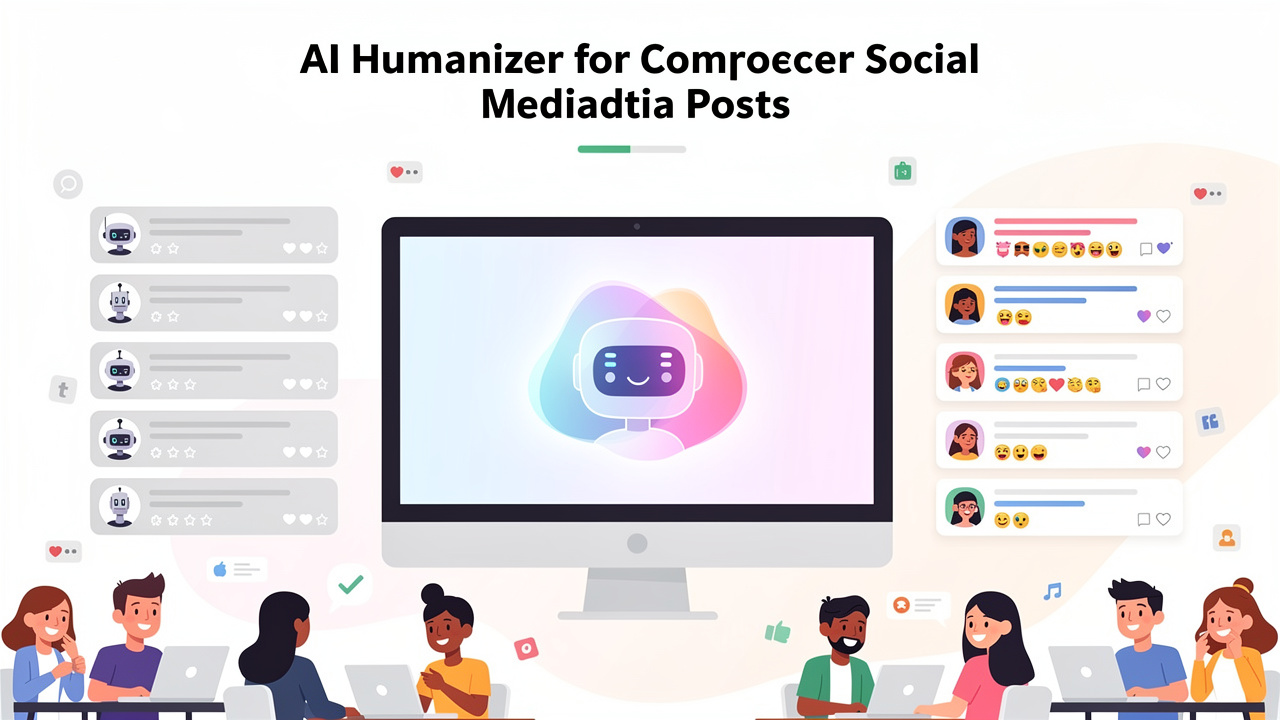
This is exactly where AI humanizer tools fit in. They're not your run-of-the-mill grammar checkers or caption builders. They're advanced software designed to process content made by an AI and reword it in such a way that it feels like an actual individual wrote it—imbued with emotion, culturally relevant nuance, and consistent tonality.
Properly utilized, they can truly revolutionize your content approach.
Why the Human Touch Still Matters on Social Media
Platforms like Instagram, LinkedIn, TikTok, X (originally Twitter) aren't just business destinations; they are inherently social. Your audience is logging in to interact with other humans—or at least with brands that seem human. Rigid, predictable updates don't merely lack engagement; they damage confidence.
According to Sprout Social, 64% of consumers want brands to engage with them through social media. And that engagement isn't done with boring, all- templated conversations. It is done through tone, right time, authenticity and perhaps a dash of humor or vulnerability.
But here's the rub: most brands simply do not have the luxury of a human copy writer to sit down and write every post from scratch. Content needs are simply too high. Posting schedules are critical for reach. Which is why automation is king - and AI social media tools are so useful for maintaining humanizing content strategies.
AI Social Media Tools for Humanizing Content
There are a number of tools designed to put that human touch on any content produced by AI or template-based. They are varied in their approach, but the aim is unchanged: make it sound natural.
Popular AI Humanizer for Social Media Posts Tools:
- Humanize AI — Rewrites AI-generated text to reduce robotic phrasing and improve conversational flow; particularly useful for LinkedIn posts and professional content
- Undetectable.AI — Originally designed to bypass AI detection tools, but widely used by marketers to make content feel more organically written
- Jasper AI — Offers tone customization features that let you define a brand voice, then generate content that stays consistent with it
- Copy.ai — Includes templates for social platforms that incorporate casual language, contractions, and platform-specific idioms
- ChatGPT with custom prompts — When properly prompted with persona details, brand guidelines, and tone examples, it can generate surprisingly human-sounding posts
- Lately.ai — Analyzes your existing top-performing content, learns your unique voice, and generates new posts that mirror it
Every tool has its advantages. Jasper is perfect for multiple brand voices. Lately is a wonderful option for solo users, who do not want to engage with an existing content strategy constantly.
It all comes down to the quantity, wallet, and specific needs of your brand voice.
Key techniques these tools use include:
- Tone mirroring — matching the emotional register of your audience
- Colloquial phrasing — swapping formal constructions for casual, natural alternatives
- Empathy injection — adding language that acknowledges the reader's experience or perspective
- Rhythm variation — breaking up monotonous sentence patterns that AI tends to produce
Implementing AI Humanizer for Social Media Posts
Getting results from these tools isn't automatic. You can't just paste in AI content, click "humanize," and expect magic. Here's what actually works:
1.2 Identify your Brand Voice. The trouble is, most businesses don't have one. First, you need to clarify exactly how you want to communicate to your clients. How do you want your business to be perceived? Even better, decide on what sort of emotions you want to generate in your clients: Independent? Trustworthy? Friendly? Fun? Whatever the case, your brand voice should breathe this personality.
Before you can humanize your content with a tool, you have to understand what being human actually is for your brand. Is it gentle and nurturing? Straightforward and punchy? sarcastic and irreverent? Write it. Make a voice file with samples.
- Provide actual examples of the tool.
The majority of AI humanizer for social media posts tools will be much more effective if you provide them with samples of your highest performing posts. It's like training a new team member - context counts a lot.
- Don't let manual check slip by the wayside.—If you automate everything, you become reactive instead of proactive. Automating the manual process is counterproductive to your search for the perfect set of keywords.
AI humanizers don't eradicate editing time, they just shorten it. Always read the output aloud. If it sounds odd when you read it, then it will sound odd to the reader.
- Personalize for each platform.
A post on LinkedIn and a caption on TikTok are for two very different audiences with two very different sets of expectations. Your AI humanizer settings- your prompts- should be as well. LinkedIn is about building insight through more elongated statements. TikTok is about quick bite-sized statements, often very self-aware.
- Use actual data for improvement.
monitor engagement statistics on humanized posts compared to your prior content; modify your prompts and configurations depending on what is working. Remember, this is not a one-time-only program.
Brands Getting This Right: Real Examples
Duolingo is likely the most hyped humanized social example of AI-powered social content. The social team at Duolingo pushes the AI tools for creating a lot of content, but all of it still passed through a distinctive brand personality—messy, self-conscious, and actually funny. It comes off as totally human even when the initial draft is the work of an algorithm.
Spotify helps with at-scale social messaging through AI on the Wrapped campaign. The messages look like they are locally written by actual people, but it's actually a AI repackaging your personal content.
Glossier, the beauty brand, employs AI-powered tools to keep their consistent warm, friend-to-friend voice intact across all channels even during higher than normal social posting volumes. Their content almost never feels like a sales pitch. It feels like a personal recommendation from someone who actually uses the product.
Challenges You'll Actually Face
Truth be told, this process isn't seamless. A few real obstacles come up consistently:
- Over-humanizing can backfire. If your brand suddenly sounds too casual or too personal, long-time followers notice the shift. Consistency matters more than sounding "human" in an abstract sense.
- Cultural nuance is hard to automate. AI tools can miss the mark on humor, slang, or references that are very specific to a cultural moment. A post that's trying to sound current can easily come across as cringe-worthy if the AI gets the timing or tone slightly wrong.
- Platform algorithm changes affect what "engaging" content looks like. What worked six months ago might not land today, and AI humanizers trained on older data can lag behind those shifts.
- Authenticity skepticism is growing. Audiences are becoming more aware that brands use AI tools, and some actively distrust content that feels too polished or too consistent. The odd imperfection — a candid photo, a slightly unpolished caption — can actually perform better than perfectly humanized content.
Future Trends Worth Watching
The space is moving fast. A few developments seem particularly significant:
- Multimodal humanization — AI tools that simultaneously optimize text, image selection, and video captions together for cohesive emotional impact, rather than treating each element separately
- Real-time tone adaptation — Tools that monitor how your audience is responding to current events or trending topics and adjust your scheduled content's tone accordingly, almost in real time
- Hyper-personalized social content — Moving beyond audience segments toward truly individual content experiences, where different followers see posts that feel tailored specifically to them
- Voice-based social AI — As audio and video content grows, AI humanizers will increasingly work on spoken tone, pacing, and verbal personality — not just written text
Conclusion
AI humanizer tools aren 't an easier path to being real - they are a way to get closer to the best of both worlds: the human and the machine. When used properly, they help brands preserve their personality and human touch at a level of scale that could never exist otherwise. But the effectiveness of the tools depends on the intentional strategy you bring to it.
Communicate your voice with conviction, scrutinize every detail, and ensure your audience's real experience remains the priority. The brands having success on social media today are not fighting between AI and humanity. They are using AI on behalf of humanity, and that difference makes all the difference.