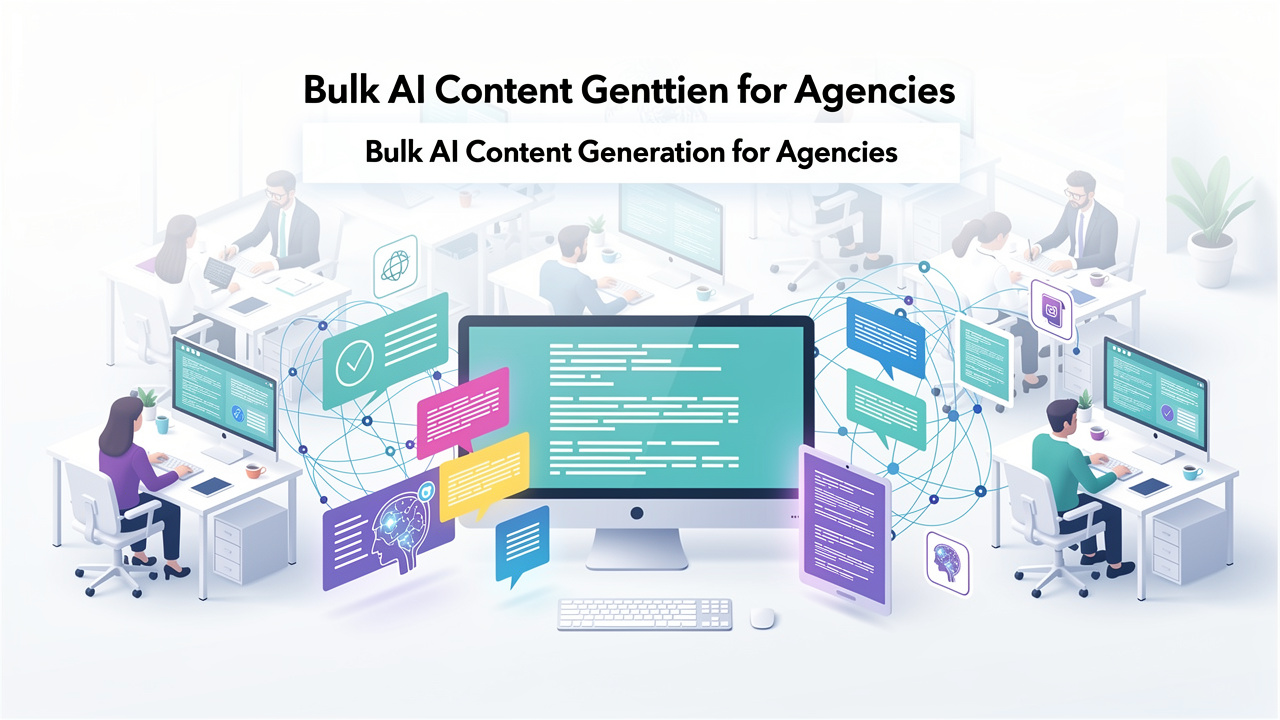
The other harsh truth for marketing agencies is that clients want more, cheaper and quicker. It's relentless. A medium-sized agency working with 20 clients could be required to churn out a hundred or more blog posts, social captions, email sequences and product descriptions monthly. This is where bulk AI content generation for agencies becomes a game-changing solution.
That is simply mind-boggling. In the traditional world, this had meant hiring additional writers to increase capacity, or elongate project time frames, or end up making compromises when it comes to quality. Batch AI content production alters that equation.
Not entirely, and not in an instant—but significantly enough that agencies neglect to take advantage of it are truly leaving income on the table.
Why Bulk AI Content Generation for Agencies Works
The biggest upside is simple: speed. An AI tool can generate the first draft of a 1,000-word blog post in less than a minute (human writers can do the same in a couple of hours). Do it a couple of hundred times a month, and you've got a truly huge increase in throughput.
But speed alone isn't the whole story.
Here's what agencies actually gain:
- Cost reduction per content unit — AI drafts cost a fraction of freelance or in-house writing, often reducing per-piece costs by 60–80%
- Consistent brand voice — when properly prompted, AI tools maintain tone, style, and terminology across massive content volumes
- Scalability without headcount — agencies can take on new clients without proportionally expanding their writing teams
- Faster client turnaround — shorter delivery windows become a genuine competitive differentiator
- Data-informed content — many AI platforms integrate with SEO tools, pulling keyword data directly into content briefs
The truth is, the efficiency benefits are genuine. But so are the limitations. That's why intelligent organizations use AI content creation tools as an enhancement for the workflow—not as a substitute for editorial decision making.
Tools and Platforms Worth Knowing
The market for AI content tools has blown up. There are many of them that just aren't right for an agency-sized operation. Here are the main options:
| Platform | Best For | Key Feature | Pricing Model |
|---|---|---|---|
| Jasper AI | Long-form content at scale | Brand voice training, team workflows | Per-seat subscription |
| Copy.ai | Marketing copy, short-form | Workflows for bulk output | Usage-based tiers |
| Writesonic | SEO-focused articles | Surfer SEO integration | Word-count plans |
| Rytr | Budget-conscious agencies | Simple interface, fast output | Freemium + paid |
| ContentShake AI | SEO content strategy | Semrush data integration | Standalone tool |
| ChatGPT (GPT-4o) | Flexible, custom workflows | API access for custom builds | Token-based pricing |
For agencies with heavy volume, the API path – crafting custom workflows on top of GPT-4o or Claude – is often the best way to go. It requires more investment up front, but offers detailed control over prompts, output format, quality validation, etc.
Best Practices for Implementing AI Content Generation
Plunging AI into the workflow of an agency isn't just selecting a tool and pushing "generate" from overhead. The agencies that do this successfully have constructed tangible processes around them. This is how it translates in the real world:
1. Build a Prompt Library
Generic prompts result in generic content. Agencies should allocate time to create thorough custom prompt templates for clients that map the brand voice, audience, tone and structure guidelines. A good prompt is essentially a briefing document - the more information you include, the better the content will be.
2. Establish a Human Review Layer
It absolutely requires editorial review with AI content. Always. The editing doesn't have to be as broad as sitting down and writing the piece entirely, but it does need to be a human that has eyes on it for factuality, brand voice, anything that sounds like an auto-generated narrative. As a guideline: AI is a mouth to produce the first draft, human is a voice to produce the final.
3. Create a Quality Tier System
It doesn't all have to be as fine-tuned. A product description for an eCommerce client is not the same as thought leadership on a B2B SaaS site. Agencies should categorize their content:
- Tier 1 — High-stakes, heavily edited (white papers, CEO bylines, case studies)
- Tier 2 — Standard editorial review (blog posts, email campaigns, landing pages)
- Tier 3 — Light-touch review (social captions, meta descriptions, FAQs)
4. Train AI on Client Materials
And most enterprise tools can take (and are happy to take) upload of brand guidelines, prior art, style documents. Investing a little time in this training step is very much worth it. ChatGPT etc fed the client's existing content will generate output that sounds much more like the client - less like the composer, more practically usable right away.
5. Integrate with Project Management
Connect tools such as Asana, Monday.com or Notion to the AI work flow to generate content requests, assign review and track delivery—without the coordination overhead that kills efficiency gains.
Real-World Case Studies
Case Study 1: E-Commerce Agency Scales Product Descriptions
An Austin-based boutique ecommerce agency was servicing a retail client with 8,000+ SKUs that required new product copy. With a three-man content team this was an impossible challenge. They built a custom GPT-4o workflow that took spreadsheet dumps of product data and spit out SEO-optimized descriptions en masse (about 500/day). Post a single pro editorial round to perfect the prompt templates, a 12-minute average per. description production time was reduced to less than 90 seconds. Organic traffic increased 34% over 6 months in part because of the more comprehensive, keyword-rich copy.
Case Study 2: Digital Marketing Agency Expands Blog Services
A 15 person digital agency in London wanted to offer content marketing without having to hire more writers. They implemented Jasper AI with Surfer SEO plug in, created a repeatable process: keyword research AI draft SEO scored human edit client delivery and in 3 months, they were creating 40% more blog content per writer per week. Most important, they won 2 new retainer clients purely due to competitive pricing-price was driven by the lower production cost.
Case Study 3: PR Agency Automates Press Release Drafts
A regional PR firm adopted an AI system to produce first draft press releases from a standard intake questionnaire that clients completed. The process reduced first draft times by 70%. The senior writers who previously devoted 50% of their time to draft writing could spend more time advising clients and developing media relationships. Staff morale went up. The quality of final outputs improved, because the writers were less exhausted by rote work.
The Honest Reality of AI Content at Scale
AI content creation isn't perfect. It can generate convincing-sounding but false content. It can repeat, it can produce more generic responses when not guided tightly enough, and it can get stuck in a default "something something" cage when faced with complex tasks—let alone anything that requires in-depth journalism, heavy-duty engineering, or pure art.
But for agencies that have heavy volumes of structured content what needs? The numbers are hard to beat. Reduced costs, quicker delivery, scalable capacity, and- if approached properly- quality that is actually good. The agencies who are winning at present are not replacing their writers with an AI, but using automated content generation for marketing agencies to make their writers a great deal more productive.
This is the real opportunity: not just automating for the sake of automating, but having leverage. Smart leverage: use it carefully, with people still providing control.
Bulk AI Content Generation for Agencies: Implementation Success
One of the most commercially advantageous efficiency improvements a marketing agency can make is bulk AI content generation for agencies. The technology has become sufficiently developed, the processes are tested and the budget savings have been proven. The difference is not a technologically enabled workflow but instead a business model with the discipline to deploy, quality control and set appropriately high expectations.
Agencies that construct robust, AI-enabled content production systems now will have the capacity to work with more clients at higher profit margins with less staff burnout. In the competitive world of marketing, that is an extremely useful first step.