Academic honesty is a pillar of all respectable research organizations. And today, our current ideas of academic honesty are being challenged not by students plagiarizing each other's essays, but a completely different threat: the AI generated scientific writing. The SciSpace AI detector is one of the more promising AI detection tools that have been produced in response to this issue, and it's worth understanding exactly how it works, how effective it actually is, and where it belongs in the research process while maintaining academic integrity.
What SciSpace AI Detector Actually Does
SciSpace (previously Typeset.io) is developing an AI detection tool, which is one feature of a larger research productivity platform. The detector evaluates the text and then provides a score of the likelihood that the writing was produced by a human or a large language model, such as ChatGPT, Claude, or Gemini.
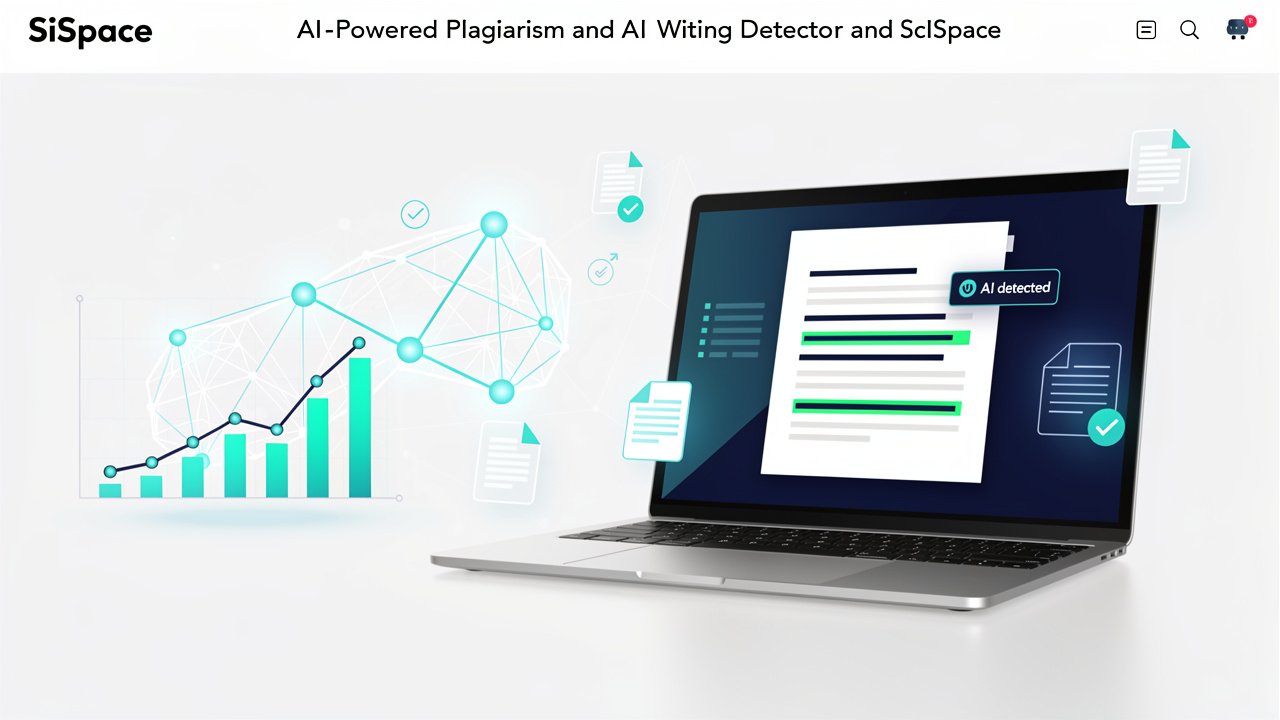
The important point is it doesn't simply mark something as "AI" or "not AI." It marks narrow pieces of a document so that people who are using it get detailed information as to what is worrying them. That's really helpful. An overall determination provides nearly no information about which part is actually a problem – sentence-by-sentence information is very helpful for scholars, teachers and editors.
The detector examines the text by a pattern-recognition program, trained on huge pools of human- and AI-produced writing. It searches for certain statistical patterns—with terms like perplexity and burstiness—that tend to differ from human writing. Specifically, humans tend to produce more bursty writing, swinging in fits and starts between short, simple sentences and long, complex ones. AI writing usually follows a fairly even, machine-like pattern:
Benefits for Researchers and Academic Institutions
Researchers benefit from the SciSpace AI detector in ways that go beyond simple plagiarism checking. Here's a breakdown of the core advantages:
- Manuscript screening before submission: Authors can check their own work to ensure that any AI-assisted sections are appropriately flagged or revised before journal submission.
- Editorial workflow integration: Peer reviewers and journal editors can use the tool as a preliminary filter, reducing the manual burden of identifying suspicious submissions.
- Student assessment support: Instructors reviewing thesis chapters or seminar papers can identify sections that may require closer examination.
- Institutional policy compliance: Universities increasingly require disclosure of AI use; the detector helps enforce and verify those policies.
- Self-auditing for collaborative projects: In multi-author papers, contributors can verify that all sections meet the agreed-upon writing standards.
The tool is also coupled with all of SciSpace's other tools for research, such as a literature search engine and PDF reader, so users won't have to jump between platforms to use several research tools. That type of workflow integration counts. Time is at a premium in academia.
Accuracy: What the Data Shows
There isn't an 'unbreakable' AI detector. Not an 'uncapable' one. But the point isn't a qualification—it's a statement that should inform your approach.
SciSpace's detector detects fairly accurately on obvious AI generated content. For text produced without significant human editing it performs as well or better than others of this type in our internal tests and third-party comparisons: 85-95% on unmodified AI text. But accuracy takes a hit once the content has been heavily paraphrased, re-edited or run through an AI humanization tool. That a disadvantage, certainly.
The false positives is something else to be concerned about. Often even those who are native English speakers tend to create writing patterns that detection models will call "AI-like" – shorter, lower-sentences, simpler-syntax, more homogenous construction. This is an important equity concern in the world-wide academia. A scientist writing in their third language may get unfairly flagged, for this reason SciSpace and other similar systems recommend that detection scores be considered just one data point.
Real-World Research Scenarios
Case Study 1: Journal Pre-Submission Screening
A team of biomedical researchers at a medium-sized European university submitted a joint paper about protein folding processes. Prior to submitting it to a high-impact journal, the paper's corresponding author subjected the document to the SciSpace AI Detector. Three entire paragraphs (all in the literature review) scored very highly for AI-written text--those paragraphs written by a junior author who had entered them into ChatGPT to generate a rough outline. The team rewrote the sections to include original commentary before submitting the paper, which was accepted without any concerns raised over academic integrity.
Case Study 2: Graduate Thesis Review
A North American university graduate program coordinator utilized SciSpace to check thesis chapters. A student dissertation methodology chapter had an odd uniformity of sentence structure and diction. The coordinator employed the detection report as the foundation of a dialogue with the student, not accusations of misdeed, about writing procedures and disclosure of AI use. The student admitted employing AI for structural drafting and then rewrote the chapter.
These examples are certainly not unique. Used across all disciplines, the tool functions as a dialogue starter not a disciplinary cudgel. Certainly the way to go.
Best Practices for Using AI Detection in Scientific Writing
Using these AI detection tools effectively requires some discipline. Here are practical guidelines:
- Never treat a single score as definitive. Detection scores are probabilistic. Always combine them with contextual judgment.
- Run detection before peer review, not after. Catching issues early reduces embarrassment and editorial friction.
- Disclose AI use according to your institution's policy — and use the detector to verify that disclosed sections align with what the tool flags.
- Account for non-native speaker bias. If a flagged author writes in English as a second or third language, apply extra scrutiny before drawing conclusions.
- Use the tool iteratively. Run detection on early drafts, revise, and run again. Think of it as part of the editing process.
- Document your process. Keep records of detection reports, especially in institutional or high-stakes submission contexts.
- Combine with traditional plagiarism checking. AI detection and plagiarism detection serve different functions; you need both.
Implications for Academic Integrity
The larger debate here is truly complex. AI writing tools are not intrinsically deceptive: they can be valuable resources for synthesizing the literature, aiding with translation, and helping in initial drafting. The issue is not the use of AI, but the misrepresentation of it as human thinking.
The SciSpace AI Detector doesn't get us out of that moral dilemma. What they do is make it more difficult not to have the discussion. Each institution that uses these tools is announcing that AI use is going to be scrutinized and that in itself should incentivize honesty. And I think that is a good thing whether or not the tools work well.
And what does "original research" mean in an age of AI? In all honesty, it's (or will be) changing - and detection tools are among the things encouraging academia to be more precise about guidelines for maintaining academic integrity.
Future Trends in AI Detection Technology
The next few years will bring significant changes to how AI detection works in academic contexts. Several trends are already visible:
- Watermarking technology: Some AI developers are embedding invisible statistical signatures into AI-generated text, which would make detection far more reliable than current pattern-recognition approaches.
- Multimodal detection: Future tools will likely analyze not just text but also AI-generated figures, data tables, and even citation patterns.
- Real-time integration: Detection built directly into manuscript submission portals, rather than as a separate step, is already being piloted by some publishers.
- Contextual AI models: Detectors trained specifically on scientific writing (rather than general text) will improve accuracy for research-specific content.
- Collaborative human-AI writing standards: Rather than binary detection, future systems may quantify the degree of AI contribution, enabling nuanced disclosure rather than simple pass/fail judgments.
SciSpace is already placed to grow with these trends, as it is already embedded into research workflows and is a science-specific service.
Conclusion
SciSpace AI Detector is a serious — if flawed — answer to a real problem facing contemporary academia. It performs best when used as an aid for clarity and discussion — not as a disembodied arbitrator. Researchers who know what it cannot do, use it carefully, and pair it with explicit institutional policies will find it very helpful.
The technology will continue to evolve. The most difficult task—that of articulating standards for honest, AI-enabled research—remains squarely in the hands of the academicians.