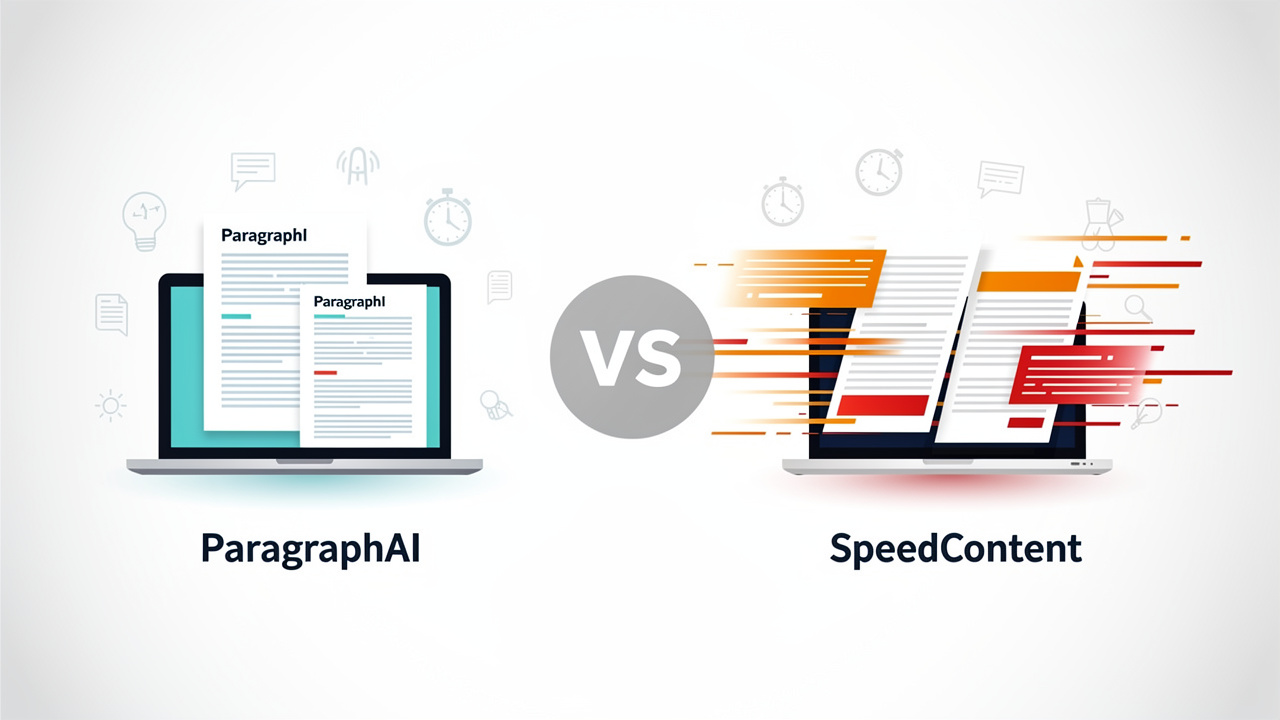
Deciding on the best AI writing tools in 2024 isn't a walk in the park. With the sheer proliferation of solutions, two names we keep hearing in conversations with professional copywriters are ParagraphAI and SpeedContent. When comparing ParagraphAI vs speedcontent, both cater to the same user base, making you work faster, producing better work, and - let's be honest - making the subscription fee worth paying every month.
However, they do different things. This article defines both tools in terms of the factors that do matter to the everyday worker: interface, quality of output, speed of output, features, and price. Nothing more.
Just a simple comparison so you can make a cost-effective choice.
User Interface and Onboarding Experience
ParagraphAI
ParagraphAI emphasizes its simplicity. Its dashboard is minimal, fairly uncluttered (which is probably a good or a bad thing, depending on your preference). The new user experience is quick to learn and fairly intuitive: in my experience most users are ready to give it a shot within a couple of minutes, and the onboarding series is one of the best I've seen: it walks you through tone settings, brand voice, then displays the available templates, without sounding patronizing.
This is where ParagraphAI stands out, however. Very few of the AI writing tools I have tried match how natural ParagraphAI feels on a phone screen. Those who find themselves writing copy on the go - captions for social media, fast replies to emails, short pieces - will find this tool very responsive and easy to use on a mobile device.
The desktop version, on the other hand, may lack enough features for large, multi-part writing projects.
SpeedContent
SpeedContent is the flip side. Made for advanced users, the interface is packed - project folder, campaign template, SEO score panels, tone analyzers and a team collaboration sidebar. Most users find the complexity overwhelming at first – takes around 30 to 45 minutes to get comfortable.
But once you've broken through the first wall of friction?
SpeedContent's workspace is great. The function that allows you to run multiple client campaigns within one workspace, that has version history and team comments, makes it feel more like a content operations platform than a simple writing assistant. If you're a solo creator, it probably is overkill.
For an agency managing ten or 15 clients at once, it's more than just helpful.
ParagraphAI vs speedcontent: Content Output Quality
ParagraphAI
Paragraph AI generates tidy, grammatically coherent content and excels at short form writing. A few edits to social media updates, email subject lines, product descriptions or tag lines and they're ready to use. The controls for tone are very predictable and the brand voice feature is okay once you've trained it with sample content.
Where I find ParagraphAIs weakness is long form. Blog posts and white papers, all feel a little flatstructurally sound, but lacking the argumentative punch or stylistic personality that makes other written content more memorable. editing will also take you longer than usual with something over 800 words.
SpeedContent
The long-form content from SpeedContent is definitely better. It threads context throughout paragraphs so that some points later in an article actually reference previous information rather than being a series of bullet points pasted together. That might seem like a trivial difference—it's not. It's the difference between content that flows as a logical argument and content that jumps around like five different prompts.
For marketing copywriters in particular, SpeedContent's persuasion templates are definitely worth calling out. Landing pages, case study draft versions, and email sequence templates are all assisted by conversion templates built into the generation engine itself (AIDA, PAS, and a handful of SpeedContent proprietary templates called "conversion scaffolding" in the system); the outputs are hit and miss, but the best ones are quite effective and even comparable to decent human writing.
Short-form is okay, but nothing outstanding. ParagraphAI beats it in this respect.
Content Generation Speed
They both run quickly. Fast by any reasonable definition. But there are differences in the way in which they are fast.
ParagraphAI makes a social post of 150 words in two to four seconds and a 1,500 word social post in 15 to 25 seconds, depending on what is asked of it. SpeedContent takes about four to eight seconds to generate a short post, but is more scalable when working on the 1,500-word blog post draft (it will take almost 40 seconds to produce this).
The speed advantage that ParagraphAI provides is tangible when there is a high volume of short-form work to process. Whereas for agencies that handle a high volume of long-form work each day, SpeedContent's architecture more easily manages the volume - especially when several team members producing content are at it at once without dragging the system to a halt.
Feature Sets for Professional Copywriters
ParagraphAI Key Features
- Brand Voice Training — Upload sample content to calibrate tone and style
- Multi-language support — Covers 30+ languages with solid accuracy
- Chrome extension — Write directly inside Gmail, Google Docs, and social platforms
- Paraphrasing and rewriting tools — Genuinely useful for refreshing existing content
- Mobile app (iOS and Android) — Best-in-class for mobile writing workflows
SpeedContent Key Features
- Campaign management dashboard — Organize content by client, campaign, or channel
- SEO integration — Real-time keyword density scoring and readability metrics
- Team collaboration tools — Comments, version history, and role-based access
- Conversion-focused templates — Pre-built frameworks for landing pages, emails, and ads
- API access — Available on higher tiers for custom integrations
- Plagiarism checker — Built-in, no third-party subscription required
SpeedContent just has more features. However, quantity of features isn't always the gold standard - ParagraphAI's leaner, more streamlined toolkit allows you to spend less time with the tool, and more time writing.
ParagraphAI vs speedcontent: Pricing Models
| Plan | ParagraphAI | SpeedContent |
|---|---|---|
| Free Tier | Yes (limited words/month) | Yes (very restricted) |
| Entry-Level Paid | $9.99/month | $19/month |
| Professional | $29.99/month | $49/month |
| Team/Agency | $79.99/month (5 users) | $129/month (10 users) |
| Enterprise | Custom pricing | Custom pricing |
ParagraphAI is the cheaper choice at all levels, which is relevant if you're a solo creator or small team with limited overhead. It's easier to swallow the additional cost of SpeedContent when you're billing customers and you value the collaborative infrastructure. It doesn't seem like a significant premium within an agency environment when you're paying per seat, and can be directly related to billable hours.
There are discounts for yearly billing of approximately 20 to 25 percent on both services, which could be useful to keep in mind if you're planning on a long term subscription.
Target Use Cases
ParagraphAI is the right choice when you:
- Primarily produce short-form content (social, email, ads)
- Work independently or in a very small team
- Need strong mobile functionality
- Want a lower-cost entry point into AI-assisted writing
- Value simplicity over feature density
SpeedContent is the right choice when you:
- Manage multiple clients or campaigns simultaneously
- Need strong long-form content output
- Require team collaboration and version control
- Want built-in SEO tools without third-party add-ons
- Can absorb a higher monthly cost against client billing
AI Copywriting Platform Comparison: Final Recommendation Table
| Criteria | Best Choice | Why |
|---|---|---|
| Marketing Agencies | SpeedContent | Campaign management, team tools, and long-form quality justify the cost |
| Individual Creators | ParagraphAI | More affordable, simpler interface, excellent mobile experience |
| High-Volume Short-Form | ParagraphAI | Faster generation, lower cost per output |
| Long-Form Content at Scale | SpeedContent | Superior context threading and document structure |
| Budget-Conscious Users | ParagraphAI | Significantly lower pricing at every tier |
| SEO-Focused Teams | SpeedContent | Built-in SEO scoring without extra subscriptions |
| Multilingual Projects | ParagraphAI | Broader language support and more reliable accuracy |
| Client-Facing Collaboration | SpeedContent | Version history, commenting, and role-based access |
Conclusion
There is no objectively superior tool - what is better will depend on your needs. Anyone claiming otherwise has an incentive to sell you something. ParagraphAI is better at accessibility, bulk, content speed, mobile and 'value for money'. SpeedContent is better at long-form content, content team structure, SEO and campaign management.
To be honest, it really depends on your workflow. A solo creator or freelancer who needs a quick, inexpensive tool for writing support could see real benefit from ParagraphAI, without forking over money for features they simply won't need. A marketing team or content agency with a need for a single app to support multiple complex workflows will find SpeedContent's pricetag well worth it.
Want to be certain? Begin with the free tier of ParagraphAI and the trial of SpeedContent at the same time. Process the same project through each and you'll notice the answer popping up in most cases quite fast.