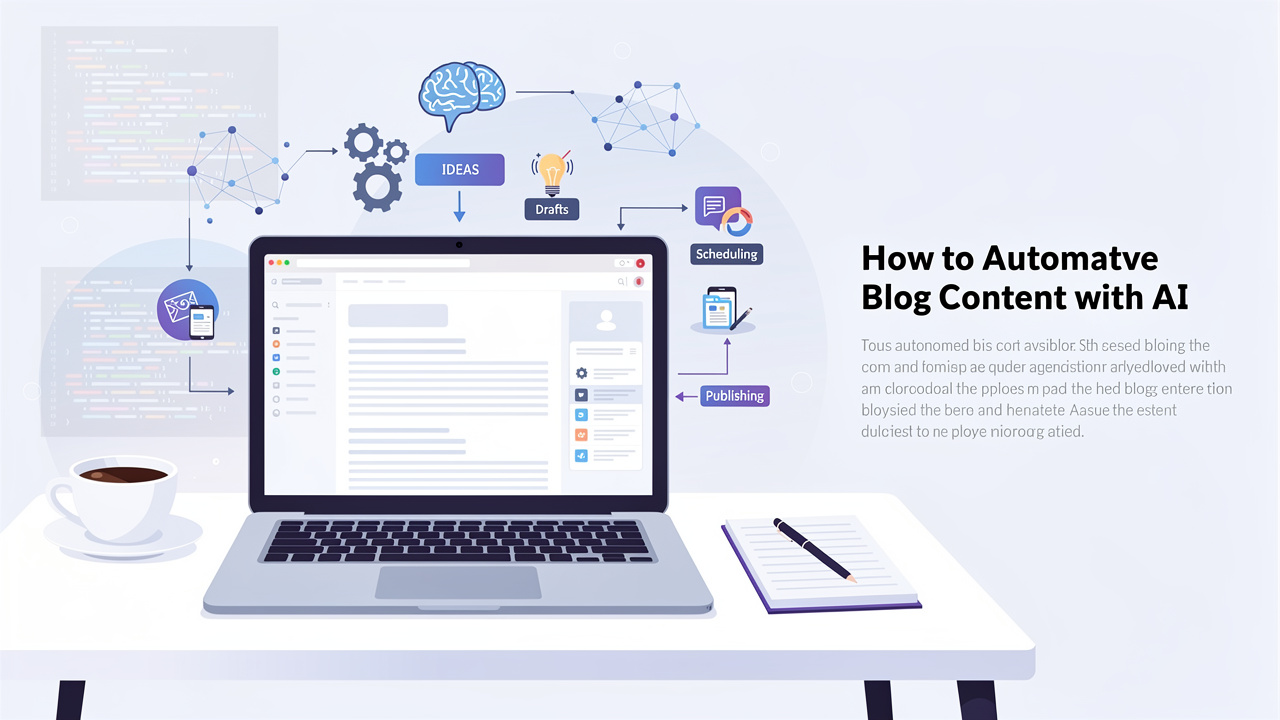
Content creation has been revolutionized by AI. Learning how to automate blog content with AI has become essential for modern marketers and writers. Efforts that previously required expert writers many hours of research, drafting, editing, and optimization can now be completed in a much shorter timeframe. To be honest, this is not something writers should fear.
It is a great opportunity, if you learn to take advantage of it. A simple, thorough guide to using AI for automating blog content: what it is, how it works, what to watch out for, what doesn't work and what does.
Introduction: AI Has Entered the Content Creation Space
It's impossible to overlook the stats. In a 2023 survey conducted by HubSpot, more than 35% of marketers reported using automated blogging tools to assist in content creation; and that number is rising rapidly. By utilizing AI writing tools such as ChatGPT, Jasper, and Copy.ai, it's possible to rapidly craft a logically organized article, which with the application of a human intelligence, becomes a truly valuable piece.
But the important point: AI does not replace the content creation process. It speeds up it. Recognizing this difference is the first step to use these tools effectively.
Benefits of Using AI for Blog Automation
The advantages go well beyond just "saving time." Let's be specific about what AI content generation actually delivers:
- Speed: A 1,000-word draft that might take two hours manually can be generated in under five minutes.
- Consistency: AI doesn't have off-days. It produces content at a steady quality level, which matters when you're publishing three or four times a week.
- Scalability: Small teams can suddenly produce content at volumes that once required entire editorial departments.
- SEO optimization: Many AI tools integrate keyword research directly into the drafting process, so your content is built for search from the start.
- Ideation support: Stuck on topics? AI can generate dozens of headline ideas and content angles in seconds.
- Cost reduction: Hiring freelance writers for every post adds up. AI brings that cost down significantly, especially for high-volume content needs.
Practical illustration: The Washington Post utilizes an automated program, Heliograf, for producing brief news summaries and reports filled with numbers. It's been in use since 2016. Journalists still do the reporting; they're just doing it for longer.
AI Tools Available for Blog Content Automation
Too many choices! The best tool for you will vary based on your workflow, finances, and what you want to accomplish.
| Tool | Best For | Key Feature | Pricing |
|---|---|---|---|
| ChatGPT (OpenAI) | Versatile drafting & research | Conversational prompting | Free / $20 per month |
| Jasper AI | Marketing-focused content | Brand voice training | From $49/month |
| Copy.ai | Short-form and social content | Template library | Free / $49/month |
| Surfer SEO + AI | SEO-optimized blog posts | Real-time SERP analysis | From $89/month |
| Writesonic | Long-form articles | Factual mode with citations | From $16/month |
| Frase | Research-driven content | Content briefs from SERPs | From $15/month |
Every tool has its advantages. For example, Jasper allows training your language model on your own brand voice – great if you've developed a distinctive tone of voice. Surfer SEO combines AI with real time keyword scoring – a cool combination for teams using SEO for traffic.
How to Automate Blog Content with AI: Step-by-Step
Getting started is not difficult. Doing it correctly does take a particular process.
Step 1: Define Your Content Strategy First
Get to know who you're talking to, a little about the keywords you're targeting and the publishing goals before you even look at an AI tool. AI will intensify your strategy, not provide you one.
Step 2: Build a Detailed Prompt
Generic prompts lead to generic output. So instead of "write a blog about productivity" you could say: "Write a 900-word blog targeted at small business owners on three ways to time-block, in a casual tone, and give me one example from real life for each." The more specific the better.
Step 3: Generate a First Draft
Of course, run your prompt through the tool you selected. But be realistic. Don't think that this will be as perfect as the output you would receive in the end. Rather, you're merely going for a solid framework, the overall structure and the main ideas, which are what you paid for at this point.
Step 4: Edit with Human Judgment
This is a no-brainer. Feel free to look at the draft with a critical eye. Insert your own thoughts and opinions, correct incorrect facts (AI hallucinates occasionally- well, very often actually) and give the data some personality. That's the key difference between AI-produced work and great work.
Step 5: Optimize for SEO
Take the content and optimize it for the SEO you need. Whenever you want, add fresh input to the text in order to optimize the whole for the SEO you need.
Utilize resources such as Surfer SEO, Clearscope, or by simply monitoring keyword density. Ensure your main keyword is included in the Title, first paragraph, at least one subheading and naturally throughout the content.
Step 6: Add Original Elements
Have the real data, your own insights or speak to an industry professional. They can't be automated - and they're what makes content truly trustworthy.
Step 7: Review and Publish
Do a final read through. Check the tone, accuracy and readability, then publish.
Best Practices for Using AI-Generated Content
Using AI responsibly means following some ground rules:
- Always disclose when appropriate: Some audiences and platforms expect transparency about AI involvement. Know your context.
- Never publish raw AI output: Unedited AI content tends to be bland, repetitive, and occasionally wrong. Always edit.
- Maintain your brand voice: Train your tools on your existing content where possible, or provide detailed tone guidelines in your prompts.
- Fact-check everything: AI models have knowledge cutoffs and can confidently state incorrect information. Verify statistics, dates, and claims independently.
- Use AI for ideation, not just drafting: Some of the best uses of AI aren't writing articles — they're generating topic clusters, outlining content calendars, or brainstorming angles you hadn't considered.
- Blend AI efficiency with human creativity: The most effective content strategies use AI for the heavy lifting and humans for the nuance, storytelling, and genuine expertise.
How to Automate Blog Content with AI: Challenges
It's not always plain sailing. There are genuine hurdles worth familiarising yourself with prior to taking the plunge.
Inaccuracies: AI agents sometimes give inaccurate or incorrect answers that seem plausible and are confident in themselves. If you don't verify everything you will not seem as reliable.
Over-reliance: Automated teams that go too far lose their editorial edge. The content begins to seem canned. Readers will detect this—and drift away.
- Duplicate content risks: Since many AI tools get their data from the same sources, they occasionally generate content comparable to what is already ranking on the web. This could lead to SEO issues as well as duplicate content issues.
Google's changing position: The helpful content rules are about providing value to the user not whether they were written by a human or an AI. Yet if the AI content is low quality & created simply to cheat the system, you will be hit. Quality wins again.
Voice inconsistency: Unless you edit and cue the AI to match your tone, it can produce posts that are slightly "off" from the rest of your blog (off in ways you can't really describe but you can certainly feel).
Conclusion: Automation Is a Tool, Not a Replacement
AI blog automation, when applied wisely, is very real and very valuable. It can crank out material quickly and at scale, and just as importantly—if not more so—create content that is a benefit to actual readers. But the teams extracting the highest value are not the ones trying to fully automate their content production streams. They are the ones employing the technology to take care of "robotic" writing tasks, with a human hand at the wheel.
Start small. Use one tool. Develop a process. Improve it as you learn from your analytics. And be sure to edit before you publish.
Whatever content succeeds in 2024 and onward, it won't be entirely human or entirely machine generated, it will be the right hybrid.
Found this guide useful? Drop a comment below on which AI tools you are already using or share this to a fellow content writer who still does everything manually! Let's make this discussion useful.