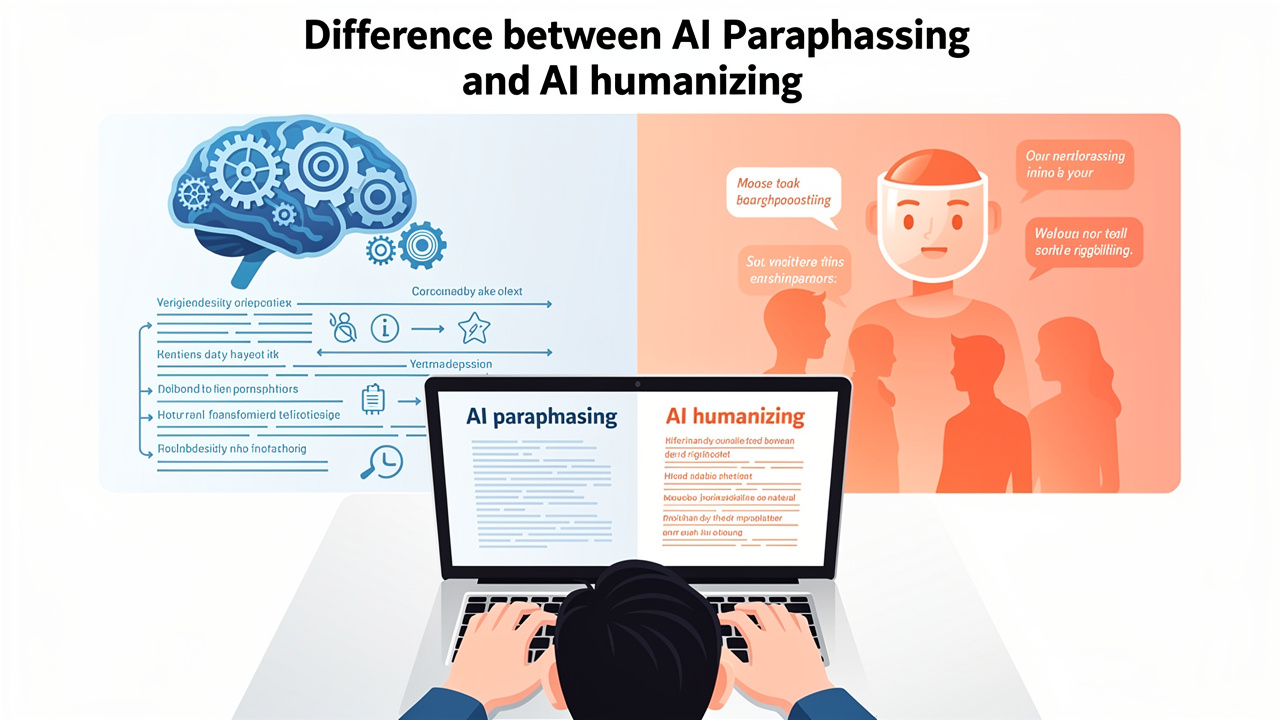
Two technologies are quietly reshaping how we write, communicate, and produce content at scale - and most people use the terms interchangeably when they really shouldn't. Understanding what is the difference between ai paraphrasing and ai humanizing isn't just academic; it's practically useful for anyone who works with written content professionally.
AI paraphrasing and AI humanizing are distinct tools with different purposes, different strengths, and very different outcomes. These AI paraphrasing techniques and AI language humanization methods serve unique roles in modern content creation.
Understanding the gap between them isn't just academic; it's practically useful for anyone who works with written content professionally.
--- ## Defining AI Paraphrasing
AI paraphrasing is the process of using machine learning models to restate existing text in different words while preserving the original meaning.
Think of it as automated rewording - the core idea stays intact, but the sentence structure, vocabulary, and phrasing shift.
These tools work by analyzing semantic meaning at a sentence or paragraph level, then generating alternative expressions using synonym substitution, sentence restructuring, and syntactic variation.
Most paraphrasing tools are trained on massive text corpora, which lets them draw from a wide vocabulary pool to produce varied output quickly.
Common applications include: - Academic writing assistance - students restate sources to avoid direct quotation - SEO content scaling - marketers create multiple versions of product descriptions or landing pages - Translation support - paraphrasing smooths awkward phrasing after machine translation - Legal and technical documentation - simplifying dense language for general audiences The goal is essentially structural transformation without meaning loss.
The content's substance stays the same; only its surface changes.
--- ## Defining AI Humanizing
AI humanizing is something quite different.
It's the process of transforming text that reads as robotic, flat, or mechanically generated into something that feels authentically written by a person.
Where paraphrasing changes how something is said, humanizing changes how it feels to read.
Humanizing tools analyze patterns that distinguish AI-generated text from human writing - things like repetitive sentence rhythm, overuse of transition phrases, lack of personality, or absence of natural imperfection - and then adjust the text to introduce variation, warmth, and voice.
Here's the thing: AI-generated content, even when factually accurate, often has a kind of sterile quality.
It's correct but lifeless.
Humanizing tools try to fix that by injecting colloquial language, varying sentence cadence, adding subtle rhetorical touches, and sometimes even introducing the kind of minor inconsistencies that signal genuine human thought.
Applications span a wide range: - Content marketing - making AI-drafted blog posts feel more personal and engaging - Email campaigns - ensuring automated outreach doesn't read like a form letter - Customer service scripts - giving chatbot responses a warmer, more conversational tone - Educational materials - adapting AI-generated explanations to sound like a real teacher talking The goal is tonal and stylistic transformation - not changing what the content says, but fundamentally changing how it connects with a reader.
--- ## Advantages of Each Approach
Both methods offer real value, but for very different reasons.
AI paraphrasing excels at: - Speed.
Rewriting large volumes of text manually takes hours; paraphrasing tools do it in seconds.
- Consistency.
The original meaning is preserved reliably across multiple rewrites.
- Plagiarism reduction.
Content teams can produce varied output from a single source without duplication.
- Accessibility.
Complex jargon can be reworded for broader audiences without losing accuracy.
AI humanizing excels at: - Engagement.
Text that sounds human holds attention longer - people don't disengage from writing that feels alive.
- Brand voice.
Humanizing tools can be tuned to reflect a specific tone, whether that's casual and warm or professional and authoritative.
- Trust-building.
Readers are increasingly skeptical of AI content; humanized writing reduces that friction.
- Emotional resonance.
A humanized piece can actually make someone feel something, which paraphrased content rarely achieves on its own.
--- ## Real-World Use Cases Across Industries
Marketing
Marketing teams use AI paraphrasing constantly for A/B testing.
They'll take a single product description and generate five variations to test which phrasing drives more clicks.
It's efficient and practical.
But humanizing is arguably more valuable in marketing's creative layer - the brand storytelling, the email subject lines, the social captions.
Customers don't respond to technically correct; they respond to genuinely interesting.
A humanized email campaign from a skincare brand, for instance, might read like advice from a knowledgeable friend rather than a polished press release.
That distinction drives conversions.
Education
In education, paraphrasing tools help teachers simplify textbook passages for different reading levels or help curriculum developers adapt content across grade levels quickly.
That's legitimate and useful.
Humanizing, though, plays a different role.
AI-generated lesson explanations can feel impersonal - almost clinical.
Humanizing those explanations makes them feel like they're coming from an actual educator who cares whether students understand.
For online learning platforms especially, that sense of human presence matters quite a bit.
Content Creation
Freelance writers and content agencies often use paraphrasing to speed up research summarization or to rework client briefs into draft content.
It's a productivity tool, basically - not a replacement for thinking, but a way to reduce the mechanical parts of writing.
Humanizing fits into the editing phase.
A writer might generate a first draft with an AI tool, then run it through a humanizing pass before publishing.
The result is content that's efficient to produce but doesn't betray its origins in how it reads.
Many professional content creators now treat humanizing as a standard step in their workflow, much like spell-checking.
--- ## Impact on Communication and Content Quality
These technologies are changing what "good writing" means in practice.
Paraphrasing tools have made content production faster and cheaper - but they've also contributed to a certain sameness across the web, where articles cover identical topics with slightly different phrasing but no distinct perspective.
Humanizing tools push back against that trend, at least partially.
They can't manufacture genuine ideas or original insight, but they can make existing content more readable, more engaging, and more distinctly voiced.
That's not nothing.
The risk, of course, is over-reliance.
Paraphrasing without editorial judgment produces accurate but hollow content.
Humanizing without accuracy leads to feel-good but potentially misleading content. As with all AI-driven writing tools, both tools function best as assistants, not substitutes, for your own thinking.
AI Paraphrasing vs AI Humanizing Usage
This guidance is practical and actionable:
Use AI Paraphrasing when: - You require various versions of the same factual information rapidly (product descriptions, FAQs, meta descriptions) - You are rephrasing technical jargon into clear, easy-to-understand terms for non-experts - You need to create a summary or digest of a source material (for a first draft, for instance) - You must ensure a high degree of accuracy, but the unique tone or voice of the original content isn't the main priority
Use AI Humanizing when: - The original writing is monotone and has the unmistakable, flat cadence of a bot-written text - Your writing style or brand needs to convey a more personal or unique personality, tone, and voice - The goals of the content involve creating emotional engagement, connecting with your audience, telling a story, or persuade them - You are writing for audiences who are somewhat wary of AI-generated material
Use Both Together when: - You used a paraphrasing tool to simplify your source material and are ready to refine it to align with your voice - You are working at a high scale but need your content to still sound naturally human and reflect your established brand tone - You are producing competitive content and are equally concerned with accuracy, engagement, and the feel of your writing
Conclusion
AI paraphrasing and AI humanizing are not mutually exclusive technologies - quite the opposite, in fact. The two tools can complement one another across the writing process.
Paraphrasing works on the structural level, changing the wording, simplifying complex concepts, and presenting variations. Humanizing addresses the interpersonal dimension, working to build connection, encourage engagement, and create resonance with your reader. The most effective writers and content teams are able to take advantage of both tools by understanding precisely what each one does best, and by always injecting their own judgment, unique voice, and perspectives.
A piece of technology may change the words. A human writer alone can determine whether the sentence deserves to be in the world at all.