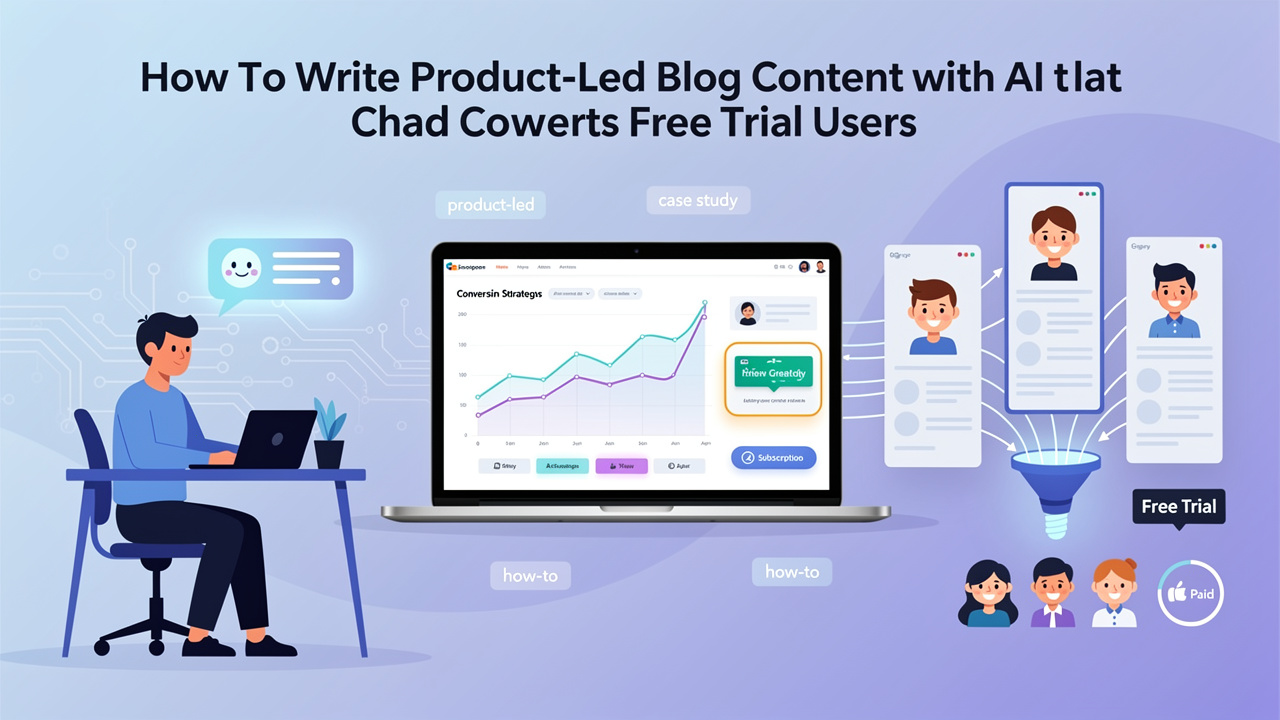
Converting free trial users into customers is one of the hardest problems in SaaS. Learning how to write product-led blog content with AI that converts SaaS free trial users can transform your conversion rates dramatically.
The hard part is already out of the way - getting someone to sign up.
But between "free" and "paid," you lose them.
Product-led content is one of the most underutilized tools to help close that gap, and in combination with AI-guided writing and intelligent SEO, the product-led content can be truly extraordinary.
What Product-Led Content Actually Means
Product-led content is much more than blogs and articles referencing your product.
That's an important distinction, albeit quite subtle.
Content that is product led solves a known pain for the reader, and have your product naturally show up as the solution—just not in a sales-y way, more "oh, here is how you'd actually use it".
Imagine how Ahrefs always creates comprehensive SEO tutorials with all of the screenshots ending up being from their tool.
Or how Notion's blog features productivity systems that, just happen to, work a treat in Notion.
It's not rammed into your face.
That's just...
Yet there.
Getting the job done.
Demonstrating its usefulness.
That's exactly the kind of model service we need to be copying.
Identify Pain Points Before Writing Content
Identify what pain points your free trial users are having before you write a single word. All of your free trial users' pain points.
This is a must.
Content that does not address the real pain point is content that gets completely overlooked.
The best approach to uncover those pain points are:
- In-app behavior data - Determine the locations where users tends to leave the app during onboarding.
If 40% of your trial usage is keeping the user from configuring their very first integration, that's a content opportunity.
- Support ticket analysis - Your customer support inbox is basically a pain points mine.
Go over the ticket raised from the trial user(s) Initially, of course, read through the tickets of trial users.
-
Exit questionnaires - One easy question survey on cancellations or trial-gone-stale can uncover patterns you wouldn't believe.
-
User interviews - Conducting as few as 5 twenty-minute user interviews a month can make a huge difference in honing your content plan
-
Find your products category on Reddit or Quora - Community forums and reddits.
People are about as sharp as a marble.
The objective would be to map the content topics as one-to-one correspondings with all friction points in the trial experience.
If users are still asking for "how do I connect X to Y"; write the go-to guide on how it works and demonstrate your product doing it.
How AI Content Generation Creates Tailored Content
AI tools such as ChatGPT, Claude and Jasper have made a real difference in increasing the speed of content team's output. AI content generation for SaaS has revolutionized how teams approach converting trial users to customers.
What I'm trying to say is - the quality of the output depends entirely on the quality of the input.
Empty heading tags generate bland content that will not garner any conversions.
Smart Utilize AI for Product Lead Content: Would go something like that:
- Use your AI tool to analyze customer language
Provide your AI tool with a set of support tickets, G2 reviews, or transcription of interviews with users and have it find common themes, complaints, and needs.
What your potential customers are saying about the problem is exactly what should be in your headline and on your first page of your website.
- Create content maps specific to different user segments
A free trial user on day 2 has very different concerns than someone on day 12 that has used three features and become dormant.
Query the AI to produce different outlines at each point of the trial journey.
So this sort of targeted content - delivered through email, in-app messages or click-to-read blog post - comes across very personal indeed for not very many people.
- Create feature-based content at scale
Have a dozen+ product features which each need that "better utilization" post? Let AI write those rapidly.
What is your job then? Well your job is now editing for accuracy or adding actual screenshots or putting the exact use cases that your customers care about.
- Rewrite optimized content for conversions
Take an old blog post, and input it into your AI. Have it identify places where you might add a product focused example, a call to action, a better example, etc.
It's also quite a good method to bring existing content that receives already traffic an additional fresh injection.
What High Converting Product-Led Posts Look Like
The highest converting product led content has some common structural elements.
Let's deconstruct these:
Problem-first framing - start with the pain, not the product.
"How to prevent forgetting client feedback" is more interesting than "How to use [Your Product] for client management."
There are also best practices for especially engaging articles:
Embedded product walkthroughs - Screenshots, quick GIFs, or embedded videos.
All non-abstract descriptions.
Actual visuals.
Number specific outcomes - "Reduced reporting time from 3 hours to 20 minutes" is way better than just winning the "saving time on reporting" argument.
Contextual CTAs - A call-to-action immediately after you offer value converts better than a banner repeated at the bottom.
For example, if you've just taught a user how to automate a workflow, this is the right time to encourage them to "start your free trial" or "upgrade to unlock automation".
Live examples - Canva blog does a good job of this.
Their design principles blog entries always show before/after comparisons created with Canva.
The product makes the point—without saying it.
Product-Led Content SEO Best Practices
Good product-led content must also be findable.
Here's how to make sure your posts rank:
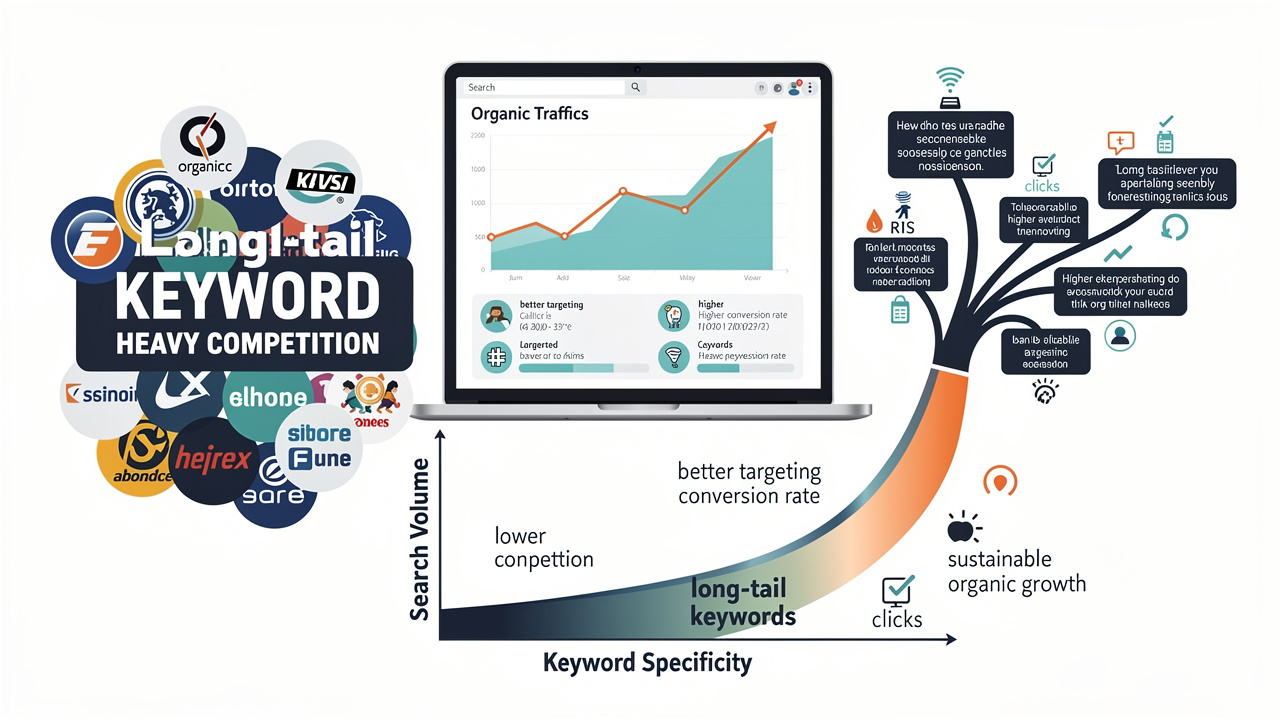
- Build longtail keywords with intention, like "automating client onboarding for agencies" tells a lot of how problem and user intent
- Use your keyword in the H1, in the first 100 words on page and in one of the subheadings
- Optimize your meta descriptions to play up what the visitor is going to get out of the post
- Create topical clusters of product-led posts with internal links
- Use schema markup on how-tos. It improves clickthrough rates in search
- Keep your page load lightning fast, including loading fast - trial users who click from Google and wait 5 seconds are gone.
Tracking Conversion Metrics That Matter
So, you've written your great content.
You must be aware if it is functioning.
Specifically for product-led content, the following metrics are valuable to track:
| Metric | What It Tells You |
|---|---|
| Trial-to-paid conversion rate, by content touchpoint | What posts are actually resulting in upgrades |
| Time-on-page, for trial users vs. general visitors | Whether your audience is engaged in-depth |
| Feature adoption after reading feature content | Did reading about a feature itself translate to adoption? |
| In-app event completion after blog post reading | Are customers reading blogs and then taking the next step? |
| Email clickthrough rates (from content-driven nurture sequences) | How well your content translates to an email channel |
Use tools like Mixpanel and Amplitude (even just your GA4 id with proper event setup) to link content viewing to downstream product activity.
Set this up early - attribution gets tricky pretty quickly if you leave it too late.
Building a Sustainable Content Engine
One great blog post isn't going to change your trial conversion rate.
It is built by consistently delivering content they have planned so that they get to see it over the whole trial journey - from first login jitters to their realization that they really cannot do their job the same way anymore without you.
Create a content calendar where particular posts are associated with particular trial phases.
Utilize AI to speed up production as efficiently as possible.
Get measured obsessively, and go all-in on what works.
The free trial period is pretty much a flirtation.
What you have with your content is the dialogue that begins to have the reader think "alright, now I am genuinely interested to see what happens."
Nail that dialogue and you'll naturally get the conversion.