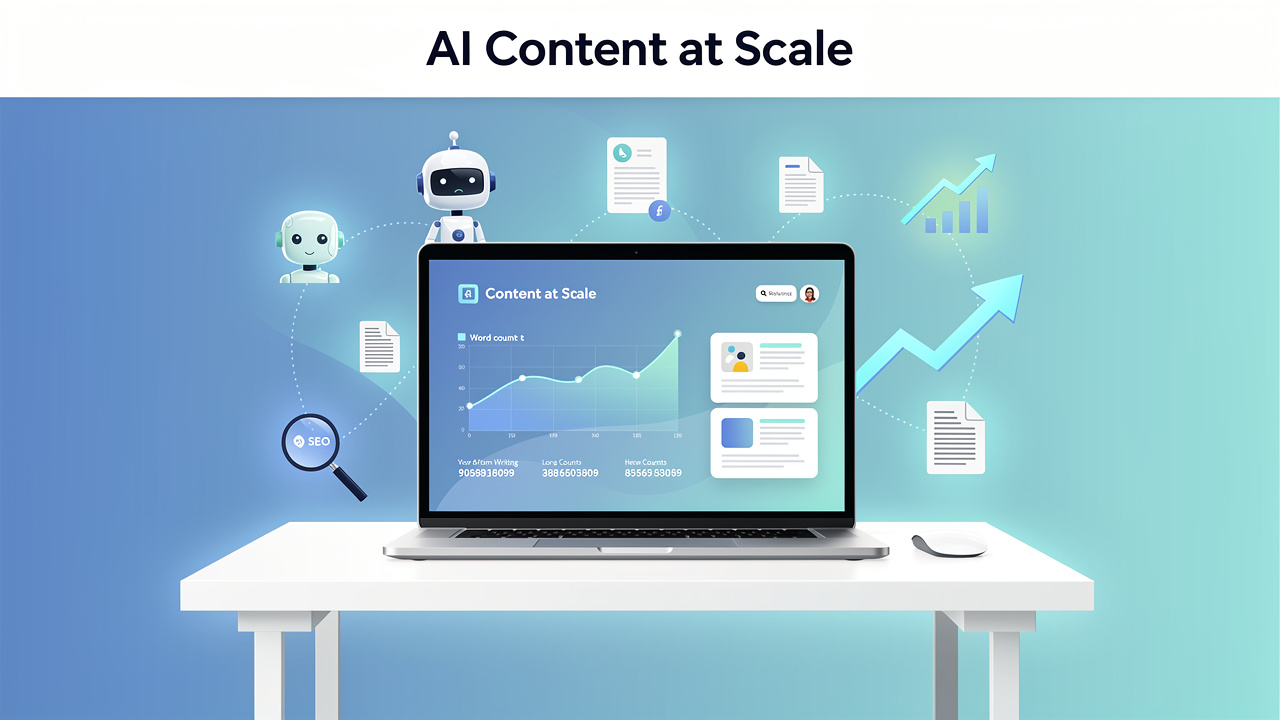
AI tools for large scale content creation In modern marketing, content creation is a major bottleneck. Every business marketer has faced a similar situation where there are multiple ongoing campaigns in progress: blogs, e-books, website content, social media updates, and a ton of email blasts all compete for writers' time. In this environment, large scale content creation software helps businesses. these Tools are more than just plain text; advanced AI writing software, large models (LLMs) generate high-quality contextual content that is also SEO optimized and tailored to the specific needs and voice of the business.
Here, we explain the process of how these tools work and how to maximize their potential. What it means to generate large scale content The idea of Large scale content creation may seem abstract, but simply put it means producing high quality content in large quantities without significant increases in cost, personnel, or duration. In other words, while traditional content teams might generate and publish 8 to 10 blog articles per month, these tools make it possible to generate over 50 to 100 articles a month with consistency in quality, accuracy, and brand voice. these are software leverage on the power of Natural Language Processing (NLP), transformer-based artificial intelligence and sometimes utilize real-time web research capabilities. the leading AI content generation tools A number of programs have proven useful for content generation at scale in organizations, each with unique features and advantages:
- The Content at Scale Platform - This AI tool is designed to produce full-length, long-form, keyword-optimized blog posts and articles. it produces 2,000+ word articles based on just a keyword, or even a YouTube video link, podcast, or an existing URL, complete with meta-descriptions, headings and the ability to by-pass AI detection (important for brands that want their content to look human generated.)
- Jasper - A well-known brand name.
This AI platform comes with several customizable templates and “campaigns,” guiding users to produce consistent marketing collateral such as e-books, social media, social, email campaigns and landing pages. it connects directly to Semrush and Surfer for up-to-date optimization features. the software is especially effective thanks to the useful "brand voice" feature that will learn your tone through samples of previous written text. 3. Copy.ai - In recent years, they have transitioned from primarily providing tools for short content pieces to a longer form creation process. Workflows allow teams to produce automated content in mass-e.g., an online shop that automatically creates product descriptions from product data from a spreadsheet for hundreds or thousands of unique SKUs. 4. Writesonic - Writesonic allows marketers to instantly create accurate, fact-based content using the live information extracted from the internet through its “Chatsonic” functionality; thereby, keeping your content up-to-date and relevant. It is ideal for quickly creating new content related to events or changing industry landscape. 5. Surfer SEO + AI - While not as a dedicated tool for text generation, it complements Surfer SEO features to write SEO friendly content that is constantly tested in terms of competitiveness with similar content in Search.
Success stories in business You don’t have to just rely on theory! Some companies have shared remarkable results of their operations with AI content platforms, such as Bankrate, a leading financial publication that reduced writing times on product comparison articles, allowing more resources to be dedicated to creating expert, analytical content that require deep human expertise. Also an E-commerce store that uses copy-generating technology to churn out product descriptions, to reduce cost of a copying team with more effective, higher volume descriptions, and it also has a boost in sales conversion rates.
A leading SEO agency was able to multiply their output significantly, delivering more SEO optimized content with fewer team members than they used to. How to get the most out of AI content platforms?
Relying solely on artificial intelligence to automate your writing without proper management may have a detrimental impact on the quality of the content. Some suggestions: 1) “Train” the AI: Customize the platform with examples of your existing copy. the best, optimized content you already publish. 2. Utilize as First-draft generation: Let the AI do the initial writing but edit it carefully with a human touch to improve factual accuracy and stylistic expression. 3. Combine with SEO data: Ensure that your AI content software integrates seamlessly with an SEO platform, so that the content produced by it has strategic meaning from the start. 4. Optimize Workflow efficiency: Use content at scale when producing similar kinds of content in large volumes, such as hundred’s of Product descriptions, an FAQ pages section, etc. this makes the automation process smoother. 5. Audit often: Have a regular schedule, e.g. a quarterly content audit, where you check AI content to make sure it matches with business’ and brand’s needs over time. What are the Challenges and considerations of Large scale content creation AI tools have become an essential tool for content marketers in all industries.
Nevertheless, challenges do exist, mainly related to accuracy and originality. False data and facts are major concern with LLMs and hence factual accuracy cannot be ignored. Quality and consistent brand identity may decrease when relying on the same set of templates to produce content in volume across the entire industry, leading to its saturation in online space.
The ones who win are the brands willing to inject real subject matter expertise, novel insights, and a unique point of view - all of which AI just can’t manufacture yet. #AI detection We’re already seeing the emergence of AI detection from various publishers, search engines, and even academic circles. This may or may not matter depending on your specific environment, but it’s the current state of things. # Overreliance The truth is, it’s going to be really easy to rely too much on these tools. We will, of course, see a decline in human writing expertise - some brands will go even further, eliminating writers completely, potentially to their detriment down the line as the value and strategic advantage of human skills shifts.
The Future of AI in Content Development AI content tools will get better. That's the only real constant, and we know for a fact that multimodal AI is coming, further blurring the lines between different content formats. You’ll also be seeing tools become more sophisticated at real-time content customization.
The real competitive advantage, however, won't be having an AI tool; in a few years, nearly everyone will. It will be having the strategy to use these tools effectively: knowing what to automate, what to defend as human written, and how to ensure an authentic and distinctive editorial voice at massive scale. The businesses who excel in the future will be those that leverage AI as infrastructure - essential, powerful, but ultimately enabling human strategy.
If you're not starting to integrate these tools intentionally now, you'll be scrambling to catch up later. The content production bottleneck is solvable. The tools exist. The question is whether your team has the strategy to leverage them well.