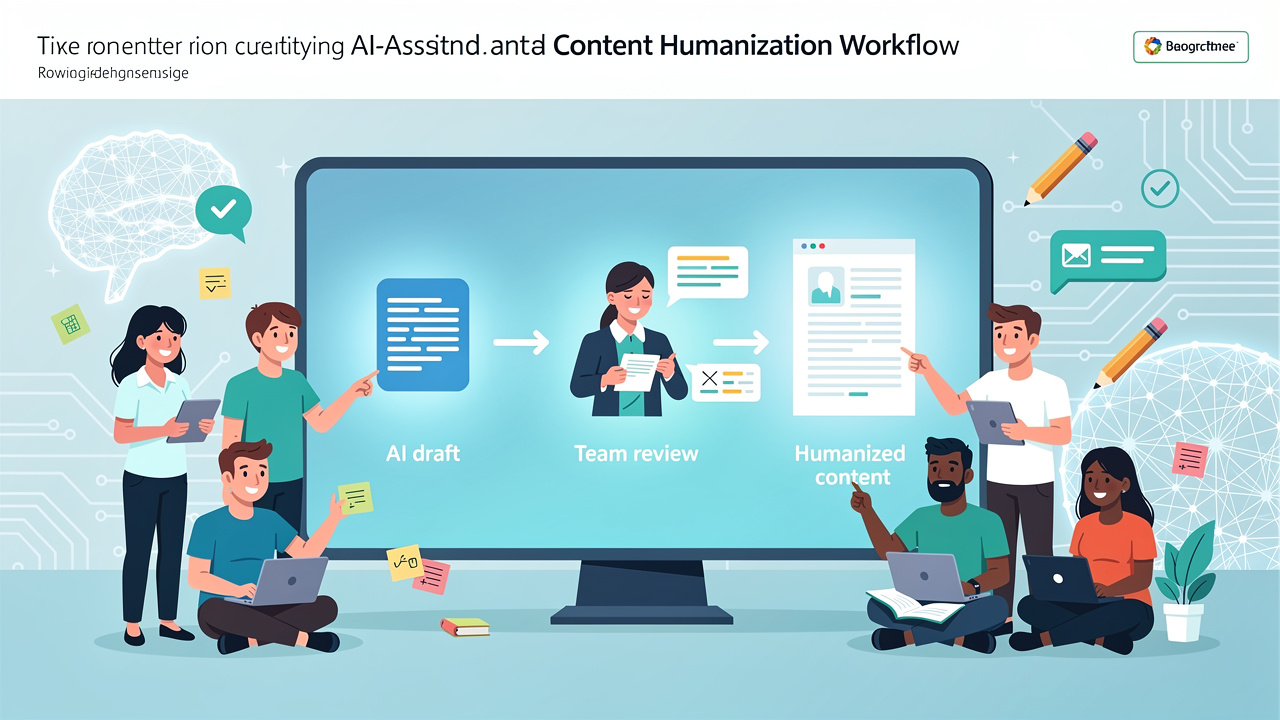
All content teams are dealing with the same internal tension: While AI can generate copy at astonishingly high speed, that copy quite often also reads like it was crafted by a complete novice. The AI content humanization workflow for content teams addresses this challenge by transforming raw AI output into engaging, human-like content.
Flat.
Generic.
Using words so safe they're impossible to remember.
AI content humanization helps, to be sure, but it's a process that involves taking all that raw AI-generated copy and transforming it—through editorial choices, tonality, and 'human flavor'—so it resonates with the reader.
And really connects.
This isn't strictly about cleaning up awkward language.
It's about creating a sense of genuine personality in the content through AI-driven content strategies that prioritize authentic human connection.
What Is AI Content Humanization and Why Do We Need It?
AI content humanization describes the editor-supplied creative phase of AI content production by which raw natural-language output is elevated to contain voice, emotional connection, and editing intelligence.
It doesn't need to be and shouldn't be claiming to be removing an AI voice in the final draft—instead, it needs to sound like a human writer who 'gets' their audience.
Note: People can smell synthetic copy from a mile off.
Repetitive structure, generalities, lifeless formatting will turn a reader off instantly.
And on the other hand, if your entire content proposition is based on meaningful, personalized outreach, that will be major.
Content that sounds human (or humanized by way of human editing) makes scaling easy.
Content that sounds robotic makes scaling harder.
AI Content Humanization Workflow for Content Teams
Implementing a process to humanize AI copy requires specific steps on the part of the content team:
Step 1—Establish a Clear Brand Voice Before You Work with AI
Your writers and content team should produce a style guide with voice descriptions, example phrases, voice-unique language, and sample texts.
Remember that GPT-4 or even ChatGPT can emulate a voice—if they receive enough direction.
How detailed your instructions are for the bot directly impacts its output.
Vague prompts get flat output.
Step 2—Reduce burdens for AI, leave the decision-making to humans
Use AI to guide research, outline, or initial copy generation.
Use tools like Jasper, Copy.ai, or GPT-4-integrated chat for this.
But your team needs to decide what's important for each piece: the story angle, inclusion or exclusion of data, the emphasis on human connection.
Trust me: The human detail matters.
Step 3—Perform a Humanize to Read-Prompts Loop
Here you take the output produced in Step 2 and send it through to a human editor to:
- Hardly vary sentence rhythm and transitions between arpeggios
- Next, replace generic statements with specific individual items or examples
- Substitute first-person brand-focused language for any absent first-person framing
- Ensure emotional connection and human attention to the audience
- Still, double-check for hallucinated facts or statistics
Step 4—Use Plagiarism & Detection Tools to Diagnose, Not to Dismiss
Run the copy through tools like Originality.ai or Copyleaks.
These can tell you if AI is likely responsible for the writing and therefore might seem less friendly or robotic, but don't rely on AI to then 'approve' your work.
Step 5—Have a human (or animal) read it before publish
Ask a human, ideally one who didn't draft or edit it, to read it cold and tell you if it rings true: 'Does this sound human? Does this sound worth reading as a human writer?'
Sometimes your gut feels the lesson.
Real-World Success Stories from Teams Who Get It
**
- : The HubSpot Content Team**
HubSpot has been transparent about their AI-integrated content strategy.
Their workflow involves generating first drafts on copy or research with AI—then having their writers add specific, modern, real-world examples and broker upgraded data and statistical context.
The results? Shorter cycles, higher quality, no 'templated' look and feel.
** 2. : A SaaS team of five writers**
Every week, this team generates content for their blog.
While they initially struggled with generic tone and oftentimes subscriber dropout, they adapted by having their writers add personal stories or recent real-life examples, thus humanizing AI drafts.
That action alone boosted engagement within a couple of months.
They saw an up: more time-on-page, better open rates.
The important point here is: Incrementally humanizing step-by-step creates ongoing benefits through human-like content creation processes.
Common Challenges and Solutions
When adopting AI in your writing team, expect to face challenges, but here's how to tackle them:
**
- : Fear of Editors Usurping a role**
No need to pretend AI-generated drafts aren't a disruptive, hard truth.
Share with your team that human editors aren't losing their roles—we're giving them the higher skill.
Higher order, but still the good stuff.
** 2. : Ensuring AI writing appears consistent**
Across sessions with the AI--mostly ChatGPT and GPT 4-you'll find that tone variations are all over the map.
The trick to consistency: detailed prompt templates in a resource repository.
You'll see: you get the same tone (or close enough).
** 3. : Detecting and controlling for verifiable accuracy**
AI just makes stuff up.
Verifying figures, source, claims, and evidence has to become part of your fold.
Build it in, me, it's not up to debate—the human verification machine.
Eat possible and not in a question—build it in too.
- Best practices to consider integrating into your content workflows: let your team start every session with predefined prompts, avoid trying to get more work done unless output is accurate, freshly confirm every statement with trusted sources, adopt the 'human moment checklist' (example personal anecdote, specific fact, timely opinion, reader touchstone), how to intro your AI work to your team: manage expectations, make sure people understand this is a process not a machine, journal and remember the wins.
A few trends do seem worth watching more closely:
Multimodal AI integration - tools are beginning to integrate text, image, and audio synthesis. Content teams will need humanization workflows that stretch further than copy to visual tone and brand consistency across formats.
Personalization at scale - AI will begin to improve at creating variations of audience segment-specific content.
The humanization task will no longer be "does this sound human" but "does this sound human to this reader?" An editorial challenge more subtle.
AI voice cloning & branded models - Some larger content teams are already training their own AI models on their published effectively creating a "custom voice". This lower the humanization burden significantly - but requires a sizable corpus of well-written human content to achieve it.
A good reason to start investing in quality publishing now.
Regulation & disclosure requirements - Expect increased requirements for disclosure of AI origins to become commonplace as more platforms and regulators demand greater transparency. Those teams who craft authentic humanization strategies will be in a stronger position to comply with those requirements without sacrificing trust.
Conclusion
Humanizing AI content is not a bandaid or a compromise - it is a new skill to master. Content teams who treat it seriously, develop deep workflows around it, and elevate and entrust genuine human editorial judgment will outproduce teams leaning on either all-AI or all-human approaches.
The AI is extraordinary.
The human is essential.
Combine the two, and most teams will find they are producing content most couldn't even dream of through effective AI-driven content strategies and human-like content creation processes.