One of the many new realities of content creation is the millions of articles released daily across the web from AI. Understanding what is burstiness and perplexity in ai content and why it matters for seo has become crucial for modern content creators and marketers.
There are millions of articles, product descriptions and blog content which are now written - at least in part - by language models through AI content generation processes.
And although it's incredible in terms of productivity, we've got a serious problem: a lot of the text sounds flat, monotonous, and strangely monotone.
This is where burstiness and perplexity are relevant.
These two ideas are key to understanding the difference between the content that people want to read and what they abandon after noticing the first couple of lines.
Having a grasp over them isn't an academic act.
These ideas translate into very tangible, real-world effects for content creators, marketers, SEO designers when it comes to rankings, conversions, and whether people actually believe a single word they read.
What is Perplexity in AI Content?
How easy is it to predict your content? Perplexity refers to the predictability of a sequence of words.
A high perplexity implies that the text is more complex to predict, it contains more information to understand and more surprises.
If we see that the text (or the model) has a low perplexity, then it is very predictable.
It's easier to think of it like this: if all sentences conform to an obvious formula and every choice of word is the most conservative choice there is, the perplexity goes down.
Here's a tangible instance.
Compare these two sentences: - »Low perplexity: Content marketing is important for any company looking to enhance its online public profile.« - »Higher perplexity: A well-placed story can do more for your brand than a hundred keyword-stuffed paragraphs ever will." The second one is less predictable.
It is based on a simile, a very clear image, and a structure which is not entirely expected.
Higher perplexity - often more interesting.
In terms of SEO content strategy this is important as search engines are getting smarter and smarter.
Google's algorithms, especially following updates such as Helpful Content and the implementation of machine learning, as seen with MUM and BERT, have become significantly more effective at identifying content that is accurate in a technical sense but vacuous intellectually.
Content with low perplexity is perceived to be artificial to the point where it feels like something such as plagiarism.
And generic content lacks authority.
Understanding Burstiness in AI Writing
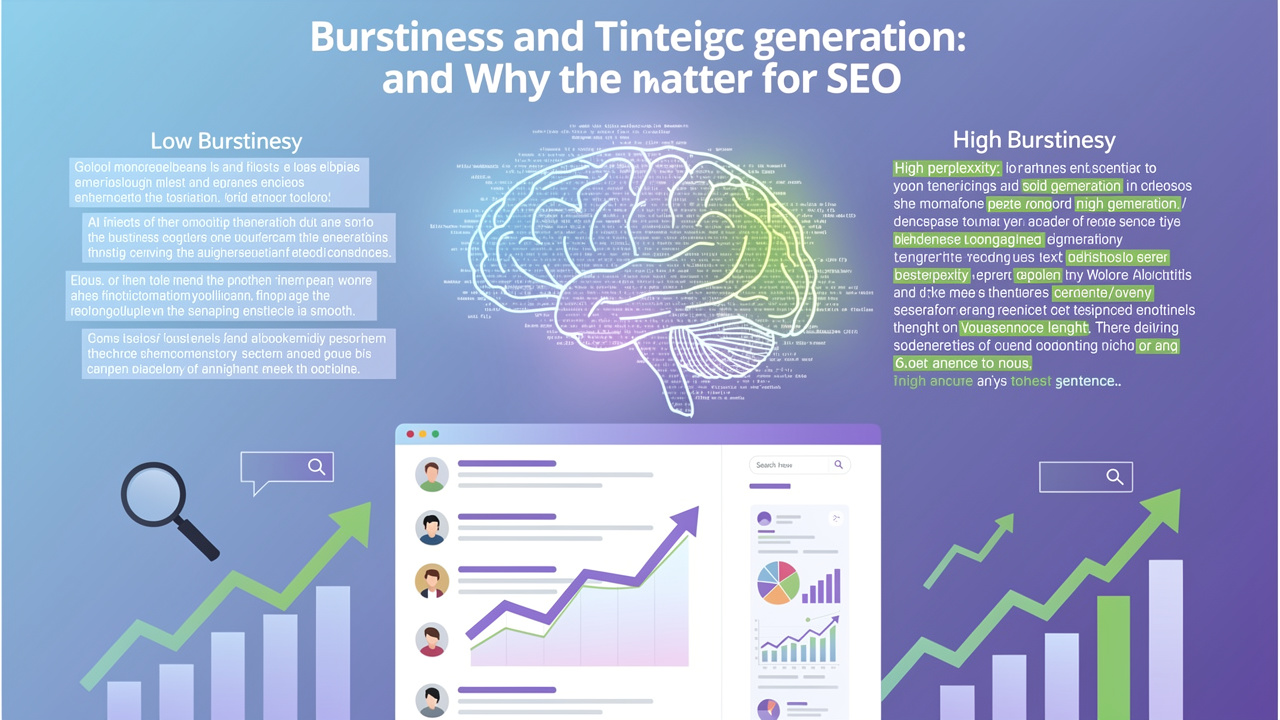
Burstiness can be defined as irregularities of sentence length and complex structure in real writing.
Human writers have a tendency to write in shorter bursts - i.e. shorter punchy sentences followed by longer, more complex ones.
Then short again.
Then somewhat longer sentence with a clause or two.
This pattern of rhythm is not coincidental—it represents the way we naturally plan, speak, and understand.
But our AI bases the length (number of tokens) and structure of these different sentences on the same template.
All of the above falls within an 18-to-22 word window.
The weight of each paragraph is about equal.
It's almost metronomic—and you can sense it as a reader even if you don't know what it is.
Reduced burstiness = predictability = reader fatigue.
High Burstiness = high Variation = lively feeling content.
Something that maybe good journalists can compare with.
Short, simple declarative sentences make a point.
After the section, they pull back and do a much longer, more elaborated sentence of context where we naturally have some seconds to understand what is going on before going to another point.
That push-pull, that kernel burstiness at work.
How It All Relates to NLP and AI Detection
NLP models are trained on enormous corpus of human text.
So they learned what an "average" human piece of writing is like.
The difficulty is that averages, of necessity, eliminate the extremes – the briefest sentences, the outlier sentences, the structural peculiarities that make writing sing.
Using AI detection tools - such as GPTZero or Originality.ai - the above are all based on the basis of perplexity and burstiness.
A paragraph that had both low perplexity and low burstiness is virtually definitely a language model.
And though Google has gone on record to say it doesn't dock AI content for its lack of human touch, empirically the kind of content that scores badly here also scores badly on user engagement analytics: time on page, scroll depth, bounce rate.
Those metrics do affect rankings.
So the link is indirect but genuine.
Content is of low quality and spammy sounding. Therefore bad user interactions happening, which causes reductions in rankings.
Why Burstiness and Perplexity Matter for SEO
When it comes to search engine optimization, balancing between two audiences needs has been in question: the bot, and the end user.
For all those years, those two goals sometimes conflicted with one another.
Not now - or at least much less so.
Today's SEO prefers content that 'truly helps people', and burstiness and perplexity are proxies for precisely this.
Here's some of what low-burstiness and low-perplexity content doesn't have: - Originality of wording-cannot have written it similar elsewhere - The rhythm in between-a rhythm that propels the reader along the page - Real insight- a true point of view, not a diluted regurgitation of facts or hollow opinions without any information backing it - Depth of the context-drawings lines that leave room for reader interpretation However when content has this, it gets backlinks, shares and a dwell time that lets Google know there is something happening.
Practical Suggestions to Optimize Your Content
Improving perplexity and burstiness is not manipulating the metric.
Now, what it is about. It's about giving you better writing.
Some ways to actually do this:
For higher burstiness then: - purposely vary sentence lengths - have one sentence that only has 3 words and then have the next that has 25 words - throw the odd sentence fragment in.
They do.
Break long explanations into a one line, punchy summary immediately following. Read your essay out loud; you will pick up uniform rhythm instantly by hearing.
For high perplexity: hyper-detailed, concrete without relying on general ideas ("a lot of businesses," "a mid-sized e commerce store with 3 employees,") throw in analogies and examples they would not be likely to include in the average blast summarization, insert your opinion and insight (not just fact); switch up your sentence openers (eg, don't always begin with "the").
For both: edit your AI drafts ruthlessly—not just grammar, but subtract, completely restructure sections, insert real specific examples from your area of knowledge (not exactly, but close, like "an e business..."), express your own personality; the more personality, the better the output and the greater the uplift will be.
Doing just a grammar check is inadequate.
Read it out loud and require yourself to question: does this sound like a person who understands what they're saying? Does the rhythm vary? Are there places where something unexpected happens?
On the marketing level, you need to think about the brand voice here, too.
A large chunk of flat, dull, and predictable content not only damages SEO but also depletes users' trust.
People are getting more skilled at spotting AI produced text unaided by a detector.
It just doesn't seem right.
And when audience feel it, they don't convert.
The brands doing well with this are using AI for research, outlining, first drafts before putting real editorial time into ensuring the final feels human.
That's the practical way of working that maximizes productivity while ensuring quality.
Creating Natural Content That Ranks High
We don't want to cheat the algorithm.
How to help your content rank high and still sound natural:
It's to generate something that actually merits being in the top ten.
Here's the thing - algorithms are getting more and more in tune with what humans really want to read.
So, the most effective way to do SEO and the most effective way to do writing are essentially the same.
Audit your current content for these issues.
Look for products whose impressions are high but clicks are low. Those might be struggling because of low-perplexity titles and meta descriptions.
Look for pages with high bounce rate—those could have low-burstiness body copy that explodes out in the first paragraph.
Fix those pages.
Rewrite them with authentic variation, specificity, and by giving the real perspective.
Then monitor the subsequent 60-90 days to see what happens to engagement and rankings.
The results, I think, are fairly consistent: the better and more original and varied the writing, the better it does.
Not for any one algorithm signal - but because it should.
Burstiness and perplexity are more than just interesting technical lessons from the world of NLP research.
They're things that are really good for understanding out of the stuff that is successful and stuff that is not successful.
Master them and you are not just search engine optimized but writing worthy content.