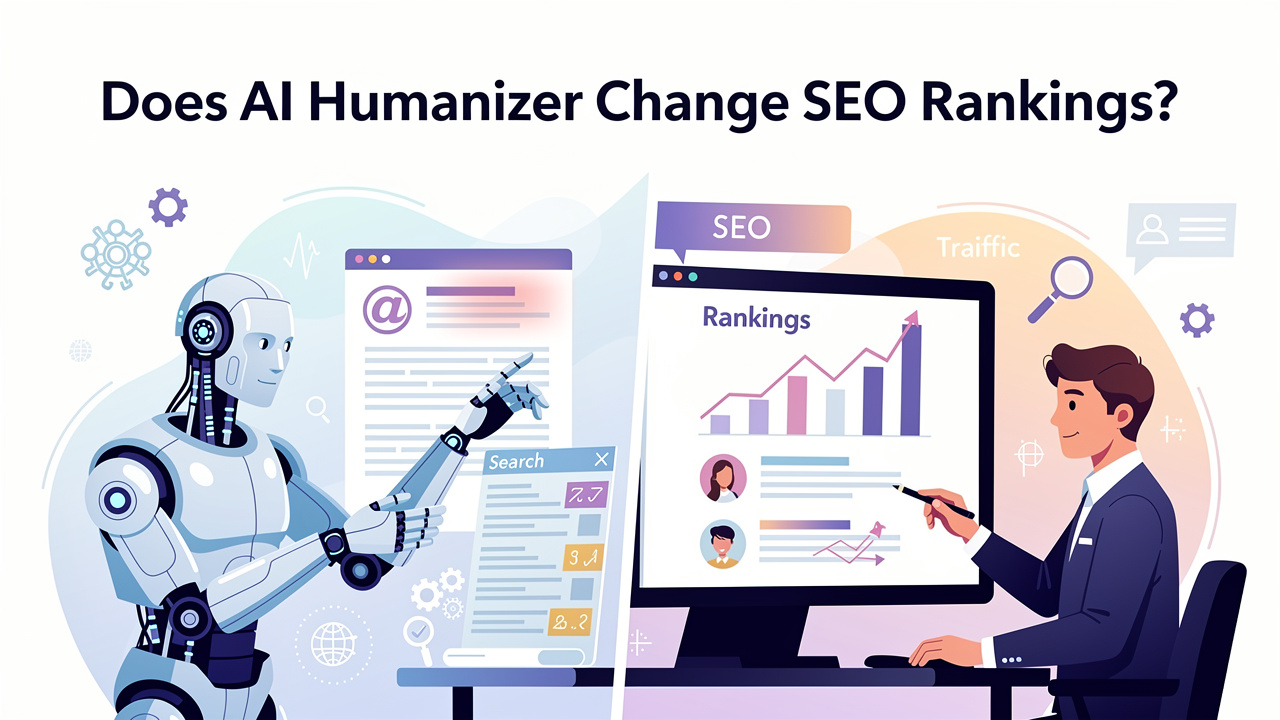
The rise of AI written content has skyrocketed on the internet, and with that a new class of tools have emerged, AI humanizers. They claim to be able to make mechanical, repetitive content sound more natural and human, more like someone wrote it rather than a machine. But the truth is, does AI humanizer change SEO rankings? The answer isn't straightforward for marketers, content strategists, and SEOs looking to rank better.
Not quite.
What Are AI Humanizer Tools?
AI humanizers, these are programs that take text written by artificial intelligence and alter the text to fool a variety of AI detectors and make the text seem more naturally written by humans. The AI humanizers achieve this by changing sentence structures, replacing overused words, modifying syntax, and occasionally adding grammatical issues that AI content detection systems look for in human writing.
Popular examples are Undetectable.ai, QuillBot and HIX Bypass. Some are independent tools, while many are incorporated into a wider workflow. The idea, in essence, is to input cold, AI-focused text and receive a more human-sounding, familiar output that escapes detection.
But there's an important caveat here - when you use a humaniser, it doesn't always make the content better. It makes it different. And that difference is huge when it comes to SEO.
How Google Actually Evaluates Content
Google has been really consistent on one thing: it doesn't matter whether a human or a machine put the words on the page. What matters is quality. Search advocate John Mueller even said back in 2023—"helpful, accurate and well-structured content performed well, regardless of whether a person or a machine created it."
Having said that, Google's new E-E-A-T schema (Experience, Expertise, Authority, and Trust) does set a much higher standard than many writers expect:
- Experience: Does the content reflect real-world, first-hand knowledge of the subject?
- Expertise: Is the information accurate, detailed, and clearly informed by subject-matter knowledge?
- Authoritativeness: Is the source credible? Are there signals — backlinks, author bios, citations — that establish credibility?
- Trustworthiness: Is the content honest, well-sourced, and free from misleading claims?
This is where AI humanized or otherwise-is so often at a disadvantage. AI doesn't have experience to draw upon. It can "feign" expertise and depth by repurposing prior training data.
But it can't do so from any kind of experiential first person perspective, to lend depth to a surface-level subject like a human writer can. A humanizer can perform surface edits to syntax but can't impart the depth of subjective expertise into shallow material that's only surface-deep-a fundamental challenge no tool can fully address.
Does AI Humanizer Change SEO Rankings Negatively?
Employing humanizers in the fine is in itself not technically unsafe. But there are a number of concrete dangers that are advisable to be taken seriously:
1. Content Quality Degradation
Most of the humanizer tools pay more attention to tricking the detector than to making the read comfortable for human readers. So you may get some AI detector test scores but the sentence or passage itself sounds a little strange, a sentence in unnatural language, a phrase with an awkward meaning, or a transition that doesn't sounds quite natural. Google's algorithms, especially following the Google helpful content update (2022-2024), are pretty decent at detecting inferior writing regardless of the lack of obvious AI writing signature.
2. Thin Content Remains Thin
Humanizing adds nothing to substance. If the original AI draft contains no more than generic examples, real analysis or useful data, then the humanizer only comes out with beautifully polished thin content. And thin content, no matter how conversational sounding, doesn't rank.
3. Potential Policy Violations on Specific Platforms
Google does not generally penalize AI content. But certain publishing portals, affiliate programs, and editor networks have policies against AI content. If one employs humanizers to disguise AI content, it may breach those provisions—carrying the risk of account suspensions or content deletions.
4. False Confidence
My biggest concern is psychological. While marketers using a humanizer may have no intention of risking the bad press, they may become complacent and neglect the editing phase. If that happens, they could end up publishing something that is undetectable, but which still has minimal strategic value.
The Potential Rewards — When Used Correctly
Having said that, humanizers do have some valid application. But, when used appropriately, they might have a place as part of a more extensive content editing process.
- They can improve sentence flow in drafts that are mechanically correct but stilted.
- They can reduce the density of formulaic AI phrases that make content feel generic.
- They can serve as a starting point for human editors who then add genuine insight, examples, and personality.
- They're useful for non-native English speakers who use AI drafts and need help making the language feel more natural before applying their own expertise.
The main difference is this: humanizers are comfortable as editing assistants but not as completing tools. Using them as a finishing step and not an intermediate stage is the mistake most people make.
Does AI Humanizer Change SEO Rankings Positively?
If you are going to use any of these tools - and many content teams do - then this is how to do so without affecting your search results negatively.
-
Start with a strong AI draft: Garbage in, garbage out. If the original content is shallow or inaccurate, no humanizer will fix that. Make sure the AI draft covers the topic thoroughly before running it through any tool.
-
Always apply human editorial review: A real editor should read every piece after humanization. They should add personal insights, check factual accuracy, improve transitions, and ensure the content actually serves the reader's intent.
-
Add E-E-A-T signals manually: Include author bios with credentials, cite authoritative sources, embed real data and statistics, and reference specific case studies or examples. These signals can't be automated.
-
Don't skip keyword optimization: Humanizers sometimes rearrange sentences in ways that dilute keyword placement or break natural semantic structure. Review your target keywords and ensure they're still contextually present after humanization.
-
Use multiple quality checks: Run the final content through a readability tool (like Hemingway Editor), a plagiarism checker, and a manual review against your brand voice guidelines. Don't rely on AI content detection bypass as your primary quality metric.
-
Prioritize topical depth over surface-level coverage: One well-researched, genuinely helpful 1,500-word article will consistently outperform five humanized, shallow pieces. Volume strategies built on AI humanization tend to plateau quickly.
The Future of AI-Assisted Content Creation in SEO
This industry is truly at an inflection point. AI tools—humanizers and everything else—aren't disappearing. They will become smarter, more built-in to editorial workflows, and more able to generate content indistinguishable from human-authored material.
But search engines are changing just as fast. Google's focus on trying to understand "intent", "expertise", and "genuinely helpful" will make that difference between the layer of content that is indistinguishable from AI and truly great content not smaller but bigger. The algorithms are prioritising genuine knowledge and genuine usefulness more and more—and there's nothing a human can do to fake that from a poor start.
The ideal solution is not excluding the machine, nor the human. The best way to go is a mixture: use AI to gather research, create first drafts and organize structure; use humanizers where it makes sense to fit the content together; dedicate the human effort in the parts of the piece where the human touch makes the biggest difference: in editorial decision, speakerlike voice and adding all the knowledge and personal insights.
Conclusion
AI humanizer tools are also a very gray area when it comes to SEO. They are neither a silver bullet, nor a dangerous black hat tool. The effect they have on ranking will be directly determined by how they are used.
For instance, if they are used as an easy way out of actual editorial effort, the resulting content may fool all of the sniffing tools, but will likely still not rank well as it is still missing its depth, authority, and true worth. On the other hand, if they are used as part of a larger human-monitored workflow, they can be used to generate more readable, interesting content. The future—and, indeed, the here and now—belongs to those content teams that can discern the difference.
The AI and humanization tools are tools—and brilliant tools, at that—but you're not going to get very far if you're seeking out AI to replace expertise, truth, or the insight that develops only when you already know your subject. Success requires a foundation built on the basics, using the tools when they help, and shunning them the moment they hinder.