A vaguely written blog post about tax planning might leave readers puzzled.
A poorly written article on drug doses could actually end up harming a patient.
That's the weight healthcare writers - and the AI tools they use - must constantly remember.
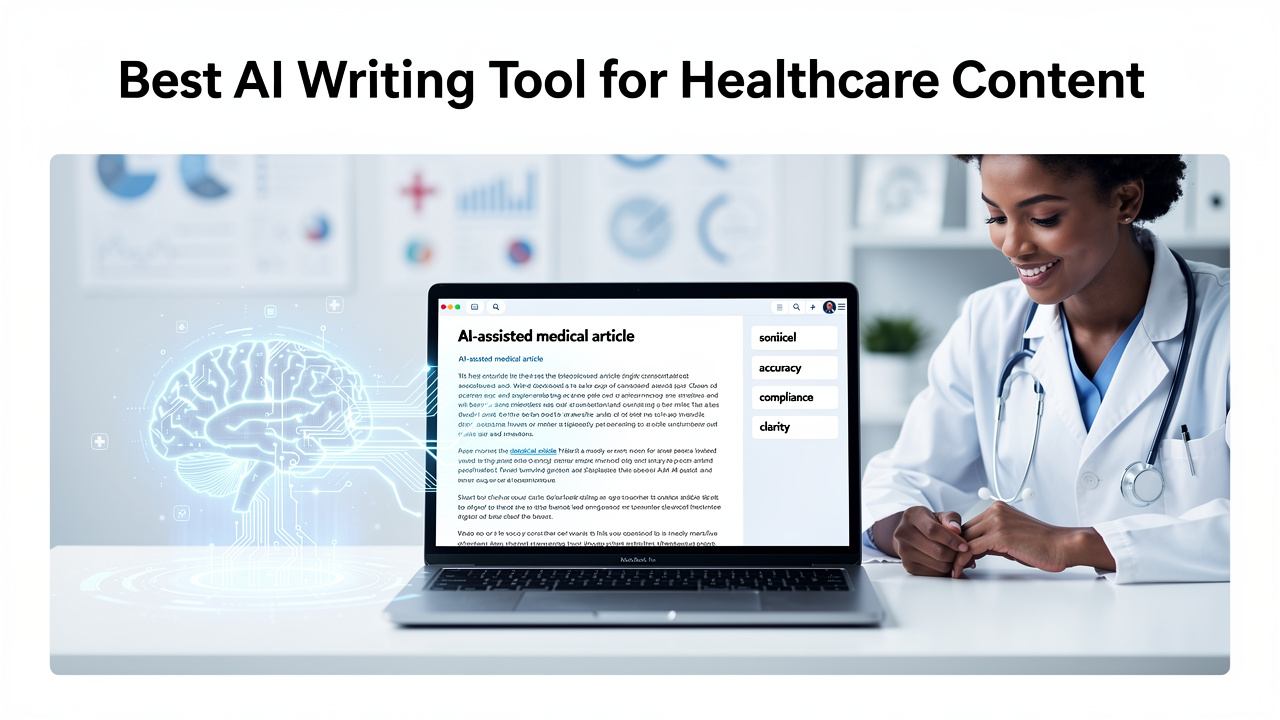
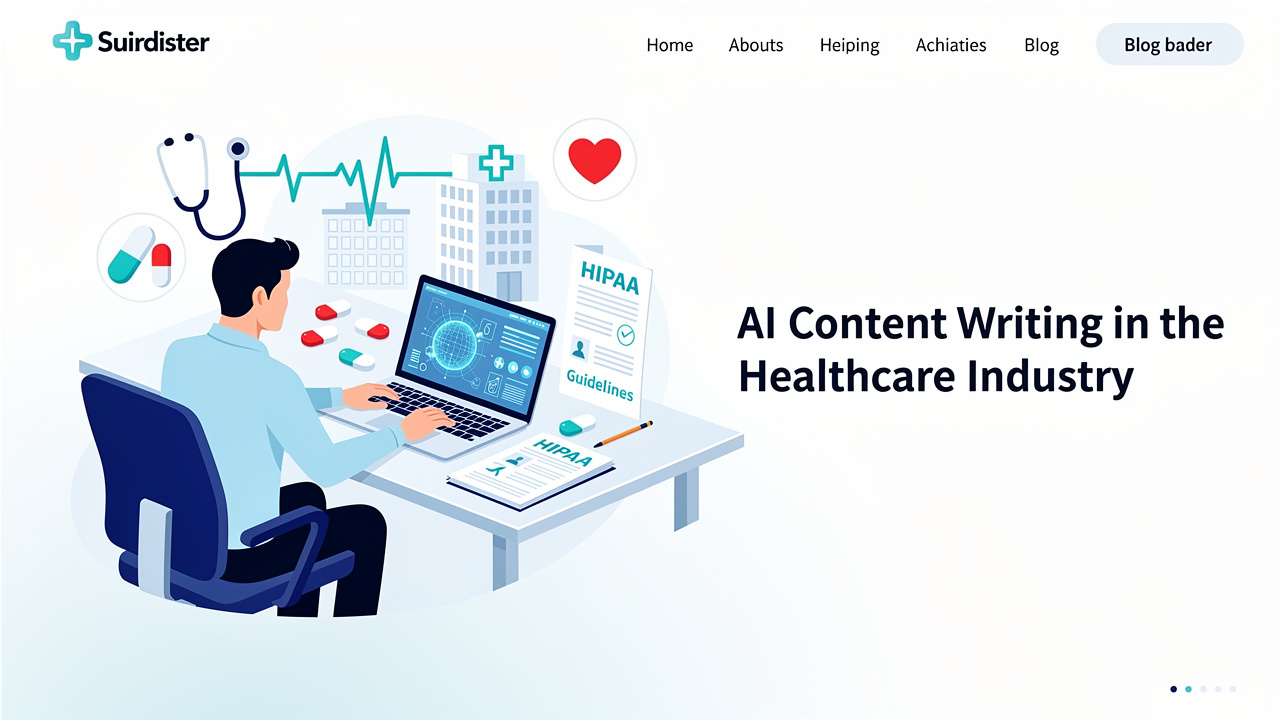
AI content writing for healthcare industry tips and compliance are becoming increasingly important as AI writing tools are starting to be of real use in healthcare content generation.
They can make healthcare patient education tools more quickly, craft clinical summaries, and assist marketing teams at hospitals and health systems.
But adopting them effectively involves a specific approach.
Here's what you should consider.
Why Healthcare Content Requires a Different Approach
Most industries can afford to develop AI-generated content without much oversight.
Healthcare cannot.
The mélange of handling healthcare data means that the potential for errors has much more serious consequences.
Healthcare content developers - whether human or human-assisted by AI - operate within a framework of regulation.
The CDC sets the standard for public health guidance.
The FDA oversees how some drugs and procedures are marketed.
Advertising standards set by the FTC catch health claims.
And professional medical bodies regulate best practices for clinical accuracy and professional ethics.
You can't ignore one without risking several others.
So before launching an AI project for healthcare content, organizations must make sure they understand exactly what they need to manage and can't ignore.
Healthcare Content Compliance Standards for AI Writing
Get a solid content governance plan in place first. AI tools are incomplete knowledge repositories of their own.
Without regular review, established policies, and style guides, they won't meet your legal requirements.
In practice:
- Develop a healthcare-specific content brief template including items for audience context, required legal or clinical disclaimers and most importantly, whether a clinician should review the output prior to publication
- Designate a healthcare professional (ideally a nurse or doctor) to review the health-specific content before your AI-automated content is published
- Make your AI use practices clear in your workflow. (Several providers are now demanding this internally as part of audits)
- Create a cancer condition incidence disclaimer document for writers to easily include in articles, for regulatory reasons
Healthcare content compliance can't be tacked on as an afterthought.
It must be baked into the process from the outset, and this particularly applies when you plan to have AI-do the first draft.
Accuracy—This cannot be compromised
I'll tell you what: AI language tools have read a ton, but they don't fully comprehend medicine.
Instead, they search for patterns and imitate learned language.
Given that, there's a high risk of factual inaccuracies creeping through.
In healthcare writing, this isn't a semantic concern.
Incorrect information about drug interactions, symptoms, or clinical research can directly harm or mislead patients who are trying to make informed decisions.
This is what makes accuracy processes so important:
-
Don't allow the AI content to publish anything not vet-ed. No figures about drugs, procedures, or physiologies should be included without being traced back to a valid source.
-
Rely on AI as a structural frame. Let AI create a draft skeleton, introduction and lay explanations of basic concepts, then insert the clinical specifics that you've verified separately.
-
Implement a clinical accuracy factcheck layer such as ISO-approved Isabel DDx (diagnostic, mostly) or enshrine a review step into your internal workflow before publishing.
-
Use date stamping. Medical knowledge changes all the time.
What was current in 2018 may not be in 2023.
Classic GPT-3 is trained on older material and may not update automatically.
AI Writing Tools for Healthcare Industry Best Practices
Several AI content generation tools are already best practice for healthcare content settings:
- Jasper AI—one of the most popular and widely adopted writers by healthcare marketing teams; can be run with custom brand voice considerations and custom style parameters aligned to healthcare style and policy
- Nuance Dragon Ambient eXperience(DAX)—more clinical oriented; designed to help clinicians with documentation rather than marketing material, but very applicable to health systems
- Articoolo and Copysmith—good for developing initial drafts of patient education material which clinicians can subsequently correct and enhance
- Grammarly Business—not an content generation engine itself, but important for compliance sensitive writing, due to ability to catch tone and phrasing issues that might be confusing or unclear to patients
- ChatGPT Enterprise—this version can be run with much stricter data privacy rules than the consumer version, and can be configured with more complex system prompts that encode for compliance under bedrock parameters.
None of these AI writing tools for healthcare are simple to run in healthcare context: each one needs oversight, a standardized editorial process, and clear rules for how to use.
Each one is a tool that can be integrated into best practice governance.
Best practices for the most common issues
Issue: AI generated content sounds bland and formulaic. Fix: By providing detailed inputs into AI engines, including patient demographic information, specific medical conditions, and your institutional style guide, you can get outputs that are much more personalized and varied.
You get what you put into AI—be very detailed.
Issue: Content becomes outdated very quickly. Fix: Establish a process for auditing AI generated content.
Baseline is every 12 months, more often if the clinical recommendations or interventions in the content area get updated frequently.
Issue: Clinicians resist trusting AI drafts. Fix: Use the AI as a medical writing assistant, not a medicolegal expert.
Once clinicians understand their role is to review a fourth or fifth draft, rather than validate a new clinical pathway, they'll come on board much faster.
Issue: Ensuring ongoing consistent regulatory and clinical compliance across diverse content team. Fix: Develop master AI prompts for the most common types of content delivered to patients, which can be shared and amended as new regulations or organizational desires shift.
For example, build a set of template prompts for new patient education on all new procedures.
In conclusion
While nothing is perfect when adopting these in healthcare settings, AI can certainly cut delivery speeds, unify branding, and produce much more scalable patient education.
AI still can't provide clinical expertise, decisioning, or ethical considerations.
The early adopters making this succeed are organizations instituting AI as a trusted assistant, and embedding it within the right governance framework.
Design your oversight system first.
Make your team aware of the dangers.
Never input protected information.
Never include AI in clinical review unless you want to risk losing all clinician trust going forward.
Use a review period of no less than 12 months for anything generated.
That will be the best predictor of success rather than failure.