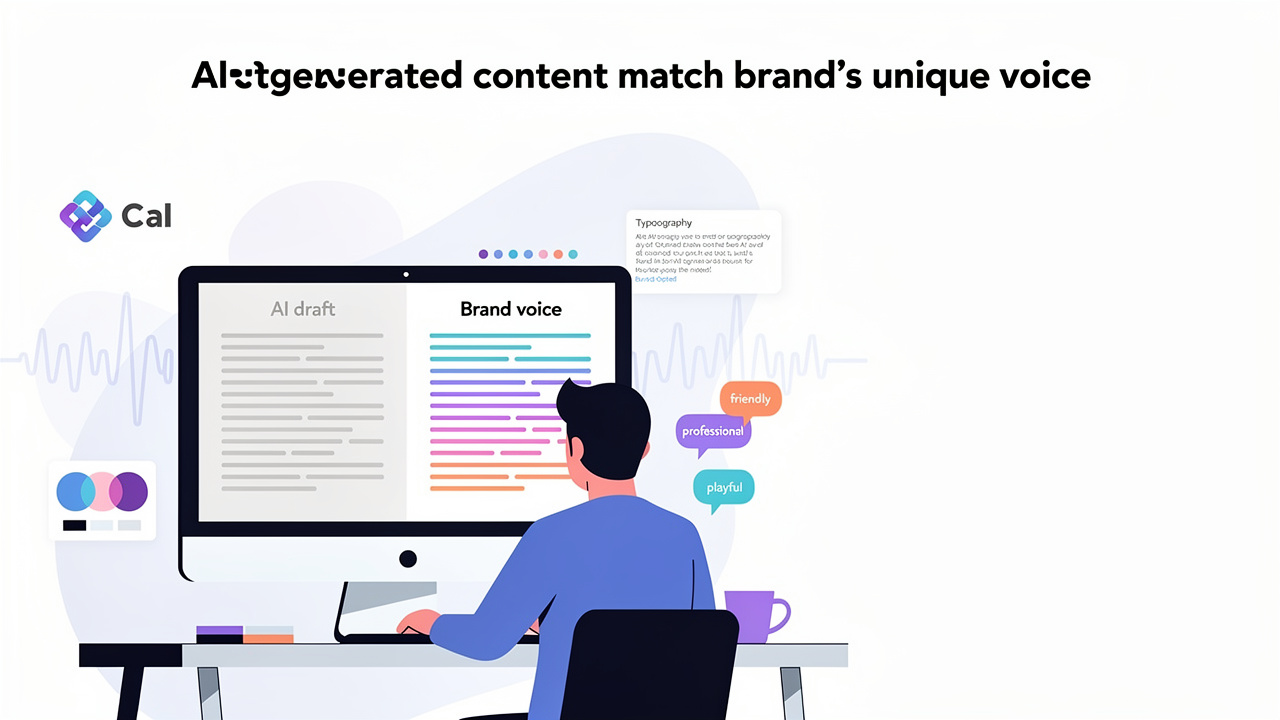
AI-generated content has a problem. Not a capability problem (today's LMs can write quickly in just about any context) - a lack of identity problem. Left unchecked, AI will churn out writing that reads as if it were written by a solid intern who has absolutely no personal contact with your customers, does not have any understanding of your company's back story, and would be hard pressed to identify your brand amidst a field of lookalikes. Learning how to make AI content sound like a brand voice is essential for maintaining authentic communication with your audience.
That's just fixable. The trick is, it takes proactive effort in the beginning, rather than passively hoping AI will "work it out."
Step One: Build a Brand Voice Document That Actually Works
Most brand voice documents are completely pointless. You have things like "we are professional yet friendly" or "we combine knowledge with warmth" which can be applied to any business in the universe. AI models just need this more specific information for effective AI brand voice customization.
A functional brand voice document for AI use should include the following components:
Vocabulary lists – positive and negative:
- Words and phrases your brand uses (e.g., "straightforward," "built for," "real results")
- Words your brand actively avoids (e.g., "synergy," "leverage," "cutting-edge," "disrupt")
- Industry jargon your audience expects vs. jargon that alienates them
Sentence structure preferences:
- Do you write in short, punchy sentences? Or longer, more explanatory ones?
- Do you use questions to engage readers, or do you make declarative statements?
- Is passive voice ever acceptable, or always off-limits?
Tone calibration examples:
- Pull three to five pieces of your best-performing content
- Annotate them — literally mark why specific sentences work
- Include "this is us" and "this is not us" examples side by side
Audience relationship definition:
- Are you talking to peers, at beginners, or alongside experts?
- Is your reader a skeptic who needs convincing, or an enthusiast who needs direction?
All of your AI prompts will be based on this document. Without it, you're just building on sand.
Prompt Engineering: Where Personality Gets Injected
Here is the secret most marketers overlook- the quality of your AI output is nearly 100% dependent on the quality of your input. General prompts get you General content. Specific, multi-layered prompts get you content that actually sounds like something and demonstrates how to make AI content sound like a brand voice effectively.
The anatomy of a brand-aligned
Begin with a role definition. Don't say "write a blog post." Say: You are a senior content strategist at [Brand Name], a mid-market company whose products help streamline operations teams. We have a no-nonsense, somewhat dry, highly pragmatic voice—our sentences are full of concrete details, we're not afraid to avoid catchphrases, and we assume that readers are smart and busy.
Then put some structure on it. Think of sentence length (both minimum and maximum), paragraph size, headers, no headers, and how you want your call to action to look.
Make sure to cover some vocabulary anchors—three to five words/phrases you'd like to have integrated into the text naturally. No forcing; just list them.
Finally, include a negative constraint. For instance: •"Do not use motivational words, superlatives and any sentence you could find in a generic marketing e-mail". Negative constraints are very underused and also very powerful.
Some of the specific prompt strategies that work reasonably effectively are:
- "Write this in the style of [specific content piece URL or pasted excerpt]" — giving the AI a concrete example beats abstract description every time
- "Before writing, identify three ways this topic could be framed. Then choose the framing most consistent with a brand that values [specific value]." — this forces the model to think before generating
- "Rewrite this paragraph to be 20% more [blunt/warm/technical] while keeping the core argument intact" — useful for tone-dialing during revision
Prompt engineering is not a one-and-done task. It's a learned skill that will evolve. The templates that are successful for your brand in Q1 may need refinements by Q2…or once the models roll out new upgrades.
The Human-in-the-Loop Requirement
No matter how advanced, AI doesn't do away with human editing. And not only copyediting—substantive editing that captures all those little nuances where the generated content begins to stray from the brand. This process is crucial for humanizing AI-generated content.
AI has particular failure modes when it comes to brand voice:
- It tends toward completeness over selectiveness — including every relevant point rather than choosing the three that actually matter to your audience
- It defaults to neutral when the brief calls for opinionated
- It smooths out the deliberate roughness that makes some brand voices feel authentic
- It can't replicate earned authority — the kind that comes from genuine expertise, not just accurate information
Human editors need to ask specific questions when reviewing AI content:
- Does this sound like someone who actually knows our customers?
- Would our best writer be embarrassed by any sentence here?
- Is the opinion level right — too hedged, too bold, or just right?
- Are there any phrases that feel borrowed from a competitor?
- Does the opening hook match how we actually start pieces?
Create a review process where AI content is a draft, not a deliverable. The AI does all the heavy lifting of structure and pre-formed content, then human does the identity construction.
Identifying Your Brand's Specific Language Fingerprints
All brands have linguistic fingerprints. Small, unique details that make something instantly recognizable. The truth is, you can't find them by gut feeling, you have to analyze.
Hands on exercises to help you recognize your fingerprints:
Pull your last 20 pieces of top-performing content and run a basic text analysis. Look for:
- Average sentence length
- Most frequently used verbs (these reveal energy and action orientation)
- Common opening words for paragraphs
- Ratio of questions to statements
- How often you use the second person ("you") vs. first person plural ("we")
Compare that to your competitor content. Those differences, those places where your general rule structures differ from industry conventions, are often your most unique brand assets.
Certain brands, for instance, consistently begin with a counterintuitive fact. Still others consistently anchor all vague ideas with a precise number or fact. Some of these micro-patterns are used by every other marketer, while some are unique. These micro-patterns are far more important than most marketers understand, because readers sense the difference even if they can't pinpoint it.
After determining this fingerprints, record it deliberately in your brand voice guide, and put it in your AI prompts.
Brand Voice Alignment Checklist
Before publishing any AI assisted writing, use this checklist. Be honest. If the answer is "maybe", it's a "no".
Vocabulary & Terminology
- Does the piece avoid brand-prohibited words and phrases?
- Are brand-preferred terms used naturally (not forced)?
- Is industry jargon calibrated to audience expertise level?
Tone & Personality
- Does the opening sentence sound like your brand, not a generic content template?
- Is the opinion level consistent with your brand's positioning (authoritative, collaborative, provocative, etc.)?
- Are there any sentences that feel borrowed from a competitor's style?
Sentence Structure & Rhythm
- Does the sentence length variation match your brand's typical rhythm?
- Are paragraphs the right length for your format and audience?
- Does the piece flow when read aloud, or does it feel mechanical?
Audience Relationship
- Does the content speak to the right person at the right level of expertise?
- Is the call-to-action phrased the way your brand typically phrases it?
- Would a loyal customer recognize this as coming from you without seeing the logo?
Human Review Confirmation
- Has a human editor reviewed for identity, not just accuracy?
- Have all AI-generated statistics or claims been independently verified?
- Has the piece been read aloud at least once to catch mechanical phrasing?
The Bottom Line
These AI content tools are truly powerful. However, power without specificity creates chaos. The brands that will succeed at AI enabled content won't be the biggest users of the most advanced models - they'll be the ones who spend the grunt work of nailing down who they are with enough detail that a machine can roughly replicate it.
Construct the voice doc, engineer the prompts meticulously, edit toward our identity, not just toward good grammar and then look at that checklist...do it every time, even when you're in a rush, I mean especially when you're in a rush.
The objective is not for AI to be mistaken for a human. It's for AI to be mistaken for you.