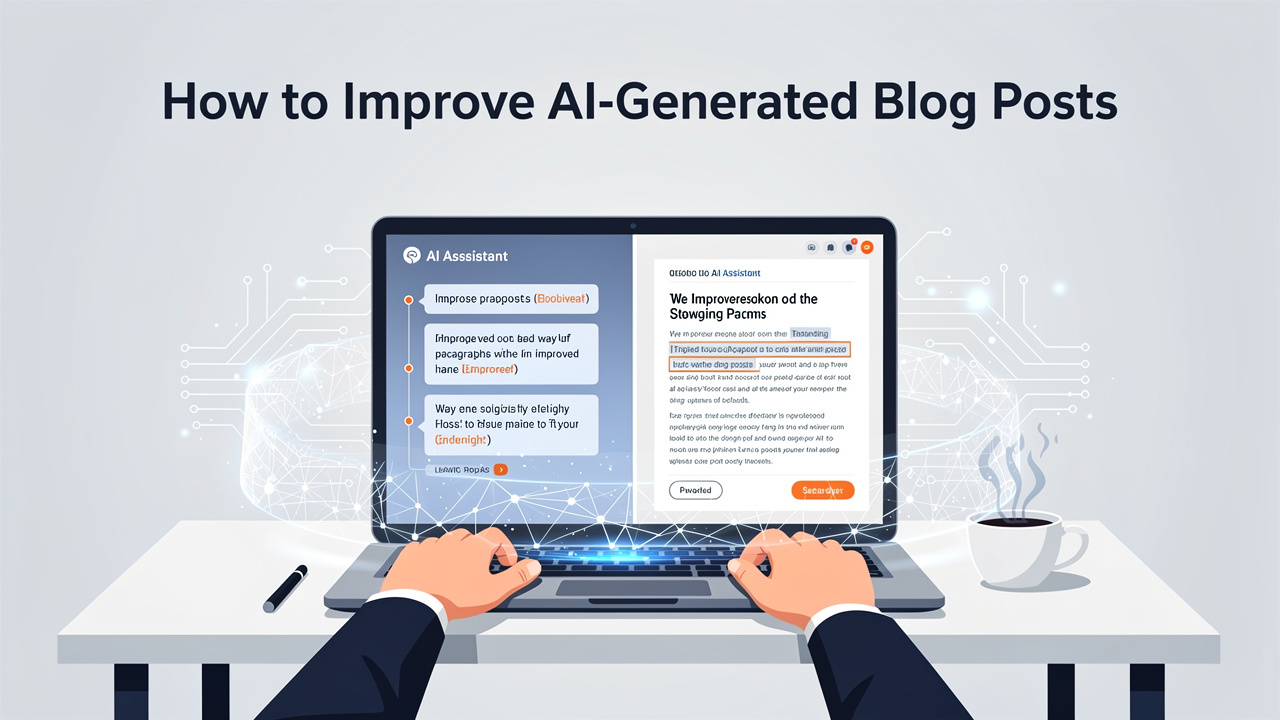
Learning how to improve AI-generated blog posts has become an integral part of the professional and popular blogging worlds. ChatGPT, Claude, Gemini, and whatever else are capable of writing a 1,000 word draft in less than 60 seconds. That's no joke, and it really is unbelievable.
But 'fast' does not necessarily mean 'good.' When the AI spit out a pile of text, it's often uninspired or so generic that it seems completely soulless, in a way that the reader understands instinctively, even if he can't always pin down precisely why. That skill of turning AI's output into something that readers want to consume is one certainly well worth learning.
Why Content Quality Still Matters (More Than Ever)
Search engines are figuring this out. Our readers are figuring this out. And the internet is getting absolutely bombarded with lousy AI-generated content we never asked for.
Google's helpful content updates have definitely made it very clear that content created just to be content will get dinged, whereas content that is actually useful will be appreciated. Quality content. It builds trust.
It keeps readers engaged. It generates backlinks, social shares and return visits -- things you can't cajole out of a semi-conscious robot no matter how hard you try. So when you employ AI as a tool in your writing arsenal, remember: you're not trying to replace quality, you're trying to get to quality.
That's a huge difference.
How to Improve AI-Generated Blog Posts From Start
The best way to improve AI output is to start before reading the first draft. How well the prompt is crafted affects how well the return will be crafted when enhancing AI writing.
Practical guides on prompt engineering that deliver:
- Be specific about your audience — "write for mid-level marketing managers at B2B SaaS companies" beats "write for marketers"
- Specify tone explicitly: "conversational but authoritative," "warm and encouraging," "direct and no-fluff"
- Include structural requirements upfront — ask for headers, bullet points, or numbered steps if you need them
- Provide examples of writing you admire, or paste in a sample of your own previous work and ask the AI to match the style
- Request a first draft, then ask the AI to critique its own output — this often surfaces weaknesses the model itself can identify
An underused trick: instruct the AI to produce the same paragraph three times. You might be amazed at how much better the third one is than the first (if you're really lucky, it might be a lot better.). This can push the model beyond its default usages.
Strategies for Human Editing That Transform AI Drafts
This is where the real work begins. AI drafts are the starting point, not the end product when optimizing blog content.
The layered editing approach:
- Read for structure first — Does the piece flow logically? Are sections in the right order? Cut or rearrange before fixing sentences.
- Cut the filler — AI loves padding. Phrases like "it's important to note that" and "in today's fast-paced world" contribute nothing. Delete them without mercy.
- Add your voice — Insert personal opinions, real experiences, or specific examples that only a human could provide. This is the single most powerful improvement you can make.
- Fix the transitions — AI transitions tend to be formulaic and stiff. Rewrite them to feel natural.
- Vary the sentence rhythm — If every sentence is roughly the same length, the writing feels robotic. Break it up. Add a two-word sentence. Then write a longer one that develops the idea with more nuance.
- Fact-check everything — AI hallucinates. Statistics, quotes, dates, and specific claims all need verification before publishing.
From my perspective, if I want an edited AI draft that is more or less the same as a full human draft, then it will take me around 40% of the time. It's a huge productivity gain not taking a shortcut.
Tools That Complement AI Writing
AI writing tools function at their most effective when in the context of a solid toolkit.
| Tool | Purpose | Best For |
|---|---|---|
| Grammarly | Grammar, clarity, tone suggestions | Polishing final drafts |
| Hemingway Editor | Readability scoring, sentence simplification | Cutting complexity |
| Surfer SEO | Content optimization against top-ranking pages | SEO-focused posts |
| Originality.ai | AI detection and plagiarism checking | Publishing confidence |
| Clearscope | Keyword relevance and topic coverage | Content depth analysis |
These tools are not about replacing the human eye—they provide a second set of eyes and can often catch issues the human eye did not. particularly helpful when you've been looking at the same document for hours.
Optimizing Tone, Voice, and Engagement for Different Audiences
Tone is everything. A post intended for software engineers should not read the same as a post intended for lifestyle bloggers, and AI frequently settles on a kind of boring, generic middle-of-the-road style that is unappealing to all parties.
For the engineers: Remove all exhortations and hype. Details matter, be accurate. Use correct technical terminology without excessive explanation. Technical people dislike being patronized.
For our general consumer sets, don' forget about the human side of everything. Use contractions, break things up into shorter paragraphs, use analogies that link the unfamiliar to the known—something like "it's like a hard drive that lives on the Internet instead of your desktop" for cloud storage.
For B2B Pro audiences: Combine competence and accessibility. B2B Pro Readers are busy and skeptical. Come right out with the benefit. Back up your claim with your B2B proof points. Don't make them "read all about it."
There is a one-step fix for the tone of AI drafts. Simply read your finished draft aloud. If you have trouble pronouncing a sentence or if the sentence sounds odd in your mouth, then rewrite it. Your ear will catch what your eye does not.
How to Improve AI-Generated Blog Posts: Real Examples
Case study one: A travel blog utilized ChatGPT to produce a piece titled "10 Secret Attractions in Lisbon." The initial rough draft was factual and technically correct, yet void of resonance- only one and zeroes. After revision, the author introduced her own experiences getting lost in Alfama, replaced the general call to action with a detailed dining suggestion including a menu item and price, and rephrased the first paragraph to send the reader immediately onto a cobblestone avenue at sunset. The number of clicks rose 340% in relation to an average post.
2nd case study:A SaaS firm was using AI to generate a blog post on 'how to reduce churn.' The first draft was quite generic. The marketing team optimized it to put in their own IP, added quotes from their customer success team, and replaced vague suggestions with clear processes based on their product. The piece then became their most performant content piece that quarter.
One thing they all have in common, is that the skeleton was there from the start and the AI helped flesh out the idea.
The Future of AI in Blogging
That AI will become more of a player in the blogging world seems certain. What it won't do—what there is no inherent reason it should do—is supplant human writers. Instead, it will transform the time spent by those human writers. The hard, rote work of composing articles (library search, skeleton framing, first-draft writing) will increasingly be handled by the machine. The arts of writing (sensing the authentic needs of a particular audience, editorial discernment, honing an editorial voice) will remain human.
But the successful bloggers will not be those who oppose AI, and those who mindlessly put out what it produces. They'll be those who see AI as a capable but flawed partner that requires a guiding hand, an editor and a human journalistic sensibility, to make content worth reading.
AI tools will continue to improve. Standards will continue to rise. And those writers who choose to learn to work with such an AI in an intelligent way – rather than abdicating their judgment to it – will be the ones consistently producing distinctive material in an ever more cluttered marketplace.
Quality still wins. It always has. AI just changes the way you get there.