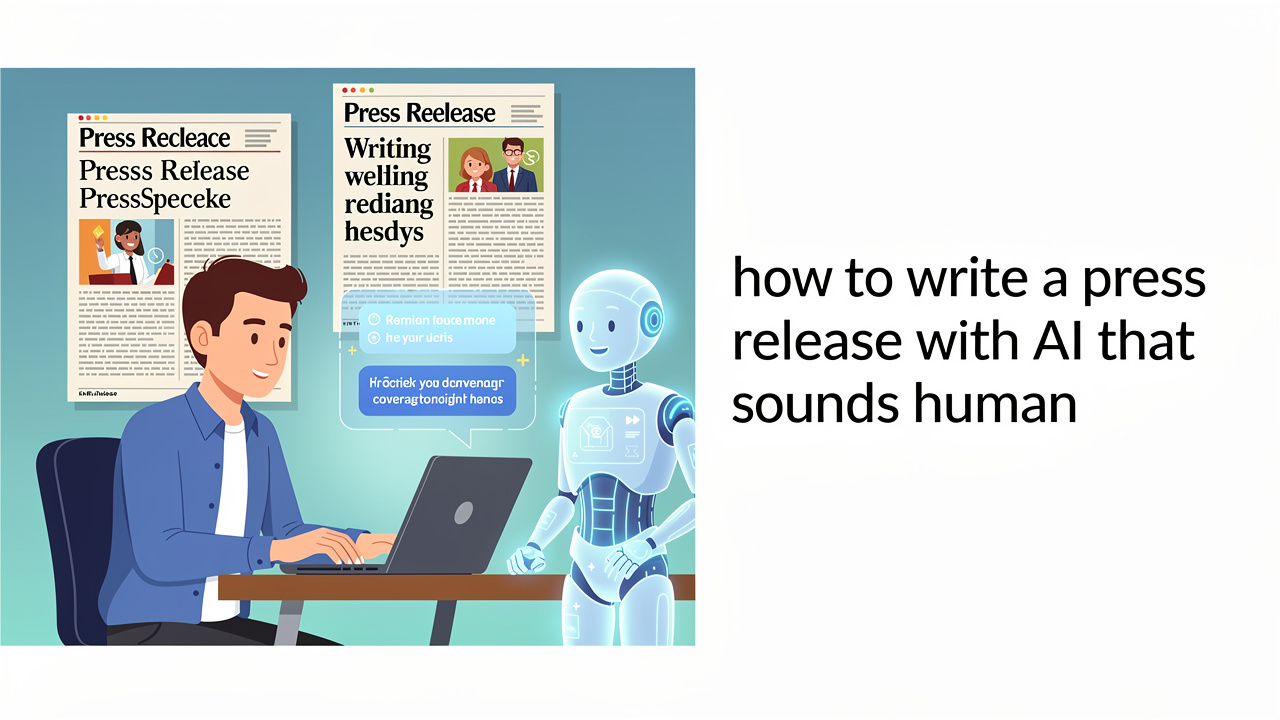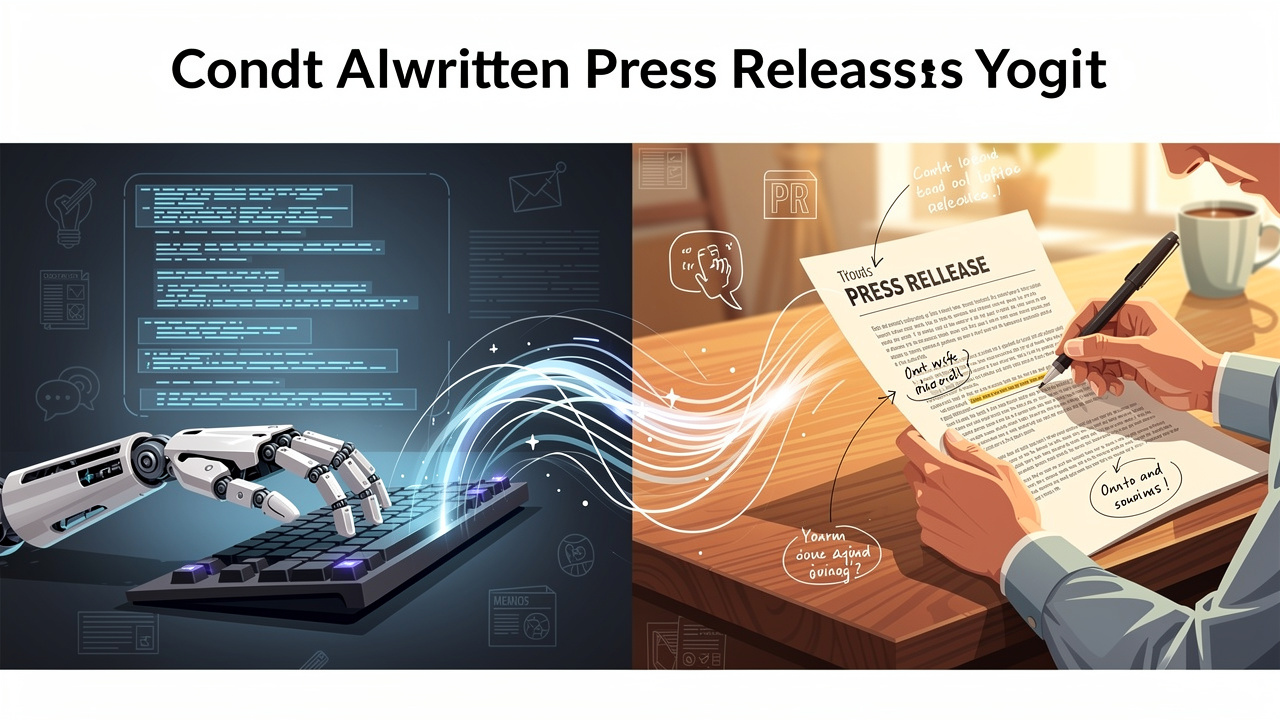
AI writing tools have done it easier and quicker to produce press releases. But easier and quicker can mean losing the personal touch in many cases - with the press release reading very mechanically and sounding an awful lot like a robot wrote it. If you have come across an AI-written press release and experienced a certain robotic, soulless tone to it, it's probably not you. Learning how to convert AI-written press releases to human-sounding content is essential for modern PR professionals.
Humans can smell the inherent dullness or unoriginality in an AI press release. Sometimes the life is missing in a press release and instead there is this bland neutral tone to the writing. The ability to humanize AI press releases and edit AI generated press releases into more natural-sounding ones in human voice will become a skill which every marketer and PR professional will need to have.
Below is a tutorial that takes you step-by-step through the applied, everyday process of turning robotic AI drafts into a real-sounding individual press release—as they really ought to be.
Why AI-Generated Press Releases Fall Flat
It also helps if you understand what you are trying to fix before going about fixing it.
AI is great for getting a first draft out there fast. They can draft out all the relevant points in a way that will fit the general format of the press release; and include all the boilerplate language you need. But they generally output copy that is—technically—invisible to the reader.
Here's what typically goes wrong:
- Repetitive phrasing — AI often circles back to the same sentence structures, sometimes within the same paragraph
- Generic superlatives — phrases like "industry-leading," "cutting-edge," and "best-in-class" appear constantly, without any supporting evidence
- Passive voice overuse — "It was announced that..." instead of "We announced..."
- Missing personality — no brand voice, no humor, no warmth, no urgency
- Vague claims — lots of noise, not much signal
Also, remember that U.S. journalists receive hundreds of press releases each week. Get a robotic-sounding one in the bin.
Step 1: Run a "Robotic Language Audit" Before You Edit Anything
Don't begin editing 'blind'. Read the whole draft out loud before you begin editing it, as this really is one of the best editing methods there is.
Your ears are more likely to pick up on errors than your eyes. Tell us if you trip over a sentence, or if it sounds like a phrase you might have read in a KFC flyer in 2009.
Pay attention for:
- Sentences that all follow the same Subject-Verb-Object rhythm
- Any phrase you wouldn't actually say in conversation
- Overloaded noun phrases like "the implementation of innovative solutions"
- Transitions that feel mechanical: "Furthermore," "Additionally," "In conclusion"
- Hollow intensifiers: "very unique," "extremely important," "highly significant"
Go over and mark everything - a non-editing pass. Don't do any editing yet—just auditing. You'll get through the editing more quickly once you've seen all the glaring problems.
Step 2: Inject Your Brand Voice From the Ground Up
This is the element of real humanization.
All brands have a voice – or should. Maybe you want authoritative and formal (financial services), warm and casual (wellness brands) or punchy and to the point (B2B SaaS). AI doesn't understand your brand. It simply generates content based on a generic company in a generic industry.
To use the voice of the brand, at least:
- Pull three to five examples of your best existing content — blog posts, previous press releases, founder interviews
- Identify recurring phrases, sentence lengths, and tonal patterns your brand actually uses
- Replace AI's generic language with your brand's specific vocabulary
- If your brand uses contractions, add them. If your brand is formal, tighten the language accordingly
- Read the revised draft against your brand guidelines side by side
A trick: Rewrite in full the opening paragraph in your own words without glancing at the AI one. Use that paragraph as a benchmark to match the tone of all subsequent edits.
Step 3: Add Real Human Quotes That Actually Sound Human
Quotes written by AI are agonising. It's always a variation of: We are so excited to unveil this great innovation that is going to revolutionise the industry. That isn't how normal people speak.
Nobody. Real quotes do three things all at once – they establish perspective, document credibility and give journalists a quote. That last one is the really important bit.
How to Write (or Source) Better Quotes
- Interview the actual spokesperson — even a five-minute call yields more authentic material than any AI prompt
- Capture natural speech patterns — if the CEO says "Look, we've been working on this for two years and it's genuinely exciting," that's more compelling than polished corporate-speak
- Make quotes do real work — they should add context or perspective that isn't already in the body copy
- Avoid redundancy — don't have a quote simply repeat what the paragraph above it already said
A good quote sounds like someone who actually cares what they're saying. You can even have a bit of an imperfect sound to the quote—and that's fine. In fact, a touch of imperfection will often seem more believable than perfect corporate-speak.
Step 4: Ground the Story in Specifics and Real-World Examples
AI loves abstractions. It will say your product "drives results" or "delivers value" without defining what that actually entails.
Specificity is the cure. Remembering details: numbers, names, dates, examples—are the details that bring a press release back to reality.
Replace generic AI claims with concrete specifics. For instance, 1. "no single group of agents has every problem in its weight class or every representation of any problem in its weight class" can be replaced with 2. If a problem P is solvelable (and P does not happen to be insolvable), then for any representation R of P there is a group of agents each of whom has P in his problem range and R in his representation range.
| AI-Generated Version | Humanized Version |
|---|---|
| "The platform drives significant efficiency gains" | "The platform reduced onboarding time by 40% for clients in Q1 2025" |
| "Customers have responded positively" | "Over 3,000 users rated the feature 4.8/5 within the first month" |
| "This solution addresses key industry challenges" | "The tool solves a specific compliance bottleneck that costs mid-sized firms an average of $120K annually" |
This is just more appealing to journalists and gives them specific data points to work with, dramatically increasing the odds of your release getting published.
Step 5: Edit for Flow, Rhythm, and Emotional Resonance
The draft may still sound chopped or dull, even with the language set and quotes added. This step is in the side of the iteration, about the feel of the document - the way it flows, the breathing space in it, and whether it leaves the reader with something.
Practical Editing Techniques
- Vary sentence length deliberately — short sentences create emphasis; longer ones carry explanation and nuance
- Cut the first sentence of every paragraph — AI tends to front-load with a summary sentence that's redundant once you've read the paragraph
- Add one emotional anchor — what does this announcement mean for real people? A product launch that saves time means a professional gets home earlier. That's human.
- End with forward momentum — the closing paragraph should leave the reader with a clear sense of what happens next, not just a boilerplate "about the company" wind-down
And please - even after you finish, read it out loud one last time. If it comes across like an actual person wrote it, then you've got it.
Step 6: Verify Every Fact, Stat, and Claim
AI hallucinates. And I mean this both as an exaggeration, and also as a direct fact. It really produces realistic sounding facts, which, in some cases, are entirely made-up.
Before publishing any AI-assisted press release, verify:
- All statistics and data points against original sources
- Product names, versions, and specifications
- Names, titles, and spellings of all quoted individuals
- Dates, locations, and event details
- Any claims about competitors or market position
Just one wrong stat in a press release can damage credibility significantly, not only with journalists, but also with customers and investors. You can't afford to skip this.
Convert AI-Written Press Releases to Human: Quick Reference
- ✅ Conducted a robotic language audit (read aloud)
- ✅ Replaced generic language with brand-specific voice and vocabulary
- ✅ Sourced or rewrote quotes to sound like real humans
- ✅ Added specific data, examples, and real-world context
- ✅ Edited for sentence variety, flow, and emotional resonance
- ✅ Fact-checked every claim, stat, and name
Conclusion
If you know how to convert AI-written press releases to human-level pieces of writing, it's one of the most useful skills a 21st century PR practitioner can possess. The beauty of AI is that it can be so helpful - saving time, providing structure, and providing words to "fill the space". But it ultimately requires a human voice, real editorial knowledge to make it work.
The good news: with a reliable editing routine, you can transform a flat AI draft into an engaging piece in less than an hour. Use your next press release as a test case. Perform the audit, insert your tone, include genuine quotes, base it on details, verify each fact.
Your CTA: Can the AI writing tools you're using for your existing PR routine really deliver content that sounds like you—and not simply sounds like a brand? Use the humanization tactics covered in this guide for your next campaign, and test the difference in journalist response levels. That quality divide between AI-first and human-finalized releases certainly exists—and now you're equipped to make it disappear.