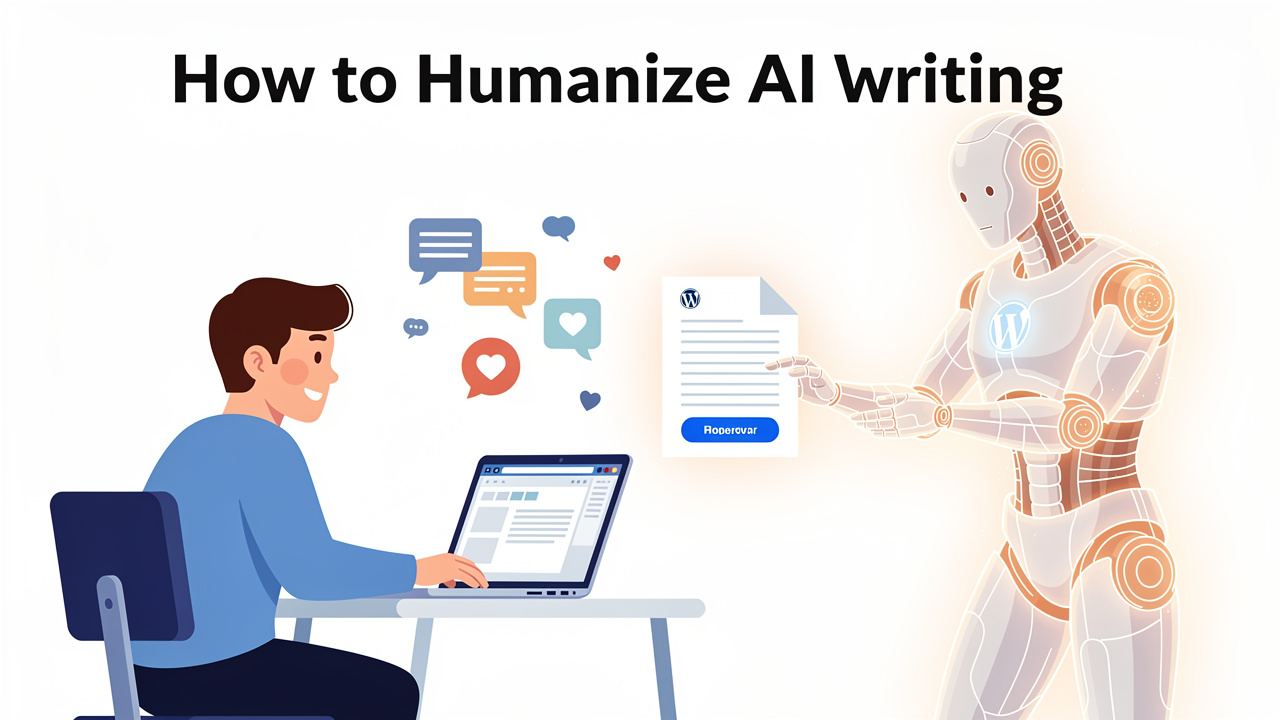
AI writing has a reputation. Most readers will identify it immediately — the flat cadence, the dubiously flawless syntax, everything striving for an inhuman absence of slight imperfection or authentic life. And so for bloggers on WordPress, it creates a dilemma when you want to humanize AI writing for WordPress blog content effectively.
You'd like the convenience of automated software, but you don't want your readers to flee in exasperation. The bottom line is—making AI content more human isn't concealing the fact that you've used AI. It's about making sure the end result actually resonates with people through AI content personalization.
And that takes intentional effort.
Why Humanization Matters More Than You Think
Readers are emotionally smart. They don't just absorb the content; they react to the way it is presented. A WordPress blog about something close to people's hearts—a personal finances, parenting, health, or fitness—does more than relay facts.
It's who a reader turns to when they don't have all the answers. That moment needs to be welcoming. Bland, lifeless content isn't just boring.
It destroys trust. Countless tests on content engagement find that emotionally engaging copy keeps people on the page longer, encourages them to come back, and gets shared across social networks. Bottom line: the human touch isn't a luxury.
It's table stakes.
Storytelling Techniques That Transform AI Output
Raw AI content tends to tell. Good writing, by contrast, shows by story. The solution is shockingly simple once you know where to look:
Begin with a scene, not a generalization. If you want to discuss productivity, don't start with "Many people are unproductive," tell me "It's 11 PM and Sarah is still staring at a half-done blog post, with three browser tabs open."
Practical storytelling techniques to layer into AI content:
- The before-and-after arc: Show a problem, then walk through the transformation. This works especially well for how-to posts and case studies.
- Micro-anecdotes: Short, two or three sentence stories that illustrate a point — they don't need to be long to be effective.
- Character-based examples: Instead of "users often find," try "imagine you're a freelance designer who just landed your first big client." That shift from passive to active, from abstract to personal, changes everything.
- Conflict and resolution: Every good story has tension. Even a blog post about SEO can frame the reader's challenge as a genuine struggle worth overcoming.
Remember, endings are also critical. We all know how AI-driven content can just... abruptly end. A strong conclusion that ties the story together or comes full circle makes content feel finished instead of left hanging.
Authentic Language: Cutting Through the Polished Veneer
AI writing can be too perfect. Every statement hits exactly the right note. Every transition reads effortlessly. And paradoxically, that perfection somehow is less believable.
Authentic language means writing the way thoughtful humans actually communicate. That includes:
- Contractions: "It's" instead of "it is." "You're" instead of "you are." Small changes, but they shift the entire register of a piece.
- Hedging when appropriate: Phrases like "this might work for you" or "in most cases" signal intellectual honesty. Humans acknowledge uncertainty; AI tends toward false confidence.
- Conversational asides: A parenthetical thought (like this one) or a quick "truth be told" signals a real voice behind the writing.
- Opinionated language: "I think this approach works better because..." is more engaging than "This approach is considered effective." Take a stand.
Swap out broad AI language for specific, descriptive terms. Instead of leverage your content strategy, say build a content plan that actually sticks. Instead of enhance user experience, say make your site easier to use.
Concrete beats abstract all the time.
Personalization and Tone: The Invisible Architecture of Connection
Tone is what the readers feel before they notice it. A blog written in the tone of casual human-to-human discussion has a very different feel from the same blog written in corporate-speak—warm and conversational, vs. stern and corporate—though the content is the same.
For WordPress blogs, tone should match three things:
- Your audience's expectations: A blog about luxury travel speaks differently than one about budget backpacking. Know who you're writing for.
- Your brand's established voice: Consistency matters. If your blog has always been casual and witty, a suddenly formal post feels jarring and off-brand.
- The emotional context of the topic: Mental health content needs gentleness. Business strategy content can be direct and punchy. Match the emotional weight of the subject.
Personalization is more than referring to "you" in the text. It involves foreseeing particular questions your readers will have and citing concrete situations they find themselves in, as well as writing as if you truly comprehend their realities. While AI can write about coping with anxiety, the humanized version respects the particular type of 2 A.M. anxiety that a parent of a sick child encounters as compared to a college student experiencing pre-finals panic.
Successful Implementations: What Actually Works
Several WordPress bloggers have found real success with this approach. A few patterns stand out:
The hybrid editing model: Use AI to create the outline of a draft. Write the intro and conclusion over entirely by hand, because those are the parts of a piece that people retain. Human writing there has a huge effect.
Adding signs of personal involvement: even minor elements like "when I experimented with this last year" or "recently a reader asked me about this" can convey an impression of authentic human presence.
Mimic language your target audience is already using—scan your blog comments and emails, then copy them word-for-word. If your readers are writing "I'm overwhelmed," then say "overwhelmed," not "stressed" or "challenged" in your own copy. It fosters an almost subconscious feeling of being understood.
Emotional signposting: brief emotional updates when an example introduces a topic. For example, "Having a bad comment on your blog really hurts, no matter how long you've been doing it - and that's totally normal." That one sentence just shifted the emotional landscape for everything afterward.
How to Humanize AI Writing for WordPress Blog Engagement
Engagement is more than comments and shares—it's making your readers feel like participators and not spectators in your content through engaging AI writing techniques.
Strategies that genuinely work:
- Direct, specific calls to action: "Leave a comment telling me which of these strategies you've tried" beats "share your thoughts below" every time.
- Vulnerability and honesty: Admitting limitations or sharing failures builds more loyalty than presenting a perfect, unassailable authority voice.
- Questions embedded in content (not as openers, but as genuine invitations mid-piece): "Have you ever tried this approach? Because honestly, the results surprised me."
- Reader recognition: Reference your audience's reality specifically. "If you're running a WordPress blog while working a full-time job, you know exactly how limited your writing time really is."
Balancing Efficiency and Empathy: Practical Tips
The whole goal is to get the best of both worlds - AI's speed and consistency, combined with genuine human warmth. Here's how to strike that balance:
- Use AI for structure and research; use your voice for delivery. Let the tool handle outlines, data summaries, and draft frameworks. Then write the actual sentences yourself, or heavily rewrite them.
- Build a personal style guide for your blog. Document your tone, your preferred phrases, words you never use, and your audience's specific language patterns. Use this as a filter for every AI draft.
- Set a "humanity check" before publishing. Read the post aloud. If any sentence sounds like something no real person would say in conversation, rewrite it.
- Prioritize the first 100 words. Readers decide within seconds whether to continue. Make sure those opening lines are entirely human in voice and emotionally grounded.
- Don't over-edit the life out of it. Sometimes a slightly imperfect sentence with personality beats a flawless but sterile one.
Best Ways to Humanize AI Writing for WordPress Blog Success
AI writing tools aren't going anywhere and for WordPress bloggers juggling multiple content calendars, SEO demands, and audience expectations all at once, that's really really positive. However, productivity without listening to will generate content in a way that truly has ceased to actually matter. Long-term winners aren't the bloggers who write most—they're the bloggers whose readers feel "seen." And that feeling comes from stories, from authenticity, from a voice that says "I know where you're coming from." AI can do the scaffolding.
But that human touch?
That part is still up to you.