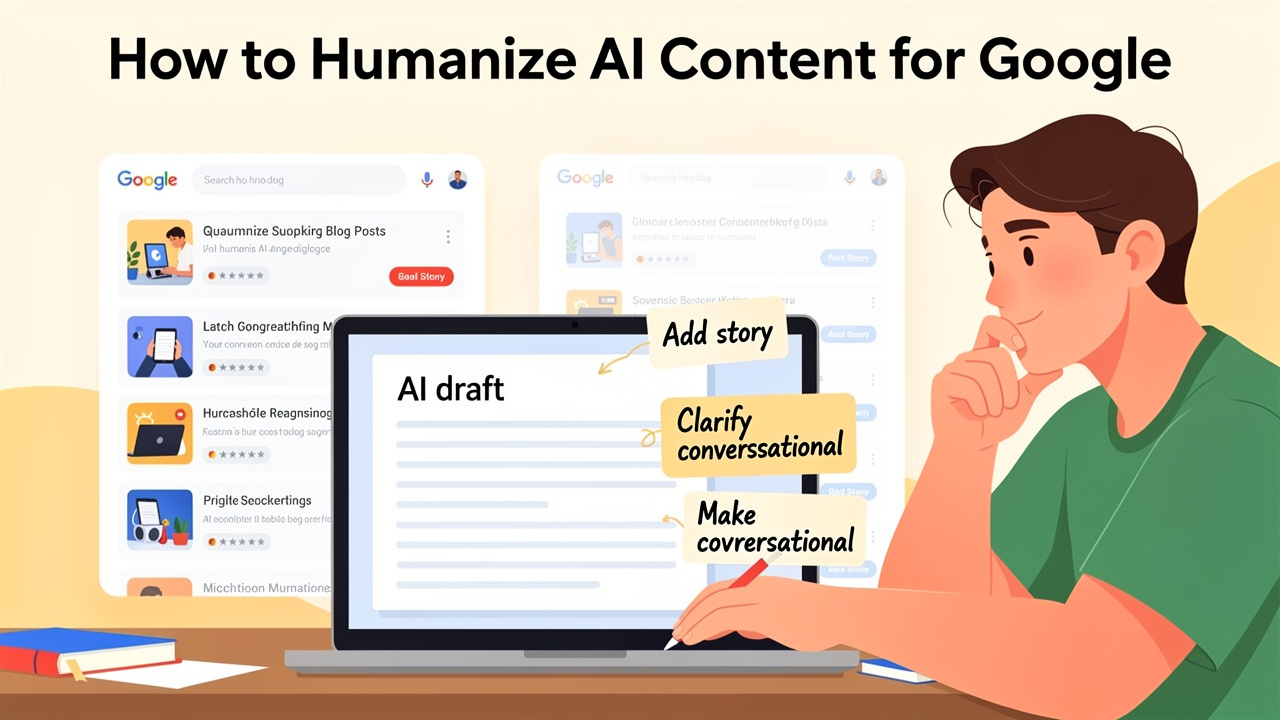
The issue with AI content isn't a technical one—sometimes the writing mechanics are spot-on. But the biggest issue is that most AI content appears to be written by someone who has actually never experienced a missed flight, a stubbed toe, or an hour of feeling completely in the dark. It's good, it's empty, and Google's algorithms are getting smarter and smarter at recognizing signals of legitimacy. Learning to humanize AI blog posts for Google requires understanding both authenticity in AI writing and enhancing AI content engagement.
Humanizing AI content is not just a creative challenge. It's a must for anyone looking to optimize SEO and secure genuine user interaction in 2024 and future years.
Why Google Favors Human-Feeling Content
Google's Helpful Content System—launched and iterated through multiple updates—seeks to identify content that appears to be written for algorithms instead of humans. It looks at indicators like experience level, expertise, and "whether the content answers the query it was sent or whether it gets the user to the next step in their journey."
Here is the thing: Google cannot reliably identify AI-writing at this time. What Google can reliably identify, however, is stale, superficial, experience-free content. And most of what you get from AI is exactly that - because AI models are not experience, they are...patterns.
By the way, experience is now explicitly one of the ranking signals of the E-E-A-T framework. Just one word, but it completely shifts the playing field. Hiking advice from someone who's been there, done that, who can describe a trail from first-hand knowledge, compares differently than one that's pulled descriptions from other trips and fused them together into one uniform "expert" voice. Experiential knowledge leaves evidence.
Core Strategies to Humanize AI Blog Posts for Google
1. Inject Personal Narrative and Specific Details
Some generic AI content states: "Meal prepping can save you time during the week."
Humanized content says: I began doing my own meal prep Sundays, after a very brutal Wednesday night of gas station sushi for dinner because I had nothing prepared. Never again.
The second version is specific, slightly embarrassing, and completely relatable. That's the goal. When editing AI drafts, actively insert:
- Concrete moments with real context (a specific day, a specific failure)
- Sensory details that only someone present would include
- Honest admissions — things that didn't work, decisions you'd change
- Numbers that are specific rather than rounded (not "a few months" but "about eleven weeks")
Lived experience. They give the reader confidence. He or she believes them, without knowing necessarily why.
2. Build Empathy Into the Structure
Content empathy isn't just tender words. It's construction. It means preparing yourself for how the reader is most likely to be confused, annoyed or doubtful, and naming those places without rushing by.
AI is frequently very "clean," and suggests linear progressions. Real human problems are not linear. A person reading about repairing their credit score may be driven by shame as well as curiosity. A person studying grief counseling does not want "five easy steps"—they want to be acknowledged before they receive information.
Practically speaking, humanized content:
- Names the emotion the reader is probably feeling before offering solutions
- Validates confusion or frustration instead of skipping straight to answers
- Includes "you might be thinking..." moments that show the writer considered objections
- Uses second-person language that feels like a conversation, not a lecture
3. Create Relatable Narratives with Real Stakes
Stories work because they make things matter. And when there's something to matter, that's how you keep people glued enough to get through the first paragraph, and that impacts bounce rates and dwell time, which impact SEO performance.
A product review starting with "I bought this standing desk because my lower back had pretty much staged a full rebellion after two years of working remotely" establishes a protagonist (the author), a problem (bad back) and some motivation (improving his life). The reader has an interest.
AI can induce the recipe of a story. But the texture of story - rebellion of a specific back - needs human intervention. That's where the editing pass becomes critical.
Practical Tips for Humanizing AI Drafts
-
Add a "real moment" opener. Replace abstract scene-setting with a specific, grounded moment that establishes context immediately.
-
Break the perfect paragraph. AI writes in suspiciously even, well-structured paragraphs. Humans don't. Add a two-word sentence. Let a thought trail off and restart. Use a dash — like this — mid-thought.
-
Insert at least one counterintuitive point. Humans notice things that contradict expectations. AI tends to confirm them. Adding one "actually, this common belief is wrong" moment signals genuine thinking.
-
Use hedging language where appropriate. Phrases like "in my experience" or "this might not work for everyone, but..." feel human because they acknowledge uncertainty. AI tends toward false confidence.
-
Read it aloud. Seriously. If you can't say a sentence naturally without stumbling, rewrite it. AI prose often reads fine on the page but sounds robotic spoken — and readability correlates strongly with engagement metrics.
-
Add a personal opinion. Not a corporate opinion, not a balanced both-sides take — an actual viewpoint. "I think the second approach is better, and here's why" is more engaging than "both approaches have merit."
Examples of Humanized AI Content Done Right
The Sleep Foundation pairs its AI-driven research with medically-reviewed and experience-based writing. Articles often recognize the reader's actual frustrations ("if you've tried every sleep tip and still can't sleep...") before providing a fix. This approach continually ranks well and attracts true backlinks.
Wirecutter uses AI to gather research but they require physical test experience narratives. The product reviews mention specific failures during testing (what broke, failed or disappointed) that distinguish them from generic comparison sites.
Everywhere one looks one finds. Filling the columns and pages are computer algorithms, relieving us of the drudgery of compiling source material and focusing our effort on bringing the experience layer that imparts credibility, clarity and navigability.
The Challenges — And How to Actually Solve Them
Challenge:Adding human tiers imparts a lot of additional weight to the system and reduce rate considerably.
Solution: Incorporate a "humanization checklist" into your editorial process (not after the fact) before publishing, which includes these five amendments: six-second personal story, one thing that goes against the grain, one expression of empathy, one concrete detail, one honest opinion. They take may be 20 minutes and the results are exponentially better.
Challenge:Feeling uncomfortable with putting one's personal experience into something one hasn't experienced oneself.
Solution: Interview someone who has. Five minutes talking to a professional, a customer, or a colleague can elicit the particular facts that a computer has no imagination. This also helps the E-E-A-T signals immensely.
Challenge: When editing the AI work, people often changes the tone of the work.
Solution: Create an explicit voice sheet before the AI layer takes over. Setthe voice's mouthfeel, a parameter that encompasses it not only language decisions but also to what extent is it emotionally fragile, opinionated, offhand, etc. An AI with a explicit voice can better replicate a defined voice than an undefined one.
How to Humanize AI Blog Posts for Google Rankings
It is crystal clear where Google is heading. Every algorithm update further intensifies the need for content that signifies real understanding, authenticity in AI writing, practical knowledge, experience, and resonance with users. In competitive categories, ranking sites do not produce the most AI-generated content—they produce the most trustworthy content. And trustworthiness is increasingly one and the same as having been written by someone who just happens to know what they are talking about, based on having actually experienced it first-hand.
AI is an incredible way to scale content production. But scale without sincerity is just digital noise. The companies and writers who learn to harness the scale AI provides with a touch of real human storytelling (the specific details, the honest confessions, the genuine moments of empathy) are the ones developing long-term SEO wins through enhancing AI content engagement.
Truthfully, this combination is more challenging than merely human produced content, or AI generated content. However, it offers much more value, and as has been argued throughout the course of this report, valuable is where you want to be in content marketing.