Understanding how to structure blog posts to rank in ChatGPT answers and AI search has become essential as AI-powered search evolves. What has worked for Google three years ago isn't guaranteed to get you that high visibility in ChatGPT, Perplexity, and Google's AI Overviews.
Those who understand how these algorithms are able to crawl and rank information will have a clear advantage - and those who don't will see their traffic silently evaporate.
The good news: How to organize content to be found by AI isn't that much different from post writing that is well organized for human speakers.
There is though also a certain set of techniques that truly has an impact.
Let's take them apart:
--- ## The Problem with Answer Stuffing: AI Search Behavior
Let's be honest. AI generated answer doesn't search keywords over multiple documents like humans do.
They are aware of the context, coherence and how the content of a piece of writing addresses a specific question.
Chat GPT and other similar programs can recognize credible, well-structured sources that provide comprehensive discussions on a topic.
Thin content, keyword-stuffed paragraphs and huge blocks of solid text are all ignored.
Clear and well-written posts tend to get references.
Imagine AI as a super fast and super impatient reader that wants to digest the valuable information in the minimum time possible.
Organize your content to benefit that visitor, and you'll excel in the rankings.
--- ## Keywords: Quality Over Quantity for AI Rankings
Keywords are still relevant in blog post optimization.
Although they continue to matter, the way they do so has changed quite a lot.
- Semantic relevance: AI is searching for meaning in the way you're asking the question. Any paraphrased question coming up in results as it is sematically equivalent to the original.
That said, strategic keywords still communicate what your post is about and tell the AI what to do with it.
Some keyword placement tips that work well:- Ensure the main keyword is present in the Title tag of the post and in the first 100 words. Write an H2 subtitle using the keyword or a synonym at least once. Use variations of the keyword (related terms) even if you have to stay within the same paragraph. Do not overuse the keyword word as it makes the content difficult to read and is also detectable by some AI engines. For instance, if you are writing an article "email marketing for small businesses" you should have that key phrase in the Title as well as in the opening 100 words and one or two semi-appropriate subtitles.
But in the post you would also use 3 other terms that are related too. Such as subscriber engagement, open rates, automated campaigns, and list segmentation.
That surrounding vocabulary communicates to AI - and humans - that you truly understand the subject.
---## Headings and Subheadings: Your Content's Skeleton
Headings do not only serve as visual structures.
They're signs that signal structure.
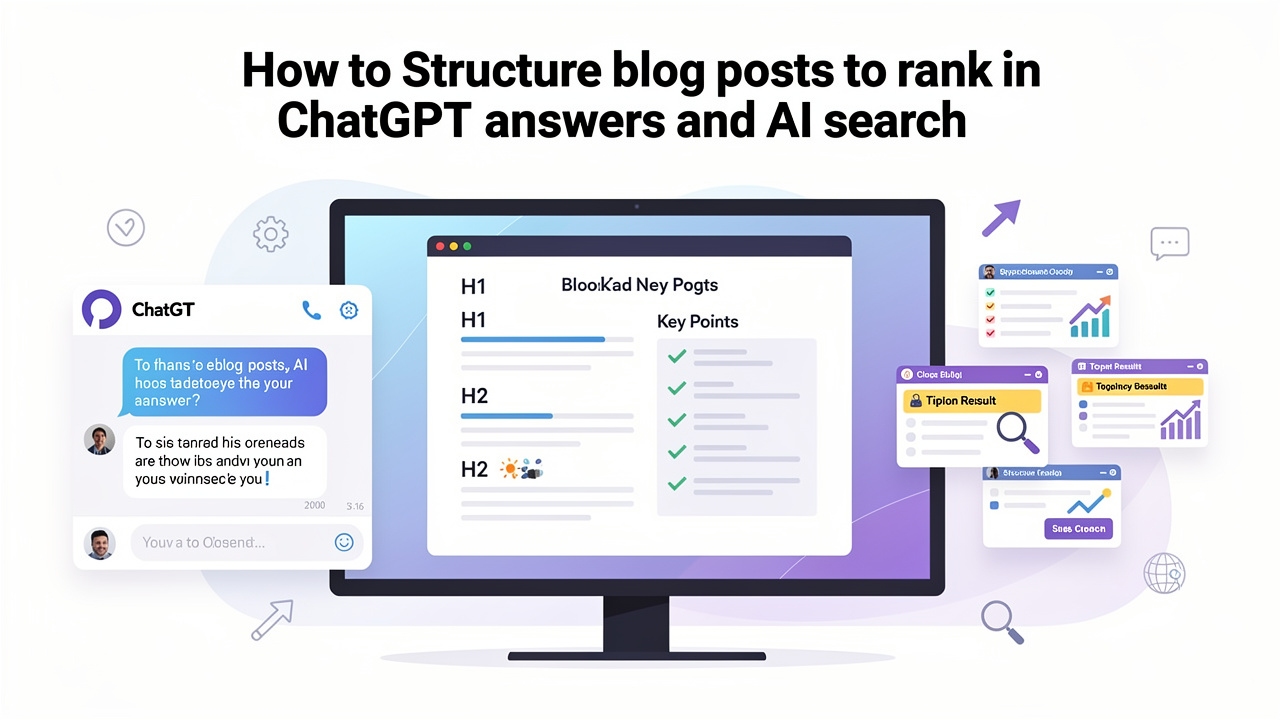
AI's use of heading hierarchies (H1, H2, H3) indicates how content in a post is formed and represents the contents of individual sections.
An example of a well-structured post is: - H1 - post title and primary keyword phrase - H2 - major theme sections (typically 3-6 in each post) - H3 - subpoints within each H2 When ChatGPT or Perplexity searches for a quote or excerpt from your post, it often finds the content immediately below a headline that accurately describes what's underneath it.
That's not a coincidence.
The heading informs the AI what the following content is about making it easier to pull out and cite.
What constitutes a good heading: [Looking to craft impactful headings? Be descriptive and precise. For instance, "How to Craft Meta Descriptions that Capture Clicks" is more effective than simply "Meta Descriptions"] - Incorporates a relevant keyword or phrase seamlessly - Addresses a question or offers apparent benefit - Keeps it short—generally within 10 words Example of a poor heading: [Heading 3—Additional Advice] Improved heading: [Three methods of using subheadings to enhance AIdisplay] The comparative difference might not seem all that crucial, but it can pack quite a punch in the competitive bounty for AIdid citation among thousands of similar blog posts.
--- ## Readability and Engagement: the Human Factor Still Comes Out on Top
Human preferences play a crucial role in the training of AI systems.
A lot of useful, easy to understand, and engaging content for real people also tends to do well for AI answers.
There're three other things which will surely minimize your chance of being surfaced; low readability score, overuse of passive voice and too much jargon in your writing.
Makes for easier to read paragraphs.
A bunch.
3-4 sentences per paragraph seems a fair upper limit: any more and you start to lose the thread with your readers (and AI).
Aside from the fact that blank space has specific visual importance, behavior on the page is equally important. Generally, nothing is accidental! Structure it so that it is easy to scan or remember. Recognizes only a few concepts: 1). White space; 2). Blocks of text; 3). Hierarchy; 4). Visibility.
Most importantly, in terms of blog writing you should refer to best practices of "Readability". - Get your blog reading between the 7 th and 9 th grade Flesch and Kincaid levels - Use active voice (5 ways to get the "Best" from your analytics "looks better" than "your analytics scan your divisions ""Consider the following for you blog each time"" sounds more natural than "Always consider our following issues for your blog and take action accordingly" - Bulletize long sections; make them numbered; put callouts in bold - Keep your sentences short for important points-it sounds more natural. Engagement signals help too:
Dwell time, low bounce rates and social shares indicate to search algorithms (and indirectly to AI training data) that your content is worthwhile reading.
A post which provides a great hook in the lead and then maintain consistent value throughout will out perform a technically optimized but boring article every time.
--- ## Meta Descriptions: Small Text, Big Impact
As with headings, however, they do not have any direct influence on the predication by the AI in a way like meta descriptions do.
But the points still are worth getting correct for a couple of reasons.
First, they influence click-through rates in traditional search, thus impacting the aggregate authority signals surrounding your content.
Secondly, certain AI tools actually scan the meta description as much as the content, especially if the actual post is paywalled, or is already locked down to anyone but a subscriber.
Meta descriptions—how to write good ones:--Keep them 150-160 characters--Place the main keyword somewhere in the first half—casually--Make them a real summary, not an ad copy--active voice—say what is to be learned—be specific Example of a weak meta description: "Read our blog post about SEO and AI search tips for better rankings." Example of a good one: "Learn the secrets of structuring blog posts for AI search engines such as ChatGPT—keyword positioning, headings, readability, meta descriptions." The second one is more specific, includes keywords, and tells you what to expect.
This clarity is essential as it allows both humans and AI systems to understand the significance of the post.
-- ## AI Content Ranking Strategies: Adapting to Change
AI powered search is a moving goal post
It keeps moving.
All the platforms including ChatGPT and Google's Search Generative Experience, and tools like Perplexity are constantly refreshing their strategies for retrieval and ranking.
What this further simply indicates to content producers is that as much as productivity is imperative, adaptability is big too.
Some interesting points to note are: - "Conversational queries are rising" there is a trend where people will start asking the question rather than typify in bits.
Those directly responding the asked question(s) (big hints for PONANTS or clear H2s similar to those asked very often) do well here.
- The emerging value of E-E-A-T signals—experience, expertise, authoritativeness, and trustworthiness.
Content published on trusted sites is ranking higher.
All of this is part of this, including author bios, citations and accuracy.
-
Higher quality, longer form content with good structure performs better—AI is able to draw more value from writing that provides value, rather than semi-relevant short form content.
-
Featured snippet optimization' and AI visibility can be in harmony- if content ranks in featured snippets in Google, it is inherently primed for citation by AI too.
Actually, the basic idea hasn't changed very much: create real value, structure properly and use a reader-friendly presentation.
AI has just made those fundamentals more tangible and more meaningful.
-- ## Final Word: Mastering AI Content Rankings
Ranking in answers generated by artificial intelligence needs knowledge in technology, and also in true writing.
Keyword usage, clear heading structure, easy-to-read copy and good meta descriptions combine to produce a powerful content strategy. Not just isolated tips, but a simple built-in framework:
The bloggers best at AI Search won't always be those who were the most clever at gaming the system.
They are users who skillfully draft, plan methodically, and adapt continuously as the field develops.
Get back to the basics here, then put them into practice without fail and you'll be so much more than most.