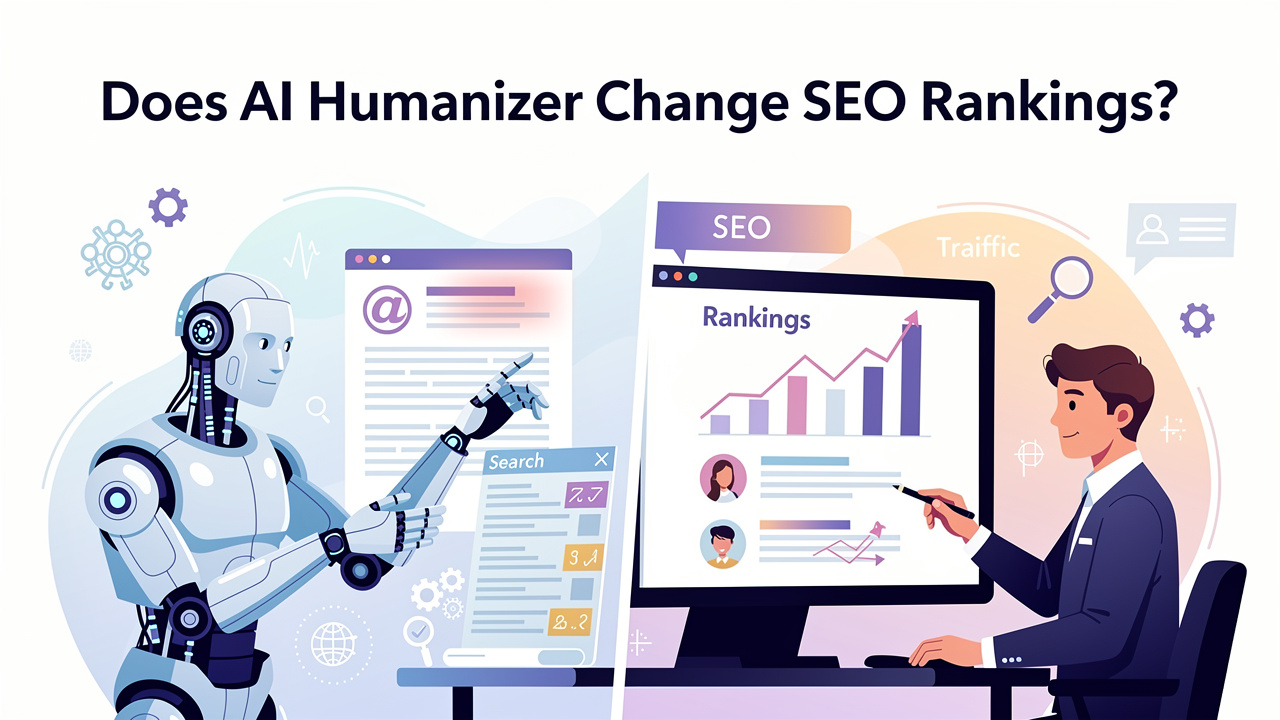
Most search engines are now experts at understanding exactly what users are searching for and this change has large effects on how well AI created content does. The simple answer to the question of whether does humanized AI content rank better is: yes, in most cases. However, the more complex answer lies behind understanding why and what "humanized" really is.
What "Humanized" AI Content Actually Means
Humanized AI content is not AI writing with a comma here or a contraction there, in the way it reads, it actually feels like it is addressing real questions with real concise answers, it flows like a conversation, not a bunch of words generated by a machine trying to mimic humanity.
Think about the difference between these two sentences:
- Generic AI: "It is important to consider the multifaceted nature of content optimization strategies."
- Humanized: "Ranking well takes more than keyword stuffing — you need content people actually want to read."
The second version is quicker to get your point across, has more of an air of authority and thus maintains the reader's attention. That's the main thing.
How Human-Like Content in SEO Affects Rankings
Google's algorithms— especially the Helpful Content System rolled out in 2022 and revised many times since—are very plainly designed to reward content written for people, not search engines. They even require content to have "experience, expertise, authoritativeness, and trustworthiness" (E-E-A-T):
This is where it really begins to get exciting. Search engines no longer only crawl text. They also interpret behavioral signals: dwell time, bounce rate, clickthrough rate... All of these factors have an influence on rankings, and humanized content optimizes behavioral signals by encouraging users to spend time reading the site.
According to a 2023 Semrush study, content possessing a clear conversational layout and targeted specifics significantly outperformed content that was minimal and generic with the same keywords, with the quality difference revealing itself as soon as 60 to 90 days in organic traffic.
Therefore, I would say there is a strong case for SEO to make AI content more human through proper AI content optimization techniques.
The User Engagement Factor
Engagement is where the humanized content really delivers. Readers are very savvy. They will be able to discern in a very short space of time if the content was written by someone who knows what they are talking about or by an AI that is simply pattern-matching without true understanding.
Generic AI content tends to:
- Use vague, circular explanations that don't actually answer anything
- Repeat the same ideas in slightly different words
- Avoid specifics, examples, or concrete details
- Sound oddly formal in places, weirdly casual in others — but not in a natural way
And humanized content that does the opposite. It stands for something. It provides concrete details.
It understands the reader. It preempts potential objections and shoots them down. From a conversion perspective, this is huge.
People buy from specificity and sincerity. Item descriptions that tell me precisely how something works—using down-to-earth language and concrete examples—convert far better than those that brag about themselves. That's not just my opinion.
That's what many years of conversion rate testing and optimization done by places such as the Nielsen Norman Group has shown time and time again.
Real-World Examples of Successful Implementation
Many brands have cracked this. HubSpot, for example, uses a machine-learning content generation tool but every article is then passed on to a human editorial team who adds relevant examples, real personal touch and authentic voice. Their blog ranks number one in search results for both marketing and sales related topics – not just due to domain authority but because people can actually read it and find it interesting.
Study cases from the Help Center of Shopify. Nearly all of its content were been written or helped by AI but the language used is direct, second-person, with detailed instructions step-by-step. It ranks for thousands of long tail queries because it answers questions completely, without fluff or vagueness.
On the other hand, a number of content farms relying on massive amounts of raw AI content production failed after the Google's Helpful Content updates to a wide extent. Some even halved or more than halved their organic traffic practically at once. It was an expensive lesson.
Expert Opinions on the Matter
There has been a major change in consensus among SEO experts over the past couple of years. Back in 2013/2014 the question of whether AI content could rank at all took up most of the debate.
Here's from John Mueller over at Google clearly on the issue of AI content: "Google doesn't devalue the AI content itself but it devalues low quality content and low quality content can be created with AI tools or by a human writing it manually - the quality is what counts." This was the key takeaway to note: if AI created content is humanized and truly provides value for the user, there's no reason it can't rank highly. Low quality or unhumanized AI content won't.
SEO specialist Lily Ray, who has been closely monitoring the Helpful Content updates from Google, has observed that websites which have demonstrated authentic authoritativeness, brilliance, and original viewpoint from the onset will bounce back more quickly following an algorithm change than websites that relied heavily on high volume, low effort content approaches.
The direction serious content teams are moving in is one of a human-in-the-loop-- the AI does the preliminary drafts, research snapshots, structural guides, and the humans come in and inject the judgment, nuance, and personality that makes the content actually compelling.
Factors That Influence Rankings Beyond Just "Quality"
Content quality is crucial, but it doesn't exist in a vacuum. Several other factors interact with humanization to determine how well content ranks:
Relevance and Search Intent
Even good stuff falls flat if it isn't what searchers are looking for. An article infused with the human touch on "how to invest" won't outrank a searcher looking for beginner advice when you wrote an in-depth academic paper. Intent alignment counts too.
Content Depth and Completeness
Content written in a humanized way is naturally more complete—as humans think about subsequent questions or awkward edge cases by their nature. This lets search engines interpret the page as a comprehensive resource.
Internal and External Linking
Content that links to accurate sources and related internal pages does better. Coincidentally, humanized content naturally links to specific sources which supports E-E-A-T signals.
Page Experience Signals
Core Web Vitals, mobile-friendliness, and page speed all impact rankings. But one thing to bear in mind - even having the perfect technical scores will not prevent content from falling flat if people bounce off instantly as it is unreadable.
Freshness/Updates
Recall the freshness: depending on the nature of the copy, be it an article or a book, the refresh rate could vary greatly. For instance, books tend to stale quickly if the contents are not updated periodically while an article can stay current for a much longer period of time.
Humanized content is more easily/updater to add relevant value to, since it is based on particular arguments, theme, concepts, examples, thus not as much on general 'webpage fluff'. Continuous, valuable updates give good freshness signals to search engines.
Trends Shaping AI Content Creation in 2024 and Beyond
The content industry is moving fast. A few trends are worth watching:
- Retrieval-Augmented Generation (RAG) tools are helping AI pull from current, specific sources rather than generating vague generalizations — making humanization easier
- AI writing assistants like Claude and GPT-4 are increasingly used for drafting rather than final publishing, with human editors making the critical final pass
- Voice and personality guidelines are becoming standard in content teams — basically style guides that tell AI (and humans) how the brand actually sounds
- Brands are investing more in subject matter expert interviews to feed AI drafts with genuine insight and original data
It's very clear: The technical aspects are run by AI, and the human aspects by human.
Does Humanized AI Content Rank Better: The Bottom Line
Why do humanized AI content perform better in terms of search rankings?
Humanized AI content performs better with the human factors that search engines look for. It results in better dwell times, lower bounce rates, improved click-through rates, and higher conversions. These behavioral signals will be factored into search rankings in the long run.
Brands that are winning in content right now aren't the ones trying to pick a side: human or AI. They're trying to combine the best of both, with AI for speed, human for results—such a combination, executed well, is really tough to beat.