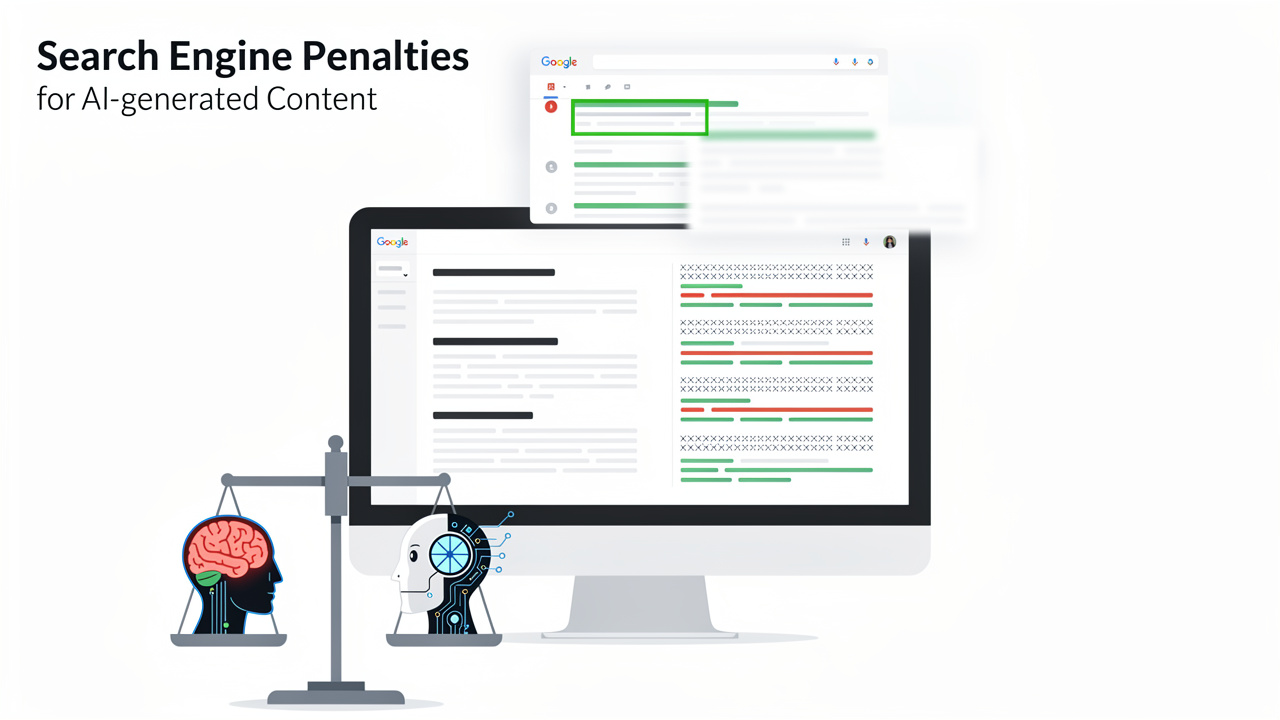
Simply put: it depends. And that little detail makes all the difference for any content strategist planning to head into 2024. The question "does Google penalize AI generated blog posts" is complex because Google won't penalize content creation simply because a computer was involved, however it will definitely devalue content that is of poor quality and not in any way useful or relevant and has been mass-produced towards the end user.
Recognising the distinction between those is the key to any bloggers SEO success when it comes to AI content creation.
Does Google Penalize AI Generated Blog Posts Officially?
Google's official position has changed significantly in recent years. Google in 2022 revised its guidance to state that Content generated by AI is not in itself a policy violation. A policy violation will occur when a piece of content is generated specifically to manipulate search rankings - whether that content is created by a human or a machine.
John Mueller, Google's Search Advocate, was candid in admitting that content that is automatically created has historically been viewed as spam. But he did also acknowledge that context makes a difference. An informative, thoroughly researched, naturally valuable piece of content that was built with the help of AI is in an entirely different category to a website that produces tens of thousands of keyword-prime, nowhere-near-editorially-updated pages.
The point is, Google's algorithms actually don't "know" if a piece of content was written by a person or by a robot. What they do know - pretty accurately - is if a piece of content fulfills user intent, shows expertise and gathers user signals such as time-on-page and very low bounce rates. This understanding is crucial for Google algorithms and SEO strategy.
How Google Evaluates Content Quality
There are multiple systems that Google uses in concert to filter content—this is important to understand for any AI-using workflow and AI content creation process.
The E-E-A-T Framework
E-A-A-T is an acronym for experience, expertise, authoritativeness, and trustworthiness. It is what Google's human quality raters use as a criteria and what the search engine's algorithms evaluate pages against.
- Experience: Has the author actually used the product, visited the place, or lived through the situation they're describing?
- Expertise: Does the content reflect genuine subject-matter knowledge?
- Authoritativeness: Is the site recognized as a credible source in its field?
- Trustworthiness: Are claims accurate, sourced, and presented honestly?
AI tools--even ones that are pretty impressive--simply can't handle the "Experience" layer. They can push out amazing synthesizations of info they get, but they can't inform you--knowingly--how it actually felt to test a product for 3 weeks or tackle a real-world problem in a real-world business. That's a human editor's input.
Helpful Content System
Google's Helpful Content System was rolled out in August 2022 and has undergone a number of revisions since. It affects content that has been created with search engines in mind rather than people. Those impacted by the rollout often experienced large ranking declines - as high as 50-80% in organic traffic overnight.
The system evaluates signals like:
- Whether content provides original analysis or just rehashes existing articles
- Whether visitors leave quickly after reading (suggesting disappointment)
- Whether the site demonstrates a clear purpose beyond SEO traffic
That's the sort of thing the tool is meant to detect—to write something that has more or less just culled from other sources and there's nothing original or new in it.
Case Studies: AI Content and Search Rankings
Nothing beats real examples when examining whether does Google penalize AI generated blog posts in practice.
CNET's AI experiment (2023): Quietly, CNET released dozens of AI-created financial explainer articles. The reaction to the uncovering was fierce. Editors found a large number of factual inaccuracies in the articles. Once edited and republished with the editorial team, most recovered their search rankings however they were likely underperforming compared to their native equivalents, even before being edited. The lesson was not that the algo brought in penalties but that an unedited output could damage credibility through the degree of errors contained.
Bankrate / Red Ventures: Two other publishers in the personal finance area, same experiment, same mixed results, same conclusion—hybrid model, using AI to generate structure/initial drafts but having an SME review, fact check, and rely on proprietary source material. Traffic was maintained and sometimes increased using this method.
Niche Site Owners: Within several SEO forums including: Reddit's r/SEO; and various case study blogs, site owners of smaller sites told us that thin ai content (articles <600 words in length containing no original data, images, or quotes from experts) always flopped. Sites that used ai to write longer, more comprehensive articles, and added human context were typically unaffected.
The Real Risk: Scaled Content Without Quality Control
Here is the part where most people go astray. The danger of these AI tools is volume. You can generate 50 articles in a day. But should you? Most likely not without quite tight editorial guard rails.
The SpamBrain infrastructure by Google was focused on the problem of scaled content abuse (a term Google employed in the documentation of its core update of March 2024). Sites which used to publish huge volumes of AI content without 'human touch' were among the most severely penalized.
The pattern Google appears to identify includes:
- Extremely similar article structures repeated across hundreds of pages
- No original statistics, quotes, or research
- Generic author bios with no verifiable credentials
- High-volume publishing schedules inconsistent with a real editorial team
Expert Opinions on AI and SEO
"The question isn't really 'did a BERT workshop write this'-the question is whether a human would find it actually useful," says Lily Ray, Senior Director of SEO at Amsive Digital, perhaps one of the more vocal voices on this matter. According to her research into the Helpful Content updates, topical authority and content depth outweigh the tool that was used: Barry Schwartz, the editor of Search Engine Roundtable, has been regularly noting that Google's core updates seem to be more correlated to site-wide quality signals than specific article source signals. A website with strong backlinks, healthy technical site and history of original useful content can publish AI enabled articles without much worries - if those articles are at par with site quality.
Best Practices for AI Content That Ranks
Getting started with AI in your content strategy without getting penalized ultimately boils down to a few rules that simply cannot be broken when considering AI content creation.
- Always add original research or firsthand experience. Interview an expert. Run a survey. Share a real example from your own work. This is the layer AI simply cannot replicate.
- Fact-check everything. AI tools hallucinate. Confidently. Verify statistics, dates, quotes, and claims before publishing.
- Optimize for humans first. Read the draft aloud. If it sounds robotic or generic, it needs revision.
- Build topical authority. Rather than spreading AI content across dozens of unrelated topics, focus on a specific niche and build comprehensive coverage.
- Use AI for structure, not soul. Let AI generate outlines, headers, and first drafts — then let human expertise shape the final voice.
- Disclose AI use where appropriate. Transparency builds trust with readers, and trust correlates with the engagement signals Google measures.
- Monitor performance closely. If an AI-assisted article underperforms, update it. Add quotes, data, or a personal case study. Google rewards freshness and improvement.
What Actually Triggers Penalties
Clarification: Google doesn't have "AI detector" built-in to the rankings. Instead, Google has quality signals that ineptly produced AI content flunks. Thin content flunks.
Inaccurate content flunks. Content that doesn't meet search intent flunks. In other words, this isn't about using AI, it's about publishing substandard work—and AI allows you to do this at scale before you've properly defined what 'good enough' means for your audience.
Conclusion
AI generated content isn't the reason why Google will penalize you though. It just leads to situations where it happens far more easily - mainly if quantity overtakes quality. And the bloggers & online marketers who are succeeding with AI are not using it to displace human mind; they are using it to enhance it.
Yes, they are creating far more material, but also far better material - by investing the time saved on research, validation and true editorial work. That's the kind of trade-off worth pursuing when balancing Google algorithms and SEO with AI content creation strategies.