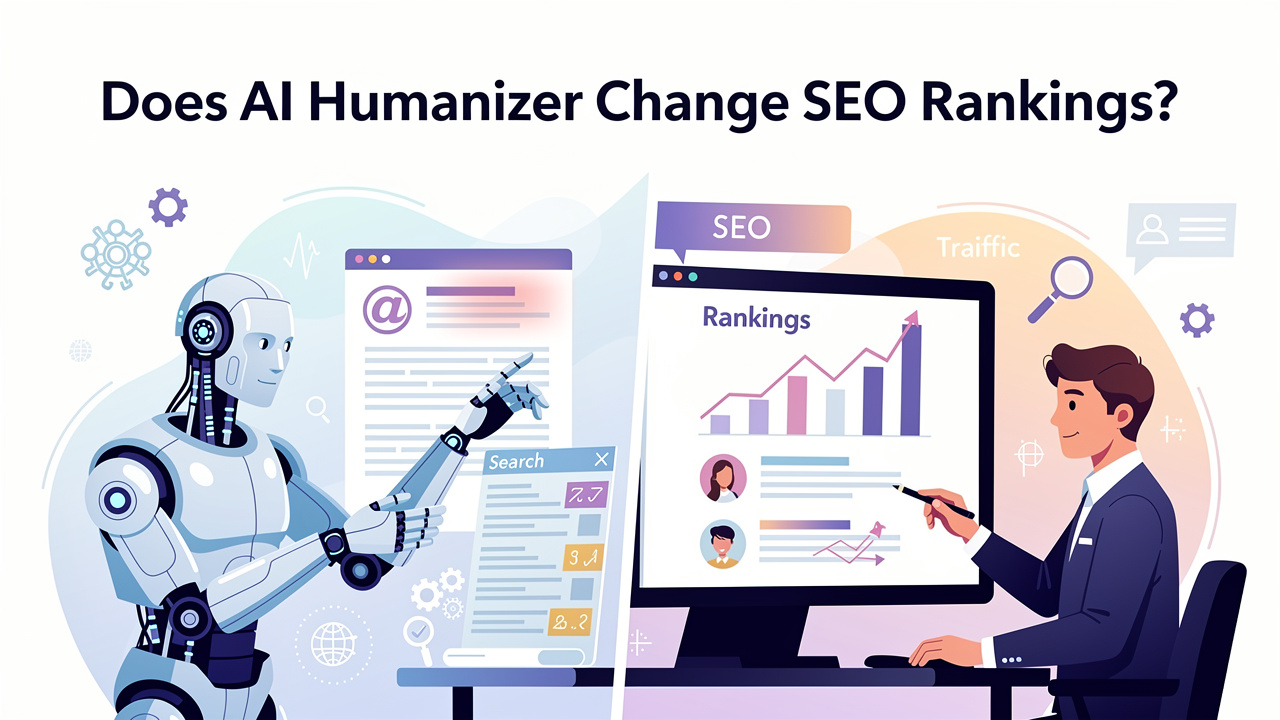
Everywhere you look, AI content is being utilized. Corporations are utilizing it, bloggers are utilizing it, and even the largest of publications has quietly begun using it for select types of content. But the question that every marketer has is simple - can AI content rank on Google? The answer affects content strategies across industries.
The quick answer is yes. However, there is far more depth here when considering AI content ranking factors and SEO strategies for AI-generated content.
How AI Content Is Actually Created
Contemporary AI-generators for writing—ChatGPT, Claude, Jasper, Copy.ai, etc.—operate by selecting the statistically best next word according to vast training corpora collected from the world wide web, books, and countless other text sources. They do not get "what is meant" in the way people do; they match patterns on scales that are truly difficult to grasp.
The results can be all over the place, depending on the quality of the prompt, which tool the AI is being used in, and the amount of human editing that occurs after the initial output. Some AI content is tight, formatted, and useful; other pieces sound good at first glance, but are ultimately empty - and the difference makes all the difference from an SEO perspective.
Very few of the most advanced content teams are replacing AI entirely. Mostly they're using it as a drafting boost. An author will get AI to create a skeleton, help work up a first draft or brainstorm angles - then spend a lot of time editing, plugging in actual examples and providing insights that only a person can offer.
Can AI Content Rank on Google: Official Position
Google's made quite explicit already (several times over since 2022) that: *they don't prefer AI or human written content—what they do prefer is helpful, accurate, userfocused content.
They even made it clearer in their March 2024 core update where they went after "scaled content abuse", which was essentially – created the web a ton of AI content, not in a way intended for humans but to take as much search traffic as possible. Tons of sites saw 50-80% traffic losses in a matter of days.
However here is the catch: a lot of sites that generated decent AI helped content, they're not moved down.
The lesson isn't "avoid AI." The lesson is don't use AI as a shortcut to leave out the hard work of making something valuable.
Current Trends in AI Content Strategy
The content marketing landscape has shifted pretty dramatically in the past two years. A few clear patterns have emerged:
- AI-assisted, human-edited content has become the dominant model among professional agencies and in-house marketing teams
- Topic cluster strategies are being built faster using AI for supporting content, while human writers focus on cornerstone pieces
- Product description generation at scale — particularly in e-commerce — is one of AI's clearest wins, where quality and uniqueness can be maintained with the right templates
- Local SEO content (think city-specific landing pages) is another area where AI handles volume effectively, provided there's actual local data being fed into the prompts
- Repurposing existing content — turning a podcast transcript or a webinar into a blog post — is arguably AI's most efficient use case right now
Brands such as HubSpot, Bankrate and CNET have all publicly tested AI content with varying degrees of success. Early CNET AI articles produced in 2023 included factual inaccuracies that had to be fact-checked and corrected, damaging their reputation temporarily. Bankrate opted for a more cautious approach with all editorial oversight embedded at the outset, and experienced much better success.
What Actually Determines Rankings: Quality, Relevance, and Engagement
Google has no "AI detector" built into their ranking algorithm (in any case, the current AI detectors aren't reliable anywhere), but what they do have are indicators of how well content actually fulfills the user need.
Quality signals are:
- Depth and accuracy of information
- Presence of original research, data, or expert quotes
- Proper sourcing and factual reliability
- E-E-A-T: Experience, Expertise, Authoritativeness, Trustworthiness
Relevance signals include:
- Keyword intent alignment — does the content actually answer what the searcher wanted?
- Topical coverage — does the page address the subject comprehensively?
- Semantic relationships — are related concepts covered naturally throughout?
User engagement signals include:
- Click-through rate from search results
- Time on page and scroll depth
- Bounce rate relative to page type
- Return visits and branded searches
AI content has a tough time with quality signals. It's quite good at relevance if you give it good, specific instructions. But real E-E-A-T signals— actual experience, the kind of experience that shows expertise— can only be provided by humans.
An AI can't tell you what it felt like to implement a given software platform into a particular business situation. It can give you the mechanics behind how the platform works, but that's not the same.
Expert Opinions on AI Writing Reliability
There is seriously conflicting opinions within the SEO community as well. Some much-respected SEO brands have been fetching to the idea of AI. Still others are deeply skeptical.
Lily Ray, a prominent SEO researcher for Amsive Digital, often makes the point that Google's quality raters are trained to spot little effort content—and that AI content, without heavy human editing, tends to break quality rater guidance on E-E-A-T.
Conversely, practitioners such as Kevin Indig have been claiming that content created by AI can most certainly perform if utilized in smart ways and edited with care, and that there's a benefit to those teams who find the right workflow rather than dismiss AI altogether.
The general consensus, more or less: AI is a tool, not a strategy. The companies having AI success stories with content have decent editorial processes, not just production faster content.
Challenges AI Content Faces in SEO
Let's be honest about the limitations:
- Factual accuracy remains a genuine problem. AI confidently states things that are simply wrong, and without expert review, those errors go live
- Originality is structurally limited — AI recombines existing information; it can't break news, conduct original research, or offer truly novel perspectives
- Thin content at scale is a real risk — it's easy to produce hundreds of technically unique but practically identical pages
- Personalization and brand voice require significant prompt engineering and editing to achieve consistently
- Algorithm vulnerability — Google's updates specifically target AI spam, and sites that built their traffic on low-quality AI content have been hit hard
Can AI Content Rank on Google: Practical Framework
If you're thinking about incorporating AI into your content strategy, here's a practical framework:
-
Start with a clear editorial standard. Define what "good enough" means before you generate a single word. Quality benchmarks should come first.
-
Use AI for acceleration, not replacement. Let AI handle first drafts, outlines, and structural work. Have a human add data, examples, quotes, and genuine perspective.
-
Prioritize E-E-A-T signals. Add author bios, cite credible sources, include original data or case studies wherever possible. These signals can't be faked or automated.
-
Audit regularly. Run content quality audits every quarter. If pages aren't performing or are generating high bounce rates, revise or consolidate them.
-
Don't chase volume for volume's sake. Publishing 500 mediocre AI articles will hurt you more than publishing 50 genuinely useful ones.
-
Test before you scale. Pilot AI content in one content category, measure performance over 90 days, then decide whether to expand.
-
Invest in prompt engineering. The quality of AI output is directly tied to input quality. Teams that develop strong, detailed prompts get dramatically better results.
Conclusion
AI content can rank on Google, this has been shown more than adequately now. However to rank highly it requires the same quality of material as it always has done: real usefulness, topical authority and content that genuinely benefits the reader.
The most successful businesses aren't messing around with AI being a sort of "magic traffic device". What they are doing is using AI as a capable but relatively far-from-perfect assistant that requires mastery, human concern for the culmination of the machine's work, and human editing. That marriage—speed of the AI plus human foresight—is where the real competitive advantage actually resides.
Truth be told, the basic strategies of SEO haven't really changed. Create something worthwhile. Make it easy to locate. Provide reasons to linger. AI can assist you in these tasks faster. However, it cannot do them for you.