Understanding what is LLM SEO and how does it differ from traditional SEO is crucial in today's evolving digital landscape. Search engine optimization have been around for a long time.
But the advent of LLMs has driven that evolution into uncharted waters in a very real way—waters that early adopters of all shapes and sizes are only just beginning to navigate, in the moment.
This LLM SEO doesn't simply mean a simple new branding of old strategies.
It is a radically different way of thinking about how content is recognized, understood and surfaced through AI applications.
But understanding this makes a huge difference if you want your content to remain fresh in years to come.
Understanding LLM SEO and Traditional SEO Differences
LLM SEO is the process of optimizing your written content for the search and discovery processes of large language model platforms - like ChatGPT, Google's AI Overviews, Perplexity AI, and Microsoft Copilot.
They don't connect keyword with the pages.
They comprehend content within a context, infer, reason, combine information from multiple sources, and produce a directly answer instead of list of blue links.
Therefore LLM SEO is essentially everything and anything that helps your content being recognized as worthy of trust and being referenced by these systems.
It is more about how to organize content so language models can understand it properly, how to enhance topical authority in a way that the AI will regard as trustworthy and how to create content in such a clear form that it becomes truly quotable.
An LLM means a Large Language Model - this is the core technology behind systems such as GPT-4, Claude, Gemini etc.
These models trained on so large datacenters that they can understand language as subtlety that older keyword-matching computers just didn't have.
Large Language Models in Search
What about current AI search? Intelligent search can't be keyword-based.
It thinks in concepts has relationships, relevant contexts.
If you ask Perplexity AI for any such, "what is the best project management software for remote teams with less than 10 people," the system does not lookup pages that contain those exact words.
It merges several authoritative, clear, and correct sources to generate its answers.
Perhaps it is a detailed comparison article, or a Reddit thread full of real user experiences, or a fairly clear FAQ page - possibly all three together.
The same applies for Google's AI Overviews (formerly Search Generative Experience).
It understands your text like a well informed human researcher would, then determines whether your explanation is sufficiently understandable, correct, and reliable enough to be incorporated into a synthesized answer.
This flips all this on its head. Where otherwise "optimisation" can be taken to mean a property or process that reduces whenever applied, This new definition covers everything.
How LLM SEO Differs from Traditional SEO
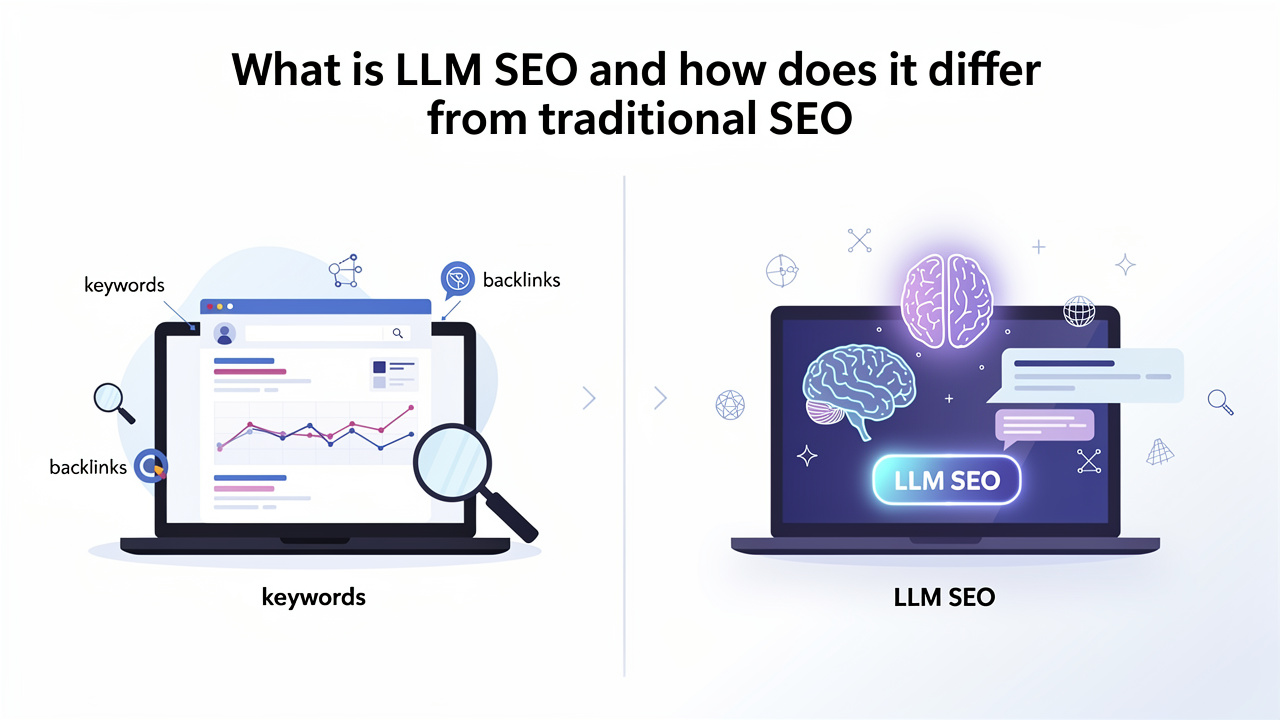
Traditional SEO and LLM SEO are certainly related, however their priorities are very different. The differences between LLM and traditional SEO become apparent when examining their core approaches.
| Factor | Traditional SEO | LLM SEO |
|---|---|---|
| Main focus | Search engine web crawlers | AI language models |
| Optimization effort | Keywords, links, tech setup | Topical expertise, knowledge, clarity, correctness |
| Content design | Rank on search results pages | Cited by AI to produce responses |
| Content DOI | Clicks from search, search results | Cited by AI to generate expert answer |
| Linking strategy | Most significant ranking component | Less so; indirect trust tokens are crucial |
| Content length | Usually targeted for word count | Targeted for completeness & clarity |
Conventional SEO is firmly rooted in signals: keywords, page authority, backlinks, loading times.
You were in fact addressing an algorithm that paid off for the qualities for which you measured.
LLM SEO requires something else.
I think the algorithm has then itself become in a way a reader.
And readers want to know. Will this make sense? Will this really help? Can I get this trustworthiness?
The Benefits of Using LLM SEO
1. Balances the playing field to some extent. Proven high quality, authoritative, informative content on a smaller website may be able to be referenced by AI even if it doesn't have the huge backlink profile that traditional SEO might have driven in the past.
Healthline, for instance, accumulated enormous traditional SEO authority for years—something a comprehensive, easily-understood health blog written with originality can rise to in AI answers nonetheless.
2. Rewards real expertise. LLMs tend to do surprisingly well at shallow content detection.
Generally, if you know your subject and write down to it and with particularity—this will be evident.
Generic broader / vague resistant copy gets ignored.
3. More durable content. Old SEO content had to be continuously updated to remain relevant.
Content that is better suited for obtaining LLM citation – for example, content that is straightforwardly, definitional or explanatory, and that, in other words, "satisfies question" – can be enduring.
4. Brand reputation accumulates. If other AI tools and models continually reference your data, your brand will be linked with the topic you cover.
The visibility has a different flavor of a
- rank, but I think this one will last longer.
The Challenges of LLM SEO
There are some significant problems to consider:
1. Hidden signals. Traditional SEO, despite its intricacies, had quantifiable indicators.
You may track your rankings, analyze backlinks, audit the technical site elements.
Using LLM SEO, you probably can't determine specifically why one citation was favored by the AI.
The optimization logic remains somewhat transparent.
2. Attribution issues. Many AI systems generate an answer with source references but no clear pathway directing traffic to those sources, unlike the usual
- .
Getting cited in ChatGPT matters for brand awareness—but it is unlikely to drive clicks.
3. Rapid changes between models.
Refers to the fact that what was referenced today may not be on another day as the what is the reference today, is part of a model that has been altered, retrained, and re-evaluated.
This is instability which old SEO, for all its volatility, didn't quite manage to cause.
4. Fabrication risk. AI is able to distort your content.
They could reference your site, perhaps somewhat misrepresenting your words.
That's a real new issue that don't really have a tidy answer yet.
How This Translates to Practice
Practically, LLM SEO means well structured, well-defined writing matters more than ever:
Content that explicitly states definitions, formatting as accurate headers and answering specific questions directly is more likely to be detected by the AI systems.
Imagine the style in which Wikipedia presents the evidence - there is no coincidence in this.
E-E-A-T, which stands for (Experience, Expertise, Authoritativeness, Trustworthiness) has been made the focus.
Google has been promoting this paradigm for quite some time, but LLMs are just handing it over.
Providing the author credentials, references, and real world evidence would allow the AI systems to have a low level of trustworthiness.
In particular, the FAQ pages and question and answer pages used in a structured format reach high positions.
If Google requires a clean answer to a particular question, and Perplexity or Google's AI Overview has provided it with that perfect, formatted document:
Recent mentions of the brand across the web have a different significance.
Previous SEO worried about backlinks using particular anchor text.
LLMs definitely look for your brand name appearing in trustworthy environments across the web—forums, reviews, news sites, citations in research papers.
Take for example, the many references given to Hubspot in AI answers on marketing. It has a lot of mentions because it's cited everywhere, not only because of a high domain authority.
The Future of LLM SEO
The trend for LLM SEO is evolving rapidly.
There are a few pretty clear trends:
AI-powered search is set to increase its share of user access to information.
According to Gartner, in 2026, traditional search engines volume can be 25% lower as AI tools take over most informational searches.
That's quite a big switch.
Multimodal optimization will be of interest.
Most LLM SEO are text only at this time, however GPT-4o and Gemini panels handle images, video and sound.
Eventually it will all count.
Answer engine optimization, or AEO, is starting to develop as a separate discipline from LLM SEO – concerned solely with gaining placement in answer boxes generated by AI, not general rankings.
Verification and source validation will offer competitive advantage.
The more advanced our AI is at judging facts the more the factual, referenced, and author transparently will begin to pull away from generic content farm-style pieces.
Final Considerations
The LLM SEO is not going to fully replace the old classic SEO; it takes time for the change to occur.
They live together right now, and I suppose they'll keep doing it for a while.
But the tide is turning.
Original Content that is truly transparent, authoritative, and organized will have more value (not only to humans, but also to the machines that are more and more determining how those humans find it).
Fundamentals like good writing and sincere expertise have always remained important.
LLM SEO just adds another barrier of making it difficult to fake them. LLM in digital marketing represents a fundamental shift in how content optimization works.