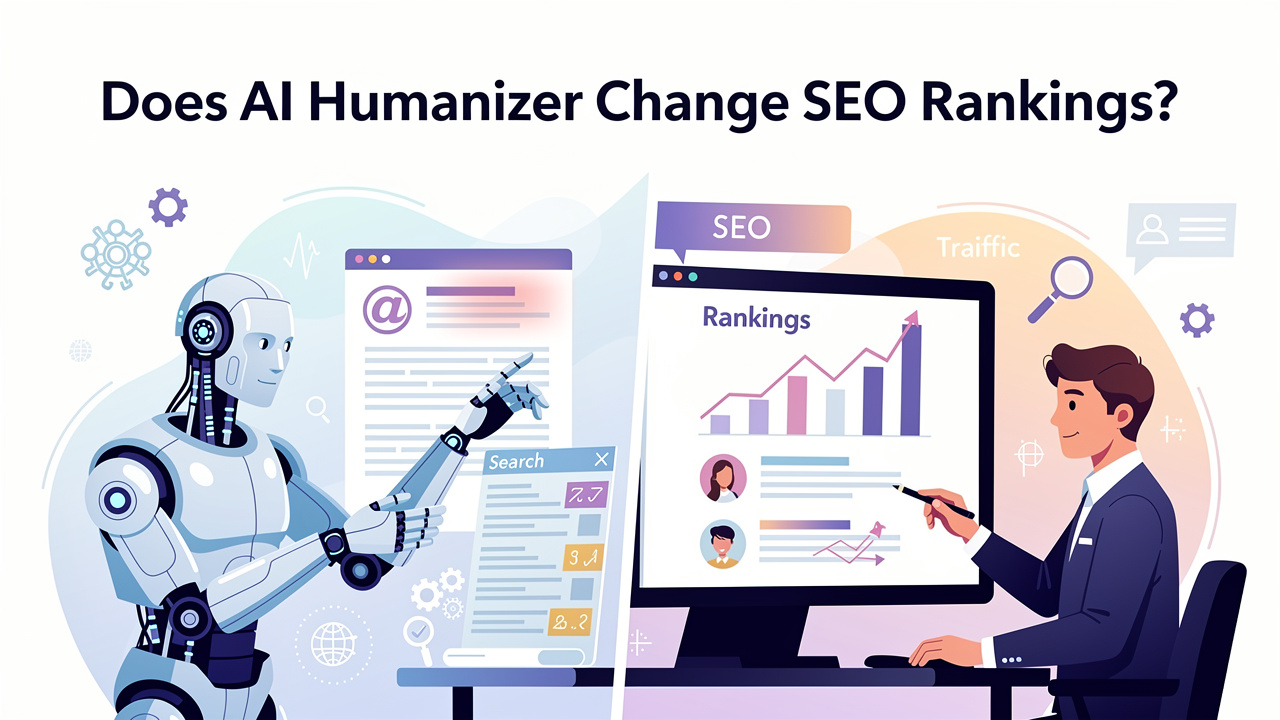
Content creation has changed dramatically over the past few years with the emergence of AI humanizer for SEO tools and AI content optimization technologies.
AI writing tools flooded the market, and suddenly businesses could churn out thousands of words in a matter of minutes.
But here's the thing - search engines got smarter, readers became more discerning, and that deluge of robotic-sounding content started working against brands rather than helping them.
That's the moment when AI humanizers appeared.
What Is an AI Humanizer for SEO?
An AI humanizer is a tool - or set of features within a more extensive platform - created to take content written by a machine and make it read like it was authored by a human.
It's not just replacing words with synonyms.
A good humanizer changes sentence structure, varies tone, breathes natural language into content, and eliminates the repetitive patterns that make AI-generated writing feel dull and mechanical.
Think of it this way: writing tools such as ChatGPT, Jasper, or Copy.ai produce material that's grammatically accurate but often dull.
Predictable sentence length, predictable transitions, no unique personality.
An AI humanizer takes that blank slate and, essentially, adds an emotional layer to it—making it more lively, diverse, and more gripping for actual human readers.
And from an SEO perspective, that difference is incredibly crucial.
Why AI Humanizer for SEO Tools Are Critical
Google has been pretty direct about one aspect: it promotes content that reflects experience, expertise, authoritativeness, and trustworthiness (E-E-A-T).
Content that seems mechanical, repetitive, or lacking in real depth will tend to rank lower - no matter how technically optimized it is.
Here's the core problem.
Search engines are becoming better at discerning neural patterns linked with AI-created text.
Unengaged users, lack of time-on-page, underwhelmed engagement metrics - all of this factors into how Google evaluates a piece of content.
If visitors drop after reading for 4 seconds because it was as engaging as a ledger, your search rank goes down.
Simple as that.
AI humanizers address this precisely through human-like content generation.
By creating content that engages readers effectively, they can: - Cut down bounce rates - prolonged time-on-page when the content interests reading audiences - Improve dwell time - a crucial indirect SEO signal - Drive more social shares - nobody wants to share post content that sounds corporate - Cultivate a distinctive brand voice - coherent, natural-sounding content engenders trust - Prevent possible AI-generated content penalties - while Google insists it won't penalize AI content one thing is certain - bad AI content will rank poorly So, content that's been humanized scores higher on a wide variety of all the essential SEO metrics.
Existing AI Humanizers
Several products out there specialize solely in this challenge.
They vary a lot in their methodologies and output quality.
Undetectable.ai
Undetectable.ai is one of the more prominent.
It centers firmly on rewriting AI interaction to pass AI detection without sacrificing readability.
It provides many "humanization levels," going from softer to more aggressive linguistic expression.
Output quality is dependably reliable - it helps a lot with eliminating redundancy in sentence structures.
The catch? It often "overhumanizes," removing the information-rich language needed in certain contexts.
Humanize AI (humanizeai.pro)
Humanize AI describes itself as a dedicated humanizer.
It has an excellent grasp on conversational structure, injecting natural translations.
The branding is straightforward, which makes it handy for creative teams with non-technical staff.
But it lacks comprehensive SEO features - you'd still need to optimize the final draft.
BypassGPT
BypassGPT approaches the problem from another angle.
In addition to humanizing, it endeavors to make the content less detectable by tools like GPTZero and Originality.ai.
This is useful when content detection is a primary concern.
The output is logically consistent, but slightly unwieldy phrasing can sometimes arise.
Jasper AI (with tone controls)
Jasper isn't solely a humanizer, but its tone-of-voice and style guide features enable users to generate content with an already mature sound.
Coupled with its Brand Voice utility, Jasper can produce content with a uniformly human tone across platforms—a clear benefit for bigger teams.
Comparing the Compatibility:
Here's a visual comparison
| Tool | Content Quality | SEO Compatibility | User Experience | GPT detection bypass |
|---|---|---|---|---|
| Undetectable.ai | Good | Limited | Very simple | Perfect |
| Humanize AI | Good | Poor | Bare minimum | Satisfactory |
| BypassGPT | Decent | None | Simple | Flawless |
| Jasper AI | Very High | Very Good | Moderate | Moderate |
Jasper wins on overall content quality and SEO integration, but it's also significantly more expensive.
For teams on a budget that just need a quickhumanization pass, Undetectable.ai or Humanize AI would serve equally well.
Strategies for Using AI Humanizers Effectively
To derive the maximum benefit, these tools must be used strategically.
Directly publishing the AI outcome after a quick run through a humanizer isn't an effective procedure.
Here's a plan to follow:
-
Begin with a clear directive. Establish your keywords, target audience, and article theme before creating your AI content. This will support more comprehensive humanization and enhance content precision.
-
Use the AI assistant to draft your paper. Rely on whatever AI text generator is most familiar: ChatGPT, ChatOn, or any other. Make sure to pay close attention to continuity and organization.
-
Utilize a humanizer tool on your draft. Interface with themes suited to your audience. Largely technical documentation will require less humanization than conversational journalistic blogs.
-
Edit properly-and-properly. AI humanizers tend to do a good job, but other than them, a human editorial team will be necessary to continue editing content. Custom content may contain useful reflections, fill in more examples, and keep brands tone-of-voice intact. This is the stage where the gap in content quality will be substantially narrowed
-
The final step is optimizing SEO. After humanizing the finished draft, add the necessary keywords according to your strategy, make sure the textual architecture looks natural, and update meta statements. Using SEO tools before humanizing has the risk of having content revise to the lowest common denominator when improperly overlooked by AI humanizers.
-
Analyze readability One tool in particular, Hemingway, is ideal for analyzing how easy your piece of content is to read. Ideally, you're going to want the writing style at an 8th-9th-grade level when writing for a general audience.
-
Do a final check for AI detection This part is optional, but it doesn't hurt, especially if you work in a crowded industry that values high-quality, perfectly original content.
Future Trends in AI Humanization and SEO
The pace of this industry is anything but slow. 3 trends should largely drive how AI humanizers develop over the course of the next few years:
Personalization at Scale
This is likely the largest of all trends.
The future humanizer will undoubtedly integrate itself into a user's CRM data and analyze a particular segment of its audience in order to customize its content to the right people rather than just a generalized "human."
Enhanced Quality Recognition
The search engine, at the end of the day, is also going to be better at recognizing quality content. When we see what SGE and AI-powered search has to offer to a general searcher, we recognize a departure from keyword stuffing towards more authoritative, original pieces of content. AI humanizers which identify genuine signals of expertise will come at an increasing premium.
Integrated Workflow Solutions
We'll also recognize a convergence between humanization and SEO tools. It will eventually evolve beyond multiple stages of separate programs and move towards a singular workflow that generates, humanizes, optimizes, and even publishes the article on the web.
Final Words
AI humanizers serve to offer a simple and easy solution to one of the more challenging aspects of modern day content marketing: producing an abundance of content that is of high quality to the reader or the search engine, while not sacrificing originality.
The many tools out there that are available today are rather impressive and only continue to get better and better, but ultimately, there is no substitute for combining both Artificial Intelligence along with the human factor.
We'll use artificial intelligence for its speed, and then human writers for their perspective. This perfect combination will not only allow our content to perform optimally in the eyes of the search engine, but also allow our reader to better resonate with and engage on a deeper level with it.