AI-generated content is a real issue for universities across the world. Turnitin's AI detection tool was introduced in 2023, and the game of cat and mouse between detection technology and AI writing has since gotten a lot more serious. Understanding how to make ChatGPT text undetectable by Turnitin requires knowledge of how detection works, and how to approach AI support on your writing with care while maintaining AI text originality.
But here's the difference: the objective shouldn't be just to avoid detection. We should be about creating really high-quality, truly new academic work that just happens to use AI in its initial stages.
How Turnitin's AI Detection Actually Works
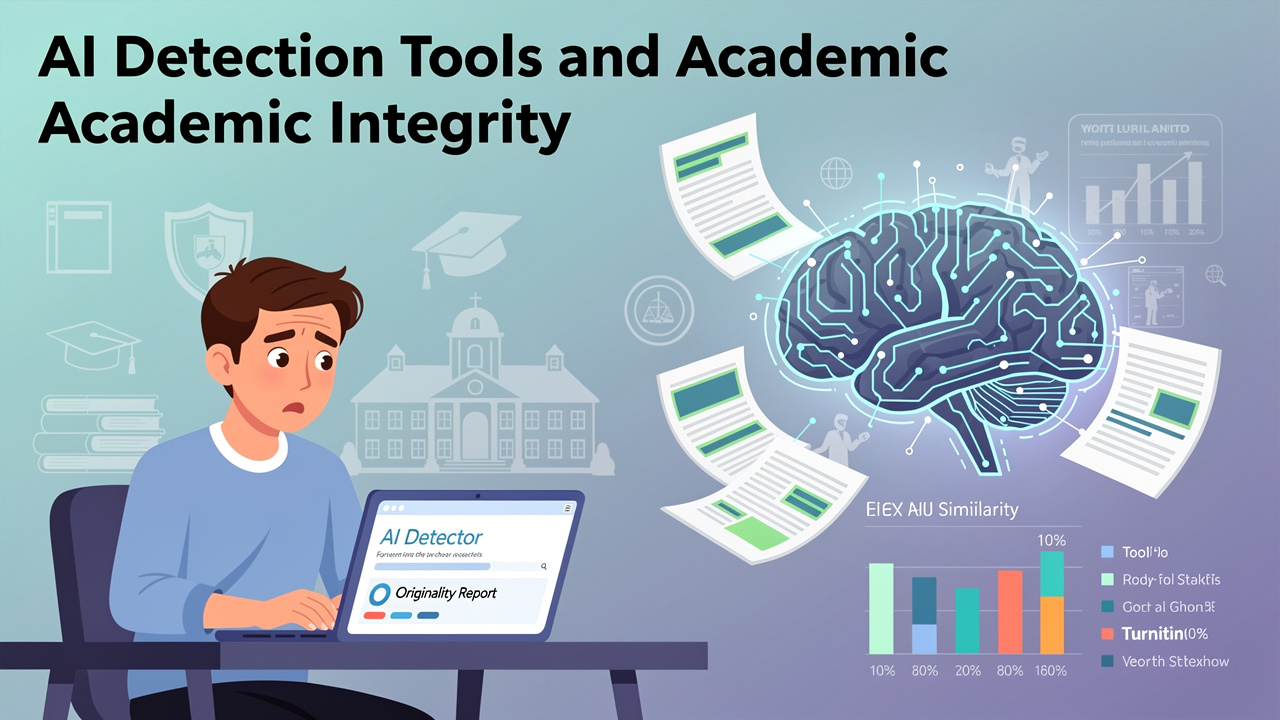
Turnitin as some of you might know has a proprietary detection program (originally designed to catch ghost writing) which evaluates the text for "perplexity" and "burstiness." Perplexity looks at how predictable the words used are- AI tends to pick statistically likely words in any given phrase - leading to overly smooth, Machine-like writing. The system doesn't identify all particular strings as "plagiarized". It examines the statistical signature of your style.
That's an important difference. You're not running a "plagiarism detector", rather a "stylistic fingerprint profiler".
How to Make ChatGPT Text Undetectable: Paraphrasing Techniques
1. Deep Structural Paraphrasing
The meta-con to avoid is superficial paraphrasing—a word-by-word substitution of synonyms. Turnitin's AI detector is not concerned if you replaced "utilize" with "use." What it is concerned with is the cadence of the sentence, the order of the clauses, the length of the words. Effective paraphrasing techniques focus on restructuring entire concepts rather than simple word replacement:
Original AI Here are the parts that very measured.
"The implementation of sustainable practices within corporate environments has demonstrated significant potential for reducing carbon emissions while simultaneously enhancing operational efficiency."
Surface paraphrase (still detectable):
"Using sustainable methods in business settings has shown great promise for cutting carbon output while improving operational performance."
Deep structural rewrite (much better):
"Companies that go green don't just help the planet — they often cut costs and streamline operations in ways that purely profit-driven strategies miss. The carbon reduction benefits are real, but they're almost a bonus."
Can you see the difference?
A revised version. The fact that a clear opinion has been included, which seems very natural, and instead of using the same present simple clause structure in every clause, the structure is completely variable.
2. Inject Personal Voice and Specific Examples
AI Written text is apt to remain on an abstract plane. Human writing, on the other hand, is prone to go to examples, and they do so automatically.
- Replace general claims with specific cases ("a 2022 McKinsey study found..." rather than "research suggests...")
- Add your own analytical commentary after AI-generated points
- Include discipline-specific jargon that you actually understand and can deploy naturally
- Reference real events, dates, or named researchers whenever possible
3. Sentence Length Variation — Deliberately
This is perhaps the single most useful trick. Read your AI draft out loud. Do you see how each sentence is about the same length? Make this happen.
Try this pattern deliberately:
- Write one very short sentence. Three words max.
- Follow with a medium sentence explaining the point in about fifteen words or so.
- Then let yourself write a genuinely long sentence that meanders a bit, includes a parenthetical thought or two, and arrives at its conclusion after the reader has had time to process the complexity — because that's what human thinking actually looks like on the page.
Repeat. Keep things varied. Not obviously so - mechanically varied is still detectable variation.
4. Strategic Use of First-Person Perspective
Nothing quite indicates human authorship like "I." Generally speaking, AI does not use first-person naturally—unless prompted to. Feel free to insert true first-person reflections along the lines of "In my reading of the literature…" or "I find this argument less convincing than…" that change the author's stylistic signature significantly.
Comparison Analysis: AI Text vs. Human-Blended Text
| Feature | Pure AI Output | Human-Blended Text |
|---|---|---|
| Sentence length | Highly uniform | Wildly varied |
| Word predictability | High (low perplexity) | Lower, more unexpected |
| Personal voice | Absent | Present, opinionated |
| Concrete examples | Generic or absent | Specific, named, dated |
| Hedging language | Formal ("it may be argued") | Natural ("maybe," "I think") |
| Emotional register | Flat, neutral | Varies — some enthusiasm, some caution |
| Transition phrases | Formulaic | Organic, sometimes abrupt |
Tools That Help Humanize AI Text
Several tools specifically target the humanization problem:
- Quillbot — useful for paraphrasing, though it needs heavy manual editing afterward
- Undetectable.ai — specifically designed to rewrite AI content with higher burstiness
- Grammarly's tone suggestions — can help you identify where your prose sounds robotic
- Your own brain — genuinely the most effective tool, especially when combined with reading your work aloud
Reading aloud is underrated. Really. You'll instantaneously realize when the pacing is approaching a flatline—and when a line of text suddenly sounds as if it was thrown together.
The Ethical Dimension — And Why It Actually Matters
Let's face it. There is a whole range of AI in use at universities, and there is a difference in ethics.
Generally acceptable:
- Using AI to brainstorm initial ideas
- Asking AI to explain a concept you don't understand
- Using AI to check grammar and clarity
- Generating an outline that you then write from scratch
Gray area:
- Using AI to draft sections that you heavily rewrite
- Using AI to suggest arguments that you then develop independently
Clearly problematic:
- Submitting AI-generated text as your own work without disclosure
- Using AI to complete assessments that explicitly prohibit it
Most universities now have mature AI policy rather than direct prohibition. Investigate the rules at your place—these differ wildly. In some situations, you will be asked to generate paragraphs with the help of ChatGPT and then heavily re-edit; in other cases, it will be forbidden entirely.
If you are unaware of the rules, it is not only because you are trying to avoid penalty, but because you are unaware of what competency you are trying to learn. Writing up academic work isn't busy work. The process of struggling to find the best argument, of doing and re-doing paragraphs that don't seem to work—this is where real learning occurs.
Outright cutting it all out and doing it with AI not only can leave you detected, but prevents the critical thinking the assignment was meant to cultivate.
Making ChatGPT Text Undetectable: Best Practices
-
Use AI for the skeleton, not the flesh. Generate an outline or a rough first draft, then rewrite every section substantially from your own understanding.
-
Add your analysis explicitly. After any AI-generated explanatory paragraph, write two or three sentences of your own analysis. This is where your grade actually lives anyway.
-
Cite properly and specifically. AI often invents citations or uses vague references. Replace every source with one you've actually checked.
-
Run multiple revision passes — one for content accuracy, one for sentence variation, one specifically for voice and personality.
-
Compare against your previous writing. Does this essay sound like you? If not, keep revising until it does.
-
Disclose when appropriate and required. Many journals and academic programs now ask for AI use statements. Honest disclosure, combined with genuine intellectual contribution, is almost always the right call.
Key Takeaways
- Turnitin detects AI through statistical patterns in writing style, not just copied phrases
- Deep structural paraphrasing beats surface synonym-swapping every time
- Sentence length variation is your single most powerful humanization tool
- Concrete examples, first-person voice, and specific citations dramatically shift your text's fingerprint
- The ethical framework matters — AI assistance exists on a spectrum, and context determines appropriateness
- Blending AI and human input thoughtfully produces better academic work than either approach alone
- Always check your institution's specific AI policy before using any AI tool in your writing process
Conclusion
The best way of getting your AI Assisted writing to pass inspection is not a technical hack, but authentic involvement with the intellectual content. When you singlehandedly do a thorough rewrite, bolt on your own analysis, stick in concrete examples, and write with varying cadences naturally, you are not just beating some computer, you are actually doing the thing for which that paper was assigned.
AI tools are truly helpful as thinking partners, brainstorming partners, and first draft machines. However, as soon as you use one to turn in work that does not convey your thought, you abandon the opportunity to learn, and take a shortcut. Which over time becomes a deficit.
Use the AI responsibly. Make changes to what you have written. Make sure you think about everything. And perhaps, just perhaps, your final piece of work will be better than it would have been if it had been written solely by the AI.