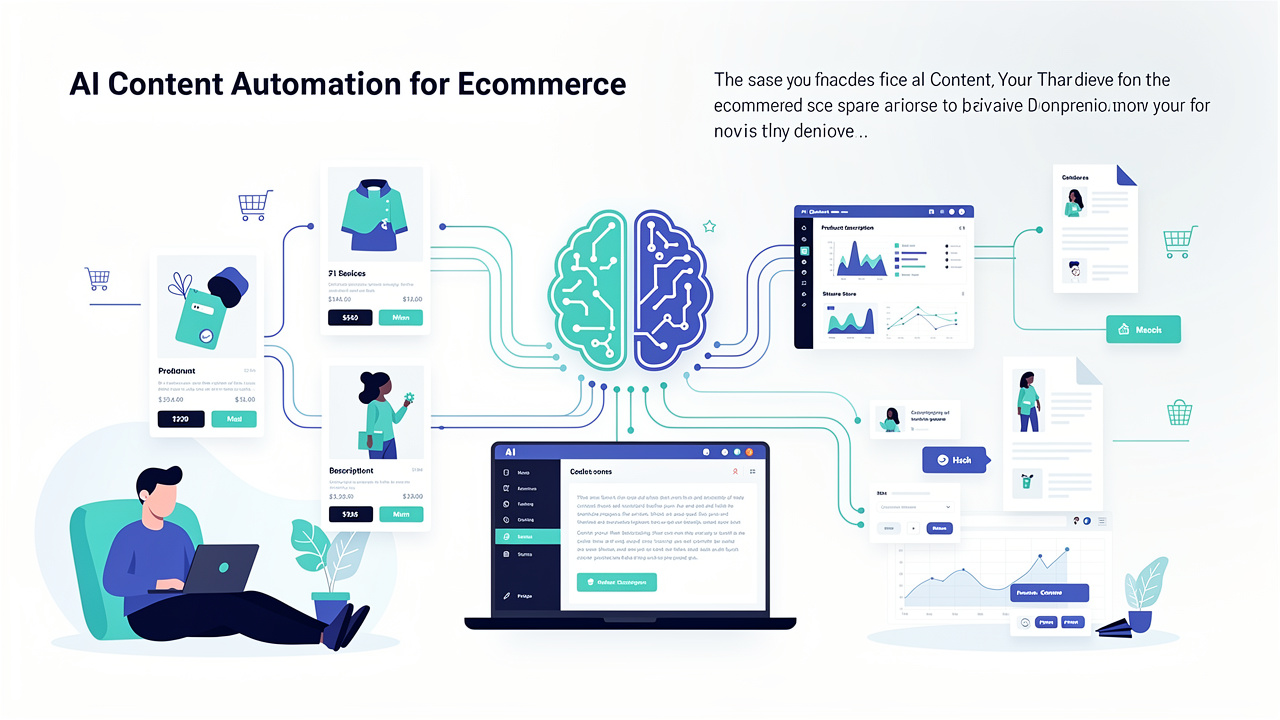
An ecommerce business averaging 10,000 products is faced with a stark truth: creating engaging, accurate, and Search Engine Optimization (SEO) friendly description text for each one simply cannot happen without some kind of dedicated support.
This is exactly what AI content automation for ecommerce is here for - not a quick fix, but a true technological breakthrough that is revolutionizing the way e-commerce businesses generate, organize and distribute large scale content. This comprehensive ecommerce content strategy transforms how retailers approach digital marketing at scale.
What AI Content Automation for Ecommerce Means
AI content automation uses artificial intelligence technologies such as natural language processing (NLP), machine learning and large language models, to automatically create, refine and adapt text content with little to no human input.
Specifically for ecommerce, this ranges from product descriptions, category pages, email campaigns, chatbot responses, social media posts and even customer reviews summaries.
It's more than just about writing faster.
It's not about more, it's about smarter. Creating smarter content - content that changes its messaging automatically depending on who is reading it, that ranks higher in search engines and even that converts more browsers into buyers more reliably than human written copy.
A 2023 McKinsey report suggests that the use of generative AI could bring annual benefits ranging from $2.6 trillion to $4.4 trillion, with marketing and sales being one of the top use cases.
Ecommerce is in that zone.
Why Ecommerce Business Needs AI Content Automation
How it comes - ecommerce content requirements are huge.
And they just keep on growing.
New products are constantly being launched.
Persistent campaigns require new copy.
Personalizing to all customers is very expensive. Some customers just haven't been targeted yet with the appropriate message.
Manually doing all this has quite a few consequences, not only slowing teams down but also leading to inconsistency, error and loss.
Three key factors why automating AI content has come of age:
- Quantity and velocity - surely the online retailers like Amazon have to maintain millions of product catalogs.
There is no way, even for fairly modest mid-sized stores with a few thousand SKUs, human writers can stay abreast of constant variations in inventory, seasonal promotions and localization purposes.
-
Consistency - The rules of brand voice are applied to every content by the AI systems - which is the hardest task for human teams to do, in particular in a distributed team.
-
Cost effective - Performing common tasks of contents automatically helps cheapen manpower.
According to a survey conducted among Shopify merchants who are leveraging AI writing tools, they are able to save 3-5 hours per week on content creation.
Key Benefits of AI Content Automation
Improved Efficiency
Manual creation of content takes a long time.
A proficient copywriter could craft comfortably write between, say 10-15 flawless product descriptions in a single day.
An AI engine - set up correctly - can comfortably produce hundreds in the same amount of time with a human editor checking and editing to the required standards.
That's not necessarily by-passing writers, it's also by-passing the production of writers that triple.
These are just a handful of some of the apps like Jasper, Copy.ai and Writesonic that are designed specifically for bulk content creation.
Feed them product features, target keywords and brand guidelines, and they create easily digestible drafts in an instant.
Personalization at Scale
This is where AI truly proves its worth.
Personalized content - product suggestions, time-sensitive subject lines, customized landing pages - always beats a generic message.
Epsilon study reveals, personalized experiences make consumers ninety times more likely to patronize a brand than eighty percent.
AI enables this to be done at scale.
Dynamic Yield, for example, and Persado are examples of services that automatically serve individual variations in content based on a person's gender, various indicators of shopping and reading behavior, and purchase history: no segmentation required.
A returning visitor who is in the market for running shoes can be served very different homepage copy than someone who arrived at the site without shopping intent and was just browsing — and that difference in messaging can translate into a big improvement in conversion rates.
Better SEO Performance
Products that don't get ranked don't convert into sales.
That was.
Using the SEO guidelines to inform the training of the AI systems enables these systems to include target keywords into the content, structure it with appropriate use of h1-h6 and meta tags, and also notify thin content entries that may negatively impact the ranking of the AI system with respect to the search engine.
Surfer SEO and Clearscope can be plugged directly into your content process and grade and suggest content in flight.
There are some tools such as Alli AI that can create and send SEO enhancements to ecommerce sites, automatically updating the site's code and making life easier for less technical owners of the stores.
One example from his research: a case study from outdoor retailer REI found a 34% increase in organic traffic to their product category pages in six months following the adoption of their AI-powered SEO content planning tools.
That's not so few.
Better Product Descriptions
Dull, lifeless product descriptions suck.
The blue-cotton t shirt.
Washable—must be machine washed at this point.
Available in sizes S-XL. What possible purpose do those words serve?
Tools powered by AI that have learned to copywriting techniques developed by professionally trained copywriters can generate benefit-led product descriptions from just specifications, solving pain points and emotional triggers.
OpenAI's GPT-4 has been integrated through APIs into ecommerce platforms, and brands are increasingly using it to write descriptions of products in a way that feels human written, logical, and brand appropriate.
Shopify now has their own AI features (built into their admin dashboard) that can generate product descriptions with only a few lines of input from the shop owner.
Scalable Customer Engagement
AI chatbots and automated sequences of emails give users a personal touch without ever needing to talk to a real person.
For example, platforms such as Klaviyo have incorporated machine learning algorithms that identify and optimize the send time for each individual subscriber. This may seem like a small change but this can reliably produce 15-20% increase in open rate over standard batch-and-blast sending.
Chatbots like Tidio or Intercom, which can be integrated with other platforms, can respond instantly to frequently asked questions, such as information on returns, delivery, stock item, etc. allowing the more experienced customer support agents free to dedicate their full attention to more challenging queries.
And as they are learned out of this interaction, they have increases effectiveness over time.
Challenges and Considerations
Unfortunately, there are snags.
Businesses should have a sober view of the challenges involved in implementation, including:
Quality control - Content created by AI can be inaccurate, inconsistent in tone, or simply cringe-worthy.
Concerns over methods human review is still imperative for more sensitive content such as product specifications or a legal directive.
Voice of the Brand consistency - none of the out of the box AI tools truly understand your brand.
Require strict guidance with style guides, sample content, and reiterative feedback so the output will resemble you.
Generic output - can lead to today's industry: since all competitors rely heavily on the same AI tools and tend to use similar prompts, outputs look uniform across competitive landscape.
Differentiation involves intentionally tailoring and infusion of human creativity.
Data privacy - Personalization engines depend on customer data.
Regulations such as GDPR, CCPA and others all impose real limits on the extent to which that data can be gathered and used – issues to be considered by an enterprise before launch.
SEO risks - Google's helpful content guidelines specifically penalise AI content, created en masse, that is poorly written.
Can trigger ranking penalties for publishing unreviewed output of in scale/amount.
The answer, then, is not 'don't employ AI' but 'make sure it actually benefits your readers'.
Essential Tools Overview
| Tool | Main purpose | Suitable for |
|---|---|---|
| Jasper | Long-form production | Descriptions, blog content |
| Surfer SEO | SEO optimization | Content scoring, content optimization |
| Dynamic Yield | Personalization | Dynamic landing pages, recommendations |
| Klaviyo | Automated email | Behavior-based email flows |
| Tidio | Customer support chatting | Automated customer support and contact |
| Writesonic | Scalable bulk content production | Creation of ad copy, category content |
Action Steps to Get Started
It is very easy to start implementing AI content automation on your website and it does not require a huge budget as well as right internal resources.
Begin here:
- Audit your existing content gaps - where the volume isn't enough or where consistency isn't maintained. Make a list of this with a plan of action.
Otherwise, innovation by itself will not generate any results and the lack of a concept or idea therefore becomes a major challenge.
- Select one use case initially, either product descriptions or email subject lines, instead of everything.
This focused approach allows you to master AI-driven marketing for ecommerce gradually while building internal expertise.
- Build a style guide - provide your AI tools something to measure their work against.
Include brand voice guidelines, tone preferences, and specific terminology that aligns with your ecommerce content strategy.
- Establish a human review process - A modest editorial review goes a long way.
Quality control ensures that automated content maintains brand standards and provides genuine value to customers.
- Measure results - monitor conversion rates, organic search and engagement pre- and post-application.
Track key performance indicators to validate the effectiveness of your AI content automation for ecommerce implementation.
Final Thoughts
AI content automation for ecommerce represents a real transformation in how ecommerce sites can function – not a shortcut, but a true efficiency and personalization accelerant when deployed correctly.
The companies experiencing the greatest breakthroughs are the ones simply applying AI for volume, speed and certainty – and leaving space for human judgment on the more subjective issues of strategy, originality and quality control.
The technology is mature enough to bring real value to a user today.
This is not a question of wanting or not wanting to use AI content automation, but rather it is about the value of using it for your particular situation and how soon you can create a workflow that actually works effectively.